
Most homeowners in the GTA do not realize their windows are in rough shape until the summer light exposes every streak, smear, and layer of grime that built up since spring. By that point, the damage to curb appeal and even to the glass itself is already done. If you have been putting off window cleaning GTA homeowners rely on before fall sets in, there are five specific signs that tell you the wait is already too long. Recognizing them early saves money, preserves your glass, and keeps your property looking the way it should.
Table of Contents
- Quick Takeaways
- Sign 1: Visible Streaks and Stubborn Film
- Sign 2: Water Spots and Mineral Deposits
- Sign 3: Spider Webs and Insect Debris in Frames
- Sign 4: Reduced Natural Light Indoors
- Sign 5: Algae, Mold, or Oxidation on Frames and Seals
- DIY vs. Professional Window Cleaning: What Actually Works
- Frequently Asked Questions
- References
Quick Takeaways
| Key Insight | Explanation |
|---|---|
| Summer sun amplifies every dirty window sign | Direct sunlight at high angles exposes film, oxidation, and streaks that are invisible on overcast days. |
| Mineral deposits etch glass permanently if left too long | Hard water spots from sprinklers or rain runoff bond to glass within weeks and require professional removal. |
| Spider activity peaks in late summer in Ontario | August and September bring the highest nest-building activity around frames, sills, and eaves in GTA homes. |
| Dirty windows reduce indoor natural light by up to 40% | Accumulated grime acts as a filter, measurably reducing the light entering a room even through double-pane glass. |
| Frame and seal contamination causes more damage than dirty glass | Algae and oxidation on frames compromise seals, leading to moisture intrusion and costly repairs down the line. |
| Professional window cleaning near me searches spike in August | Homeowners tend to search for help reactively, after the damage is visible, rather than on a proactive schedule. |
| End-of-summer is the best time to clean before fall debris season | Cleaning now creates a clean baseline before autumn leaves, rain, and wind deposit new layers of organic matter. |
Sign 1: Visible Streaks and Stubborn Film
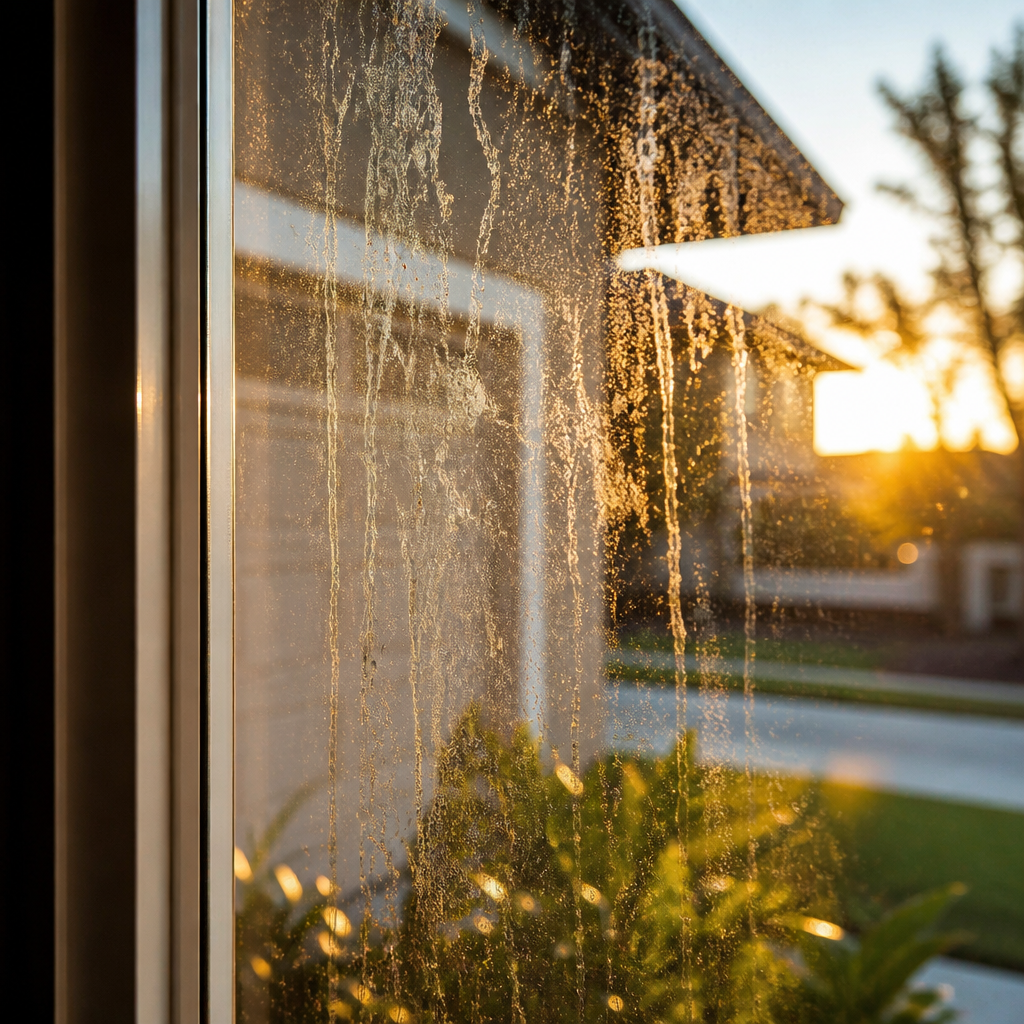
The most obvious of all dirty windows signs is also the most underestimated. Streaks and film do not just look bad. They are evidence that contaminants have bonded to the glass surface over weeks or months of heat, humidity, and airborne pollution.
In practice, the summer sun at its highest angle hits your windows differently than it does in spring or fall. That angle reveals a greasy, hazy film that is almost invisible on cloudy mornings. The film is typically a combination of exhaust residue, pollen oils, and cleaning product residue from the last time someone wiped the glass down with a household spray and a paper towel.
A common mistake is to confuse this film with condensation or a cloudy pane seal. Condensation clears. Film stays. If the haze is still present three hours after sunrise on a dry day, you are looking at surface contamination that a damp cloth will not fix.
Why DIY Streak Removal Fails on Bonded Film
Consumer glass cleaners are formulated to cut light surface grease. They are not designed to dissolve the layered biofilm and pollution residue that builds up on GTA windows between professional cleanings. When you spray and wipe, you redistribute the contamination rather than removing it, which is exactly why streaks often look worse after a DIY attempt than before.
Professional window cleaners use solutions with the correct pH for the specific type of contamination on your glass. For bonded summer film, that means a mildly alkaline solution applied with a proper applicator and removed with a clean rubber squeegee in a single controlled stroke. The result is optically clear glass, not glass that is merely less smeared.
Pro tip: Hold a flashlight at a 45-degree angle to your window at night. Any film or streaking will become immediately visible as a hazy glow across the pane. This is exactly how professional assessors evaluate glass before quoting a job.
Sign 2: Water Spots and Mineral Deposits
Water spots are not just aesthetic. They are a structural threat to your glass. In the GTA, municipal water and well water both carry dissolved calcium, magnesium, and silica. When water evaporates on your window surface, these minerals stay behind and bond to the glass at a microscopic level.
During summer, this process is accelerated by heat. Irrigation sprinklers, rainfall that dries quickly in 30-degree heat, and humidity condensation cycles all contribute to deposit buildup. A window that gets hit by a sprinkler three times a week in July will have visible etching within 30 to 45 days if the deposits are not removed.
How to Tell the Difference Between New Spots and Etched Glass
New mineral deposits feel slightly rough to the touch and look like circular white rings. They can still be removed with a professional-grade mineral remover or light abrasive polish. Etched glass, where the silica has actually altered the glass surface itself, feels smooth but shows a permanent white or grey haze that does not respond to standard cleaning.
The window of opportunity is short. Waiting until fall to address water spots that appeared in June means you are very likely looking at etched glass by the time a cleaner arrives. The cost of glass restoration or replacement is significantly higher than the cost of a mid-summer professional cleaning.
“Hard water minerals begin bonding to glass within 48 hours of initial contact on a hot surface. In summer conditions, what looks like a fresh water spot is often already a mineral deposit requiring professional removal.” Source: Corning Museum of Glass, glass surface research documentation.
Pro tip: If you have an irrigation system that hits your windows, adjust the sprinkler heads now. The cleaning itself is straightforward, but preventing recontamination from the same source every week is the longer-term solution.
Sign 3: Spider Webs and Insect Debris in Frames
Late summer in Ontario is prime spider season. August and September mark the peak of nest-building activity for species like the common house spider and the larger orb weavers that colonize window frames, corners, and eaves. If you are seeing webs across your window corners every morning, your windows are overdue for attention.
Spider webs are not just unsightly. They trap organic debris including dead insects, pollen, and dust. That trapped material decomposes against your frame and glass, leaving brown staining that becomes increasingly difficult to remove without professional equipment.
The Connection Between Webs and Gutter Debris
Spiders follow their food source. Insects are attracted to organic debris accumulating in gutters and along eaves. If your gutters are full and your eaves are dirty, the insect population around your windows will be higher, and so will the spider activity. This is exactly why Performance Window Cleaning bundles spider spraying with window and gutter cleaning as part of their exterior maintenance packages. You do not solve the web problem without addressing what is feeding it.
Insect carcasses in window tracks and sill channels also accelerate oxidation of aluminum frames and create conditions where mold can establish. A thorough professional clean clears the entire ecosystem around the window, not just the glass itself.
Sign 4: Reduced Natural Light Indoors
This sign tends to sneak up on homeowners because the change is gradual. Your eyes adapt to the reduced light level, so you do not notice the difference until you stand in a freshly cleaned room and realize how much brighter it looks.
In practice, a window with a season’s worth of pollen, pollution film, and water spot buildup can reduce visible light transmission by a measurable margin. Research from the Lawrence Berkeley National Laboratory on building energy efficiency indicates that dirty glazing can reduce daylight transmission by 20 to 40 percent depending on the contamination type and climate zone.
What Reduced Light Means for Your Energy Bill
Less natural light indoors means more artificial lighting switched on during daylight hours. In summer, artificial lighting also adds heat load to your interior, which your air conditioning then has to compensate for. Clean windows allow passive solar gain to work properly, which in summer means more daylight with less heat-generating artificial light during peak hours.
The effect is not dramatic on a single window. Across a full home with eight to twelve windows carrying a full season of contamination, it adds up. Homeowners who book a full exterior window clean before summer ends consistently report that their rooms feel noticeably brighter and larger immediately afterward.

Sign 5: Algae, Mold, or Oxidation on Frames and Seals
Most homeowners focus entirely on the glass and ignore the frames. That is the wrong priority. The frames and seals are where the most serious damage accumulates, and the consequences go beyond appearance.
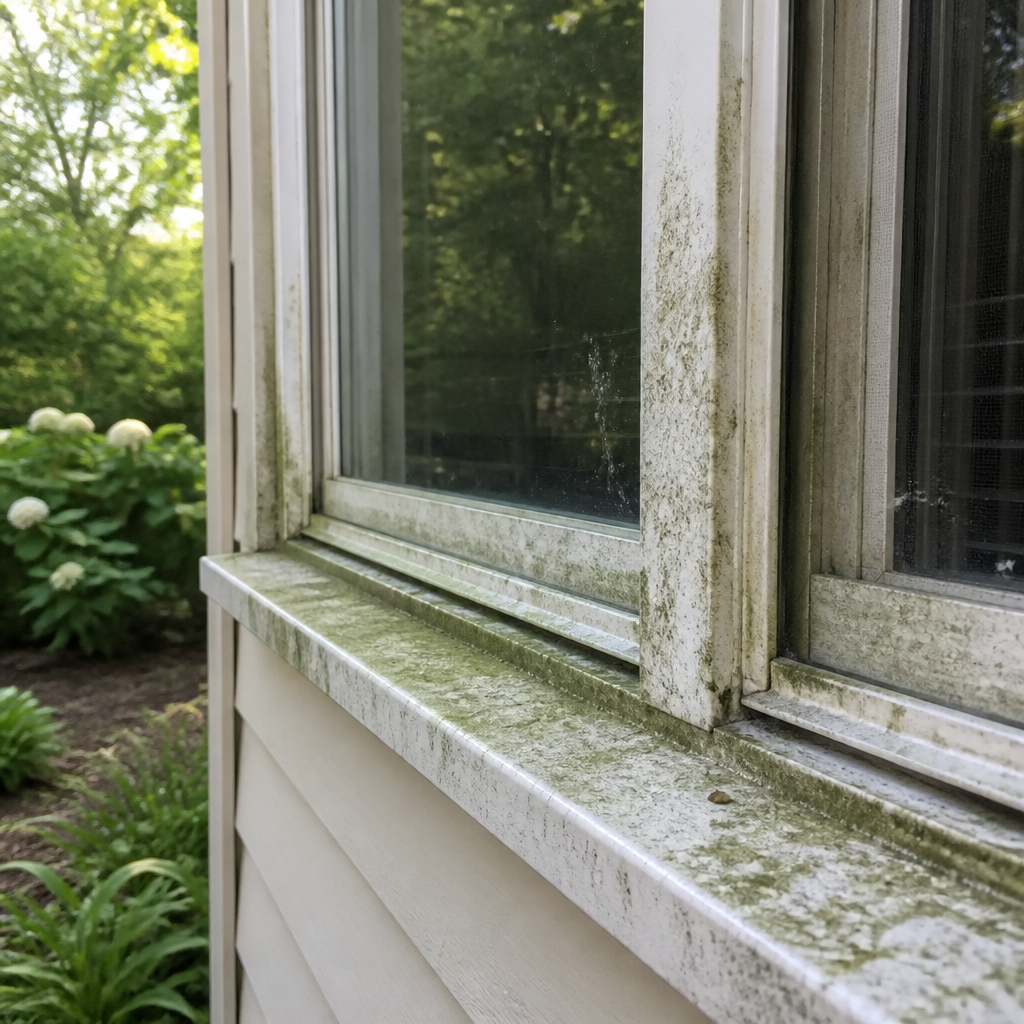
Green or black streaking on vinyl or aluminum frames is typically algae or mold establishing in the micro-texture of the frame material. It is fed by humidity, organic debris, and stagnant water in the sill channels. Left untreated through late summer and into fall, it spreads and can penetrate the seal between the frame and the glass unit.
When Frame Contamination Becomes a Structural Issue
A compromised window seal allows moisture to enter the space between double-pane glass, causing fogging that cannot be cleaned away. At that point, you are looking at a window replacement, not a window cleaning. The cost difference is substantial. A full exterior window cleaning service for a standard GTA home runs a fraction of the cost of replacing even a single sealed unit.
Oxidation on aluminum frames, which appears as a chalky white or grey residue, is a separate issue caused by the metal surface reacting to air and moisture. Professional cleaners use appropriate treatments to address oxidation without damaging the frame finish, something that is impossible to replicate with consumer products.
DIY vs. Professional Window Cleaning: What Actually Works
The debate is not really a debate. DIY window cleaning is appropriate for light interior maintenance between professional visits. It is not a substitute for professional exterior window cleaning, particularly in the GTA climate where pollution, hard water, and biological growth are consistent factors.
| Approach | Best For | Limitations |
|---|---|---|
| DIY with consumer cleaner and paper towel | Removing fingerprints and light dust from interior glass | Leaves streaks, redistributes film, cannot remove mineral deposits or algae |
| DIY with squeegee and dish soap | Light exterior touch-up on low ground-floor windows | Ineffective on hard water spots, no reach for upper floors, misses frames and seals |
| Professional window cleaning (Performance Window Cleaning model) | Complete exterior and interior cleaning, all floor levels, frame and sill treatment, mineral deposit removal | Requires scheduling; not instant |
The data consistently shows that homeowners who attempt to delay professional cleaning by extending DIY efforts end up paying more in the long run. Mineral deposits that a professional could have removed in August require abrasive polishing or glass replacement by November. Spider and algae contamination that takes 30 minutes to treat in summer takes three times longer after a wet fall has embedded it further into frames and seals.
For homeowners searching for professional window cleaning near me in the GTA, the right question is not whether to book a professional. It is whether to book before the damage compounds or after. The answer matters for your wallet and your property.
Frequently Asked Questions
How often should GTA homeowners schedule professional window cleaning?
Twice a year is the minimum for most GTA homes, with one clean in spring after pollen season and one in late summer before fall debris accumulates. Homes near busy roads, with irrigation systems that hit the glass, or with significant tree cover may need three cleanings per year to prevent mineral and organic buildup from reaching the damaging stage.
What are the most common dirty windows signs that homeowners miss?
The most missed signs are reduced indoor light levels and frame contamination. Homeowners notice streaks and obvious grime, but the gradual dimming of natural light and the green or black growth on frames and sills often go unnoticed until the damage is significant. Checking the frame and sill channels during a monthly household walkthrough catches problems early.
Can hard water spots on windows be removed without replacing the glass?
Yes, in most cases, if caught within the first season. Recent hard water deposits respond to professional-grade acidic mineral removers or fine abrasive polishing compounds. Etched glass, where the mineral has altered the glass surface itself, requires either professional restoration polishing for moderate cases or glass replacement for severe etching. Acting before the end of summer dramatically improves the odds of full removal.
Is professional window cleaning worth it for single-story homes with accessible windows?
Yes, without reservation. Accessibility is not the only factor. Professional window cleaners bring the right chemistry for your specific contamination type, proper squeegee technique that leaves no streaks, and the knowledge to treat frames, seals, tracks, and sills as part of a complete service. A homeowner with a ladder and a consumer cleaner can reach the glass but cannot replicate the result.
Why does end-of-summer window cleaning matter more than a spring clean?
Spring cleaning removes winter grime. End-of-summer cleaning removes the cumulative buildup from the most biologically active period of the year: pollen season, peak insect activity, irrigation months, and the highest UV and heat exposure. It also sets a clean baseline before fall and winter deposit a new layer of organic material from leaves, rain, and frost. Missing the late-summer window means carrying that contamination through to the following spring.
What should I look for when choosing a window cleaning company in the GTA?
Look for companies established long enough to have a track record, transparent pricing, and services that address the full window system including frames, tracks, and sills. A company that has been operating since 2008 in a competitive market like the GTA has survived because the results are consistent. Ask specifically whether their service includes mineral deposit treatment and frame cleaning, or whether those are add-ons. That distinction separates comprehensive services from basic glass-only wipes.
Have you noticed any of these signs on your own windows this summer? Share what you spotted first and how long you waited before calling in a professional.
References
- U.S. Department of Energy, research on window glazing, daylighting efficiency, and building envelope performance
- National Research Council Canada, building science resources on moisture, condensation, and window seal integrity in Canadian climates
- Statista, market data on home maintenance services spending and residential cleaning industry trends in North America
- Forbes, home improvement and property maintenance guidance for maximizing residential property value
- Corning Incorporated, materials science documentation on glass surface chemistry, mineral bonding, and surface degradation