
If you manage a commercial property in the GTA, your to-do list is already too long. Chasing subcontractors, verifying WSIB clearances, scheduling seasonal maintenance, and handling tenant complaints all compete for the same limited hours. When exterior cleaning gets pushed to the bottom of that list, the costs are real: deteriorating facades, tenant dissatisfaction, and liability exposure that falls squarely on the property manager. Commercial window cleaning in the GTA is not a luxury line item. It is a maintenance function with direct consequences for asset value, tenant retention, and operational risk. Outsourcing it is not laziness. It is the smarter operating decision.
Table of Contents
- Quick Takeaways
- The Real Cost of Doing It In-House
- What Outsourcing Actually Covers
- Liability, Compliance, and WSIB: Why It Matters More Than You Think
- Curb Appeal, Tenant Retention, and Building Value
- In-House vs. Outsourced vs. DIY Seasonal: A Direct Comparison
- How to Choose the Right Exterior Cleaning Partner in the GTA
- Frequently Asked Questions
- References
Quick Takeaways
| Key Insight | Explanation |
|---|---|
| In-house cleaning costs are routinely underestimated | When wages, benefits, equipment, training, and supervision are fully loaded, the true cost of in-house cleaning typically runs 30% to 50% higher than an outsourced contract. |
| WSIB verification is mandatory, not optional | Ontario property managers are legally required to verify WSIB clearance before any worker begins on-site. A lapsed clearance at the time of an incident creates direct liability for the property owner. |
| Exterior condition directly affects leasing performance | In competitive GTA markets, a clean facade, clear windows, and maintained entrances influence a prospective tenant’s decision before they ever walk through the door. |
| GTA’s climate accelerates building deterioration | The freeze-thaw cycle, summer humidity, and road salt all degrade building exteriors faster than in moderate climates. Regular exterior cleaning is a preservation strategy, not just aesthetics. |
| Outsourcing converts unpredictable costs into fixed ones | A flat-rate service contract replaces wages, equipment, supplies, and scheduling overhead with a single predictable line item, making budgeting far simpler. |
| Tenant retention has measurable financial value | Improved retention reduces turnover costs. For buildings with significant annual rental income, even a modest improvement in retention translates to material savings per year. |
| Single-vendor agreements reduce administrative load | A property manager who consolidates window cleaning, gutter cleaning, power washing, and exterior maintenance under one provider eliminates multiple vendor relationships and compliance files. |
The Real Cost of Doing It In-House
Most property managers underestimate what it actually costs to handle exterior cleaning with internal staff. The headline wage number looks manageable. The real number, once you load in payroll taxes, benefits, equipment purchases, training, replacement coverage during absences, and the management time spent supervising, does not look the same.
Research into commercial cleaning cost structures consistently shows that the true cost of in-house cleaning typically runs 30% to 50% higher than an outsourced contract once all those factors are counted. A facility manager who budgets based on the wage figure alone is working from an incomplete picture, and that gap shows up in the annual books whether it was planned for or not.
For exterior work specifically, the hidden costs run even higher. Professional-grade pressure washing equipment, water-fed pole systems for multi-story window cleaning, gutter vacuums, and safety gear for working at height all represent capital purchases that need maintenance, storage, and replacement. Very few property management teams have the right equipment, and even fewer have the trained personnel to use it safely and effectively.
Pro tip: Before comparing the cost of outsourcing to your current in-house approach, calculate the full loaded cost: hourly wage plus payroll burden, equipment amortization, consumables, management hours, and any cost of liability claims. The actual number is almost always higher than the one being used to justify keeping the work internal.
The Hidden Time Tax on Property Managers
Beyond the direct costs, there is a time cost that almost never appears in a budget. Scheduling seasonal exterior cleans, coordinating access, verifying credentials, following up on work quality, and managing service interruptions all pull a property manager away from higher-value tasks. That time is not free. It has an opportunity cost, and it compounds across every property in the portfolio.
A growing number of GTA property managers are consolidating exterior maintenance categories under a single master service agreement. One contract, one compliance file, one account manager, one invoice. The operational simplification is significant, and it is one of the primary practical arguments for outsourcing exterior cleaning rather than managing it piecemeal.

What Outsourcing Actually Covers
A common misconception is that outsourcing commercial exterior cleaning means hiring someone to wash windows twice a year. In practice, a well-structured exterior cleaning program for a commercial or multi-unit residential property covers considerably more ground.
For properties in the GTA, a comprehensive exterior cleaning package from a provider like Performance Window Cleaning typically includes professional window cleaning (interior and exterior), gutter and eavestrough cleaning, power washing of entrances, walkways, and siding, hand-washing of building facades and eaves, and pest removal services including spider spraying. This is not a list of optional add-ons. These are the functions that, left unmanaged, create the visible signs of deferred maintenance that affect tenant perception and building value.
Gutter and Eavestrough Cleaning Is Not Optional
Blocked gutters on a commercial property are a liability waiting to happen. In the GTA, spring thaw and autumn leaf fall create two high-risk periods when eavestrough blockages can cause water infiltration, fascia damage, and ice damming. Property managers who skip professional gutter cleaning are not saving money. They are trading a predictable service cost for an unpredictable repair bill.
Power Washing and Building Facade Maintenance
The GTA climate subjects building exteriors to road salt, freeze-thaw cycles, and summer humidity that accelerate surface degradation. Regular exterior pressure washing removes the accumulation before it etches into surfaces or provides a foothold for biological growth like mold and algae. This is a preservation function as much as a cosmetic one. Property value protection requires removing harmful elements before they contribute to structural deterioration, not after.
Pro tip: Schedule exterior cleaning services in both spring and fall for GTA commercial properties. Spring addresses the salt and grime accumulated over winter. Fall clears biological growth before it freezes into surfaces and cleans gutters ahead of the freeze season. Two visits per year is the minimum defensible schedule for most commercial properties in this climate.
Liability, Compliance, and WSIB: Why It Matters More Than You Think
Ontario property managers carry a specific legal responsibility when it comes to workers on their sites. WSIB coverage is mandatory for all workers performing on-site services, and the requirement to verify that coverage rests with the property manager, not the contractor. A lapsed WSIB clearance at the time of an incident creates direct liability for the property owner. This is not a formality. It is an exposure that has caught property managers off-guard when they assumed the contractor’s initial clearance was still valid.
A reputable commercial exterior cleaning provider handles this for you. The provider maintains current WSIB clearance, carries liability insurance (many GTA commercial cleaning firms carry $5 million in liability coverage), and employs workers who are trained to Ontario’s working at heights regulations. When you outsource, you transfer that compliance burden to the service provider.
Outsourcing cleaning services allows businesses to transfer the liability and risk associated with accidents, injuries, and property damage to the cleaning company. This minimizes potential legal and financial liabilities and allows property managers to focus on their core operations without managing cleaning-related risks.
In practice, this means asking for proof of WSIB clearance and liability insurance before any work begins, and ensuring those documents are current at each service visit. A professional provider will supply this documentation without hesitation. If a provider balks at the request, that tells you something important about how they run their operation.
Ontario Working at Heights Regulations and Commercial Cleaning
Commercial window cleaning on multi-story buildings in the GTA is subject to Ontario’s working at heights regulations. These rules govern training certification, equipment requirements, and supervision standards. Attempting this work with internal maintenance staff who lack proper certification is not just legally problematic. It is genuinely dangerous. A professional exterior cleaning company employs certified technicians and uses appropriate equipment. The liability exposure from an incident involving uncertified internal staff far exceeds any perceived cost savings.
Curb Appeal, Tenant Retention, and Building Value
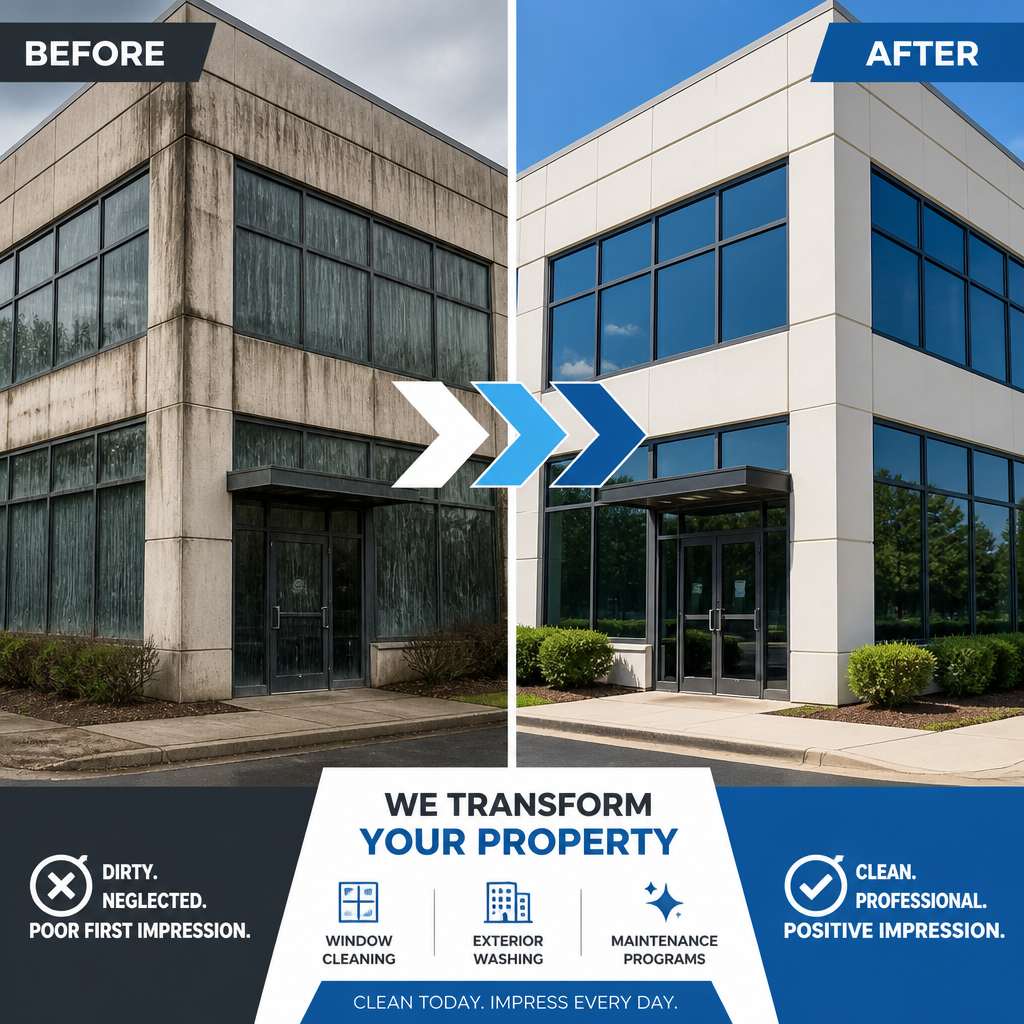
Property managers who treat exterior cleaning purely as a maintenance cost are leaving value on the table. The condition of a commercial property’s exterior is the first thing a prospective tenant sees, and research into GTA commercial real estate confirms that the exterior condition sets the tone for the entire leasing evaluation.
A clean facade, clear windows, and well-maintained entrances signal that the property is professionally managed. Neglected exteriors suggest deferred maintenance and operational inefficiency, even when the interior spaces are in good condition. The exterior of a building functions as a visible indicator of how the asset is being managed overall, and prospective tenants and investors use those signals to assess quality.
The Retention Argument Is Financial, Not Aesthetic
Curb appeal does not just attract tenants. It keeps them. When tenants feel that a property is cared for, it enhances their overall experience and strengthens their connection to the space. This supports higher retention rates and reduces turnover, which is critical for long-term asset performance.
Properties implementing regular exterior maintenance programs, including cleaning of parking areas and building facades, have been associated with improvements in tenant satisfaction and retention. For a commercial building with substantial annual rental income, even a modest improvement in tenant retention translates to meaningful savings in turnover costs and avoided vacancy periods.
Exterior Cleaning as Asset Preservation
Beyond tenant relations, regular exterior cleaning directly protects the building asset. Dirt, biological growth, road salt, and pollutants that accumulate on facades and in gutters actively degrade materials over time. Removing these contaminants on a scheduled basis extends the lifespan of the building envelope. A property that receives consistent professional exterior maintenance holds its value better and requires less costly remediation over time than one where cleaning is sporadic or deferred.
In-House vs. Outsourced vs. DIY Seasonal: A Direct Comparison
Property managers evaluating their options for exterior cleaning typically consider three approaches: maintaining a dedicated in-house maintenance team that handles cleaning tasks, outsourcing to a specialist exterior cleaning contractor, or handling cleaning reactively with internal staff on an as-needed seasonal basis. Each has a different cost structure and risk profile.
| Approach | True Cost Profile | Risk and Compliance Exposure |
|---|---|---|
| In-House Dedicated Staff | Wages plus 30-50% overhead for taxes, benefits, equipment, training, and supervision. Costs are fixed regardless of seasonal demand, meaning you pay for capacity you may not use year-round. | Full liability exposure for worker safety incidents. WSIB compliance, working at heights training, and equipment maintenance all rest with the property manager. Gaps in coverage during illness or turnover create service failures. |
| Outsourced to Professional Contractor | Single flat-rate or per-service contract that absorbs wages, equipment, insurance, and training. Predictable and budgetable. No capital expenditure on equipment. | Liability and compliance transferred to the provider. Property manager’s responsibility is limited to verifying WSIB clearance and insurance documentation before work begins. |
| Reactive DIY Seasonal | Appears cheapest on paper but generates the highest hidden costs: unplanned labour diversion, unqualified use of equipment, and the deferred maintenance costs that accumulate when cleaning is inconsistent. | Highest risk profile. Internal staff performing exterior cleaning without proper training or certification are exposed to working at heights incidents. Insurance coverage for such incidents may be disputed. |
The outsourced model wins on cost predictability and risk management for the vast majority of commercial properties above a certain scale. The in-house model can make sense in specific circumstances, but only when the full loaded cost has been honestly calculated, and that calculation rarely favors internal staffing once it is done properly.
How to Choose the Right Exterior Cleaning Partner in the GTA
Not every commercial window cleaning company in the GTA is set up to serve property managers well. There is a real difference between a residential window washing operation and a contractor structured for the accountability, documentation, and scheduling flexibility that commercial property management requires.
What to Require Before Signing Any Contract
Before engaging any exterior cleaning provider for a commercial property, verify three things without exception. First, current WSIB clearance certificate. Second, proof of commercial general liability insurance at a coverage level appropriate to your property’s value. Third, evidence that any worker performing elevated work has completed Ontario working at heights training. These are not negotiable requirements. Any qualified commercial provider will supply them immediately on request.
Service Scope and Scheduling Flexibility Matter
A commercial property manager benefits most from a provider who can handle the full scope of exterior maintenance: window cleaning, eavestrough and gutter cleaning, power washing, facade hand-washing, and pest control services like spider spraying. Dealing with a single provider across all these categories eliminates the administrative overhead of managing multiple vendor relationships and keeps your compliance documentation in one place.
Scheduling flexibility is equally important. Commercial properties have operational realities. Cleaning needs to happen without disrupting tenants, which often means early morning or weekend scheduling. A provider that can accommodate those constraints is worth more to a property manager than one that offers a slightly lower base price but only works business hours.
Customized Packages vs. One-Size-Fits-All Pricing
A retail strip mall, a mid-rise office building, and a multi-unit residential complex all have different exterior cleaning requirements. The right provider builds a service package around the property’s specific needs rather than offering a fixed menu. Performance Window Cleaning has offered customized cleaning packages since 2008, specifically because commercial properties vary too much for a rigid pricing structure to serve them well. Request a site-specific quote rather than accepting a rate sheet that was not built for your property.
Pro tip: Ask prospective exterior cleaning providers for references from other commercial property managers in the GTA, not just homeowners. The operational requirements are different enough that a glowing residential track record tells you very little about how a company performs in a commercial context.
If you manage properties in the Greater Toronto Area and want to understand what a professional exterior cleaning program would look like for your portfolio, contact Performance Window Cleaning for a customized assessment. The company has served commercial clients across the region since 2008, with services that include window cleaning, gutter cleaning, power washing, and comprehensive exterior maintenance.
Frequently Asked Questions
How often should commercial properties in the GTA schedule exterior window cleaning?
Most commercial properties in the GTA benefit from a minimum of two exterior cleaning sessions per year, typically in spring and fall. Spring cleaning addresses the salt, grit, and grime that accumulates over winter. Fall cleaning clears biological growth, prepares gutters for freeze season, and ensures the building presents well heading into the slower leasing period. High-traffic retail or office buildings with significant glass may benefit from quarterly cleaning to maintain a consistently professional appearance.
What is the difference between commercial window cleaning and residential window cleaning?
Commercial window cleaning involves larger glass surfaces, multi-story access requirements, more stringent safety and compliance obligations, and scheduling constraints that revolve around tenant and operational needs. It requires different equipment, different insurance coverage, and workers trained to Ontario working at heights standards. A residential window cleaning service may not carry the liability coverage levels or hold the certifications required to safely and legally perform work on a commercial property.
Does outsourcing exterior cleaning really save money compared to using in-house maintenance staff?
For most commercial properties, yes. The honest cost of in-house exterior cleaning includes wages, payroll taxes and benefits, equipment capital costs and maintenance, training, and the management time spent supervising and scheduling. When those costs are fully loaded, in-house cleaning typically costs 30% to 50% more than a comparable outsourced contract. The savings from outsourcing become more pronounced as the property size and scope of services increase.
What exterior cleaning services should a commercial property manager include in a maintenance program?
A complete exterior maintenance program for a commercial property in the GTA should include professional window cleaning (interior and exterior), gutter and eavestrough cleaning at minimum twice per year, power washing of entrances, walkways, and building facades, hand-washing of siding and eaves where applicable, and pest management services such as spider spraying. Addressing all of these under a single provider simplifies contract management, ensures scheduling consistency, and reduces the administrative burden on the property manager.
How do I verify that an exterior cleaning contractor is compliant with Ontario regulations?
Request a current WSIB clearance certificate before any work begins, not just at the time of contracting. Also ask for proof of commercial general liability insurance and evidence of working at heights training certification for any worker performing elevated cleaning tasks. Reputable providers will supply all three documents without resistance. Make it a standard requirement in your vendor onboarding process, and verify that the WSIB clearance is current at each service visit, not just when the contract is signed.
Can exterior cleaning help retain commercial tenants?
Yes, and the connection is more direct than many property managers assume. The exterior condition of a building shapes how existing tenants perceive the quality of property management. When tenants feel the property is actively cared for, their satisfaction and connection to the space are stronger, which supports lease renewal decisions. A neglected exterior, by contrast, signals deferred maintenance and can prompt tenants to evaluate alternatives at renewal time. Consistent exterior cleaning is one of the lowest-cost tenant retention tools available to a property manager.
Have you outsourced exterior cleaning for a commercial property you manage? Share what made the difference in choosing the right provider, or what you wish you had known before signing the contract.
References
- Commercial property maintenance guide for Toronto and GTA building managers, covering compliance, exterior cleaning, and vendor consolidation
- How curb appeal impacts commercial real estate performance, tenant retention, and leasing outcomes in competitive markets
- In-house versus outsourced commercial cleaning cost comparison, including full cost stack analysis and break-even thresholds
- Quantifying the ROI of exterior maintenance for commercial properties, including tenant retention and asset value impact
- Comparing in-house and outsourced commercial cleaning costs, including liability transfer and operational efficiency benefits