
Most storefront owners in Niagara Falls and Hamilton don’t think about their exterior until a customer mentions it. By then the damage has settled in. Between autumn rain, fallen leaves, road salt splashed up from the curb, and the grit that sticks to glass near busy intersections, a storefront that looked fine in September can look tired by the first cold week. The fix is not a deep clean in spring. It is a scheduled fall detailing pass, done before the freeze. This guide covers what to clean, what to skip, and why waiting costs more than the job itself. If you manage commercial window cleaning in Niagara Falls or a storefront in Hamilton, this is the window to act.
Table of Contents
- Quick Takeaways
- Why Fall Is the Right Window for Storefront Detailing
- Salt Film and Road Grime on Storefront Glass
- Gutters and Eavestroughs Before the First Freeze
- Pressure Washing Entrances, Walkways and Loading Areas
- Choosing a Fall Cleaning Approach
- Spider Webs, Wasps and Doorway Pests
- Scheduling Your Fall Storefront Detailing Visit
- Frequently Asked Questions
- References
Quick Takeaways
| Key Insight | Explanation |
|---|---|
| Book the exterior pass in late October or early November | Once overnight temperatures start hovering near freezing, wet cleaning becomes harder to finish properly and residue dries onto glass before it can be rinsed. |
| Remove salt film before it dulls the glass | Road spray leaves a chalky haze that regular rain spreads around rather than lifting. A second rinse step is what clears it. |
| Clear eavestroughs before the leaves stop falling | Wet leaves packed into runs overflow onto the sign band and the entrance, and the water refreezes into a walkway hazard. |
| Wash the ground before the glass | Pressure washing throws overspray that carries grime onto windows you have already cleaned. Walkways and loading areas go first. |
| Treat doorways before the heating season | Spiders and wasps move toward warm entrances in fall. Clearing the door frame, soffits, and light fixtures now prevents webs from being the first thing customers see. |
| Ask for a written scope | Confirm whether sills, tracks, screens, signage, and entrance doors are included. Most missed areas come from a vague quote, not from the crew. |
Why Fall Is the Right Window for Storefront Detailing
A storefront takes more abuse in October and November than most owners expect. Leaves collect along the sill, rain carries road grit onto the glass, and the first cold snaps leave a film that wipes off unevenly. Doors and frames pick up the grime of hundreds of shoes each week, and that buildup hardens if it sits through the cold months.
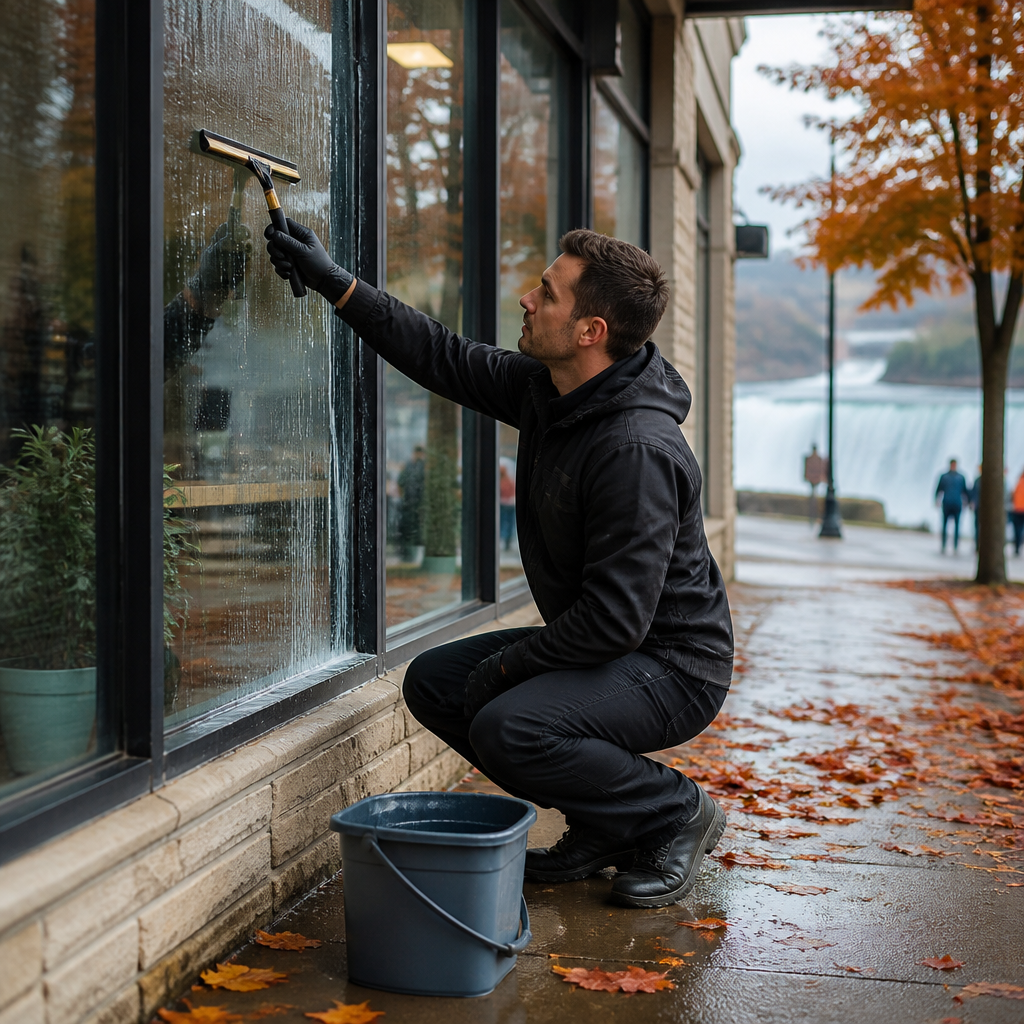
In practice, the exterior pass should happen before the first sustained freeze, which in most years arrives in late autumn across Niagara Falls and Hamilton. That gives a crew dry, mild days to work, and it lets the glass go into winter without a haze that catches low sun and makes the storefront look neglected. Owners who schedule the job for early November often find they have already missed the best dry stretch of the season.
What Changes Between September and November
Summer grime is mostly dust and pollen, which rinses off with a normal wash. Fall debris is different. Wet leaves stick to frames and weep holes, tree sap hardens on awnings, and damp weather keeps mineral residue from drying clean. A window that was streak free in August can need a two-pass process by early November.
The timing of the work matters as much as the method. A crew that arrives on a cool, dry morning can rinse, squeegee, and check each pane before the afternoon damp settles in. The same job attempted during a run of rainy days often ends up as a second visit.
The Cost of Waiting Until Spring
Owners who wait until spring usually pay twice. The first cost is the cleaning itself, since winter grime has bonded more firmly and takes longer to lift. The second is the appearance hit during the months when new customers judge a business from the sidewalk. A restaurant on a busy Hamilton street or a retail unit in Niagara Falls is often judged by its glass before anyone walks through the door.
Salt Film and Road Grime on Storefront Glass
Road salt is the problem most owners underestimate. Vehicles throw salt slurry onto curbside glass, and the mix dries as a thin, chalky film that rain alone does not remove. Left alone, it dulls the surface and makes the glass look hazy under low sun, even when the pane was cleaned a few weeks earlier.
Ask a crew to wipe one pane with a dry cloth and you will see the difference. A properly cleaned pane shows no cloudiness at an angle, and the reflection stays sharp. If the cloth comes away grey, the film is still there and the job is not finished.
Why Ordinary Rain Does Not Clean Salt Haze
Rain spreads residue rather than lifting it. You get a uniform cloudiness that looks like dirty glass from inside the store, and customers often assume the windows need replacing when the problem is simply a film. The fix is mechanical: a mild cleaning solution, a squeegee, and a second rinse with clean water.
The second rinse matters because leftover solution dries into its own film. A crew that skips it leaves streaks that look worse than the original grime. Ask whether the quote includes that step, since it is the one most often cut from low-priced jobs.
Storefronts Near Busy Corridors
Units facing a main road collect more residue than those set back from traffic. In Hamilton and Niagara Falls, the storefronts most affected tend to sit along high-traffic streets and near intersections where trucks and buses throw spray toward the curb. Those frontages should be scheduled first, not last, because the film is thickest there.
Glass that looks clean in a rainstorm can still be hazy the moment the sun comes out low across it.
That is why a visual check in daylight belongs at the end of every job. Walk the frontage from the sidewalk, then from inside the shop, and mark any pane that still shows a film before the crew packs up.
Gutters and Eavestroughs Before the First Freeze
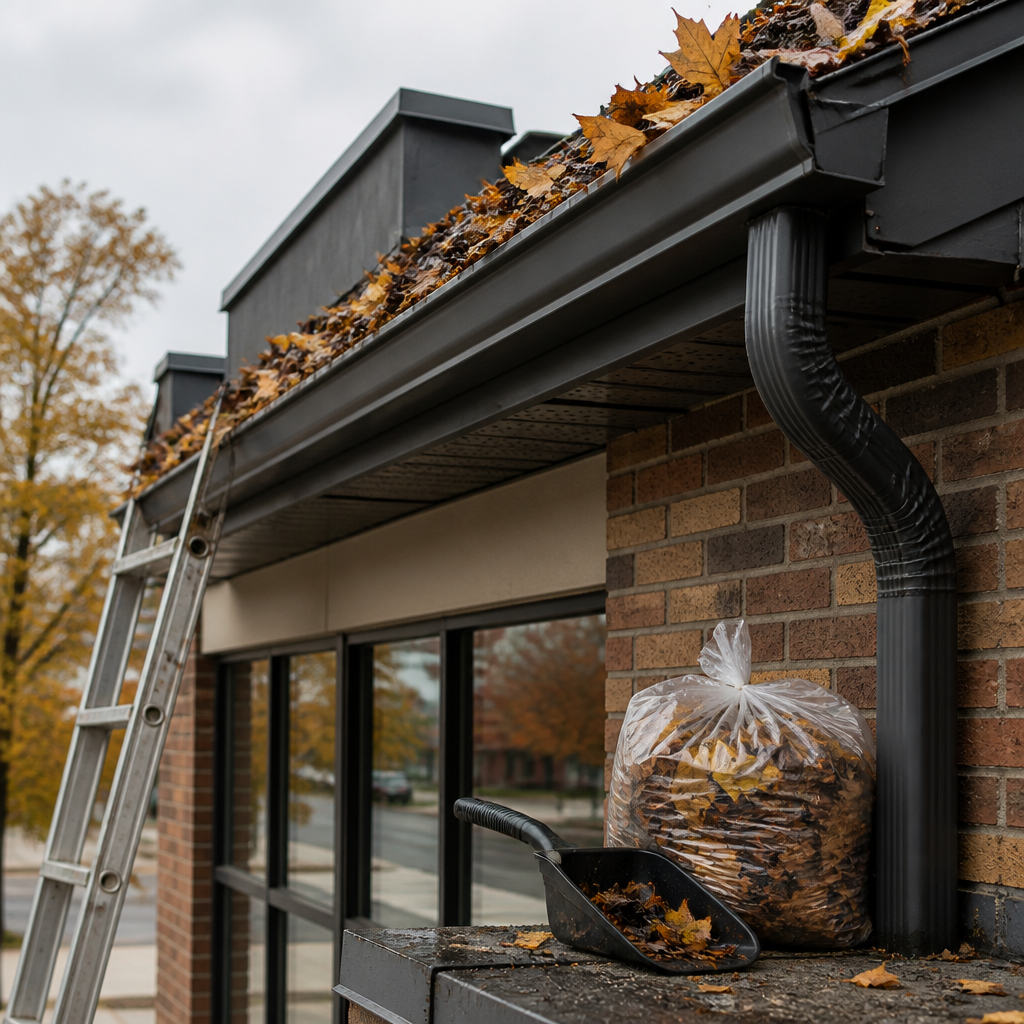
Eavestroughs are the most neglected part of a storefront exterior and often the most expensive to ignore. A clogged run overflows during rain, and the water runs down the wall, along the sign band, and onto the entrance. In winter that overflow becomes ice on the walkway, which is a liability issue for any business that depends on foot traffic.
Single storey storefronts are the ones most often skipped. Owners assume a low roof means little debris, but the runs fill just as quickly, and a short roofline can still throw a steady stream of water onto the door. A quick check of the runs during the fall visit costs little and prevents a messy spring repair.
Clearing Debris Without Damaging the Trim
Hand clearing works for short runs, but on a two storey frontage a crew should use a stable ladder and a flush tool that reaches the full length of the trough. Scooping by hand from the top is slow and often leaves compacted leaves behind at the joints.
High pressure aimed at a seam can push debris further into the joint and loosen fasteners. Keep the pressure low at the gutter itself, then use a stronger flow only to clear the downspout once the debris has been removed. This sequence protects the trim and avoids a repair call later.
Downspouts and Splash Zones
Check that each downspout discharges well away from the foundation and the storefront wall. A downspout that dumps onto a walkway forms a sheet of ice in January. Note the splash zone where water hits the pavement, since that spot usually shows the first staining and is where the ground wash should begin.
If a downspout runs into a shared alley or a loading area, mention it to the crew before the visit. Redirecting water is outside a standard cleaning scope, but flagging the problem early lets you decide whether to fix it before the freeze.
Pressure Washing Entrances, Walkways and Loading Areas
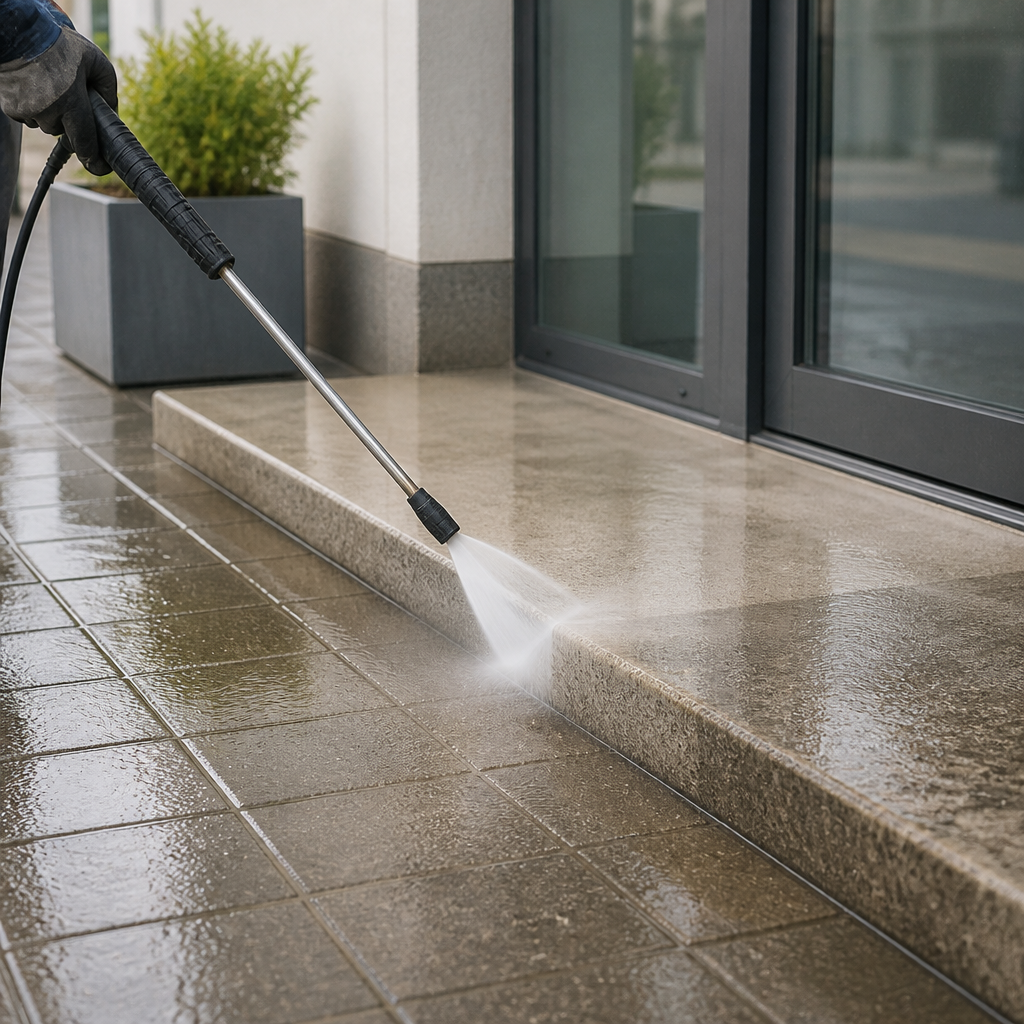
Power washing is the step that makes everything else look finished. Sidewalks, entrance tiles, and loading aprons collect oil, tire marks, and leaf stains that dull the building as much as dirty glass does. When the ground looks clean, a storefront reads as cared for before a customer reaches the door.
Sequencing Ground Surfaces Before Glass
Wash the ground before the windows. Overspray from a pressure wash rises and carries grime onto glass that has already been cleaned, so the order matters. A crew that starts with the walkway, then the entrance, then the glass avoids a second pass on the frames.
Pro tip: Ask for a dry afternoon after the walkway wash. Detergent on concrete needs time to rinse fully, and rain that arrives mid-cure can leave a dull patch that is harder to fix than the original stain.
Walkways, Patios and Loading Zones
Rear loading areas on commercial strips in Hamilton and Niagara Falls often hold oil, de-icer residue, and food waste. Those surfaces need a degreasing product, not plain water, and they need a longer rinse. Plain water pushes oil into the pores of the concrete, where it reappears after the next rain.
Patios and outdoor seating should be cleaned before furniture goes into storage for the season. Surfaces left slick with detergent are a slip risk, so the area should be rinsed thoroughly and marked with a sign until it is dry.
Choosing a Fall Cleaning Approach
Owners usually weigh three options: a one-time fall pass, a regular exterior schedule with a fall add-on, or doing the work in house with a hose and squeegee. Each suits a different kind of storefront. The table below sets out the trade-offs based on what a crew sees on site, not on what looks good in a brochure.
| Approach | Best For | Where It Falls Short |
|---|---|---|
| One-time fall pass covering glass, gutters, walkways, and doorways | Units with modest foot traffic that want one visit and one invoice before winter | Mid-season grime from road spray builds up between the fall and spring visits, so the glass can look tired by February |
| Quarterly exterior window service with a fall add-on for gutters and ground surfaces | Frontages on busy roads or near loading areas where residue returns quickly | Higher annual cost, and more visits than a low-traffic unit actually needs |
| In-house cleaning with a hose, squeegee, and ladder | Small units with low exposure and glass that is easy to reach from ground level | Upper glazing and eavestroughs are hard to reach safely, pressure is hard to control, and wet surfaces add a slip risk |
A one-time pass works well for units that sit back from traffic and have predictable foot traffic. It covers the seasonal problems in a single visit. The gap is that mid-season grime accumulates, and a storefront on a busy corridor usually needs a second visit before spring.
In practice, the in-house option looks cheaper until you count the ladder, a second person on site, and the glass you cannot reach safely. Most storefront owners who try it once end up booking a crew the following season.
Spider Webs, Wasps and Doorway Pests
Fall pushes spiders and insects toward warm building entrances. A storefront with a recessed doorway, a dark awning, or a busy overhead sign will see webs appear within days of the first cool nights. Webs at the door are the first thing a customer notices, and they make a clean-looking shop look unmaintained.
Why Fall Brings Spiders and Wasps to Doorways
Spiders build where insects gather, and light fixtures and signage attract both. Wasps look for sheltered spots under eaves and soffits, which is why the eavestrough check and the pest check should happen on the same visit. Clearing nests while they are small is simpler than waiting until a colony is established.
Tick and mosquito activity is a warm-season concern, so it rarely drives a fall booking. Spider and web control at the entrance is the fall priority, because webs and egg sacs are what return to the door first if nobody addresses them.
Spider Spraying Before Doors Stay Closed
Spraying the door frame, soffits, and light fixtures before the heating season keeps webs from rebuilding quickly. Treatment should cover the perimeter and the frame, not only the webs you can see, and the crew should note any area that needs a follow-up visit.
Pro tip: Ask your crew to inspect the inside corners of recessed entrances and the top of the door frame. Those are the two spots where webs return first after a clean, and they are easy to miss from the sidewalk.
Scheduling Your Fall Storefront Detailing Visit
The most useful thing a storefront owner can do this month is book the visit. Late October is when many owners finally look up at the frontage, and the best time slots go quickly. A booking made now leaves room to move the visit if rain shifts the forecast, which is far better than scrambling in November.
Booking Before the Calendar Fills
Give the provider your opening hours, delivery times, and any days when the entrance must stay clear. A crew that knows the schedule can plan the ground wash for quiet periods and finish the glass before the lunch rush. Owners who skip this step often find the crew arriving in the middle of a busy afternoon.
If you run more than one unit, such as a plaza with several frontages, ask for all of them on one visit. Shared scheduling cuts the cost of setup and keeps the frontages consistent in appearance.
What to Confirm in Writing
Ask for a written scope that lists each surface: windows inside and out, sills, tracks, screens, gutters and eavestroughs, walkways, entrance doors, and any signage. A vague quote is where missed areas come from. Also confirm who handles water access, where the crew can park, and whether the work will be done during business hours.
Confirm whether the price includes a second rinse on the glass and whether a follow-up is included if rain arrives mid-job. Those two details decide whether the finished frontage looks right the day you pay for it. If you want the full list of services and how they are scoped, the team at Performance Window Cleaning can walk through them before you commit.
Pro tip: Book a weekday morning so the crew can finish the ground surfaces before customers arrive. Ask for a short walk-through at the end so you can see the glass in direct light before the crew leaves.
Frequently Asked Questions
When should a storefront in Niagara Falls or Hamilton get its fall exterior cleaning?
Book it in late October or early November, before the first sustained freeze. Earlier is better if your frontage faces a busy road, because the salt and road spray film builds up quickly.
Is commercial window cleaning in Niagara Falls different from residential work?
The core task is the same, but storefronts involve larger glazed areas, heavier foot traffic, and tighter access windows during opening hours. Crews need to plan around deliveries and customer entry, which changes how the job is sequenced.
How often should storefront glass be cleaned?
A quarterly exterior service is a practical baseline for most units. Frontages on busy roads usually need more attention, and a fall pass should never be the only visit of the year.
Can a storefront be pressure washed in cool weather?
Crews can work in cool conditions, but wet surfaces need time to dry before temperatures drop below freezing. Rinse thoroughly, and do not leave standing water on walkways where it can turn to ice.
Do eavestroughs need cleaning if the building has only one storey?
Yes. Even a single storey collects leaves in the runs, and an overflow can still soak the sign band and the entrance. Single storey buildings are often overlooked, which is exactly why the problem shows up later.
Will spider spraying affect customers inside the shop?
Treatments are applied to the exterior, the door frame, and the fixtures. Ask the crew which products they use and how long the area should stay closed to foot traffic before it reopens.
What has your storefront looked like after the first wet weeks of fall, and which area would you want cleaned first if you could only choose one?