
Your storefront windows work harder than most marketing budgets ever will. They are the first thing a potential customer sees before they decide to walk in or keep walking. Yet commercial window cleaning is one of the most consistently overlooked line items in a business maintenance plan, while dirty glass quietly costs businesses foot traffic every single day. If you operate a retail shop, office, restaurant, or any commercial property, the condition of your exterior glass is not a housekeeping detail. It is a direct business driver.
Table of Contents
- Quick Takeaways
- First Impressions and Foot Traffic
- What Dirty Windows Actually Cost You
- The Glass Protection Argument
- How Often Commercial Windows Need Cleaning
- DIY vs. Professional Commercial Window Cleaning
- What a Professional Service Actually Does
- Pairing Window Cleaning with Other Exterior Services
- Frequently Asked Questions
- References
Quick Takeaways
| Key Insight | Explanation |
|---|---|
| First impressions form in seconds | Potential customers decide whether to enter a business based almost entirely on visual cues from the exterior, including window clarity. |
| Street-facing glass is your most valuable display space | Clean storefront windows let passersby see your products, atmosphere, and brand standards before spending a cent on advertising. |
| Dirty windows signal neglect, not just mess | Smudged or grimy glass sends a subconscious message that a business does not pay attention to details, which erodes trust. |
| Regular cleaning extends glass lifespan | Professional cleaning protects low-E coatings and prevents mineral deposits and contaminants from permanently etching the glass surface. |
| Cleaning frequency depends on your business type | High-traffic retail storefronts typically need exterior cleaning monthly, while office buildings may manage with quarterly service. |
| Natural light improves the indoor environment | Clean glass maximizes daylight penetration, creating brighter interiors that benefit both customers and employees. |
| Bundling services saves time and money | Combining window cleaning with power washing, gutter cleaning, and siding wash delivers a fully polished exterior in a single visit. |
First Impressions and Foot Traffic
The decision to walk into a business, or trust one enough to call, happens faster than most owners realize. Visual cues dominate that split-second judgment, and nothing communicates a business’s standards more immediately than the cleanliness of its exterior glass. Storefront windows are, in practical terms, a 24/7 advertisement that runs whether or not you are actively thinking about marketing.
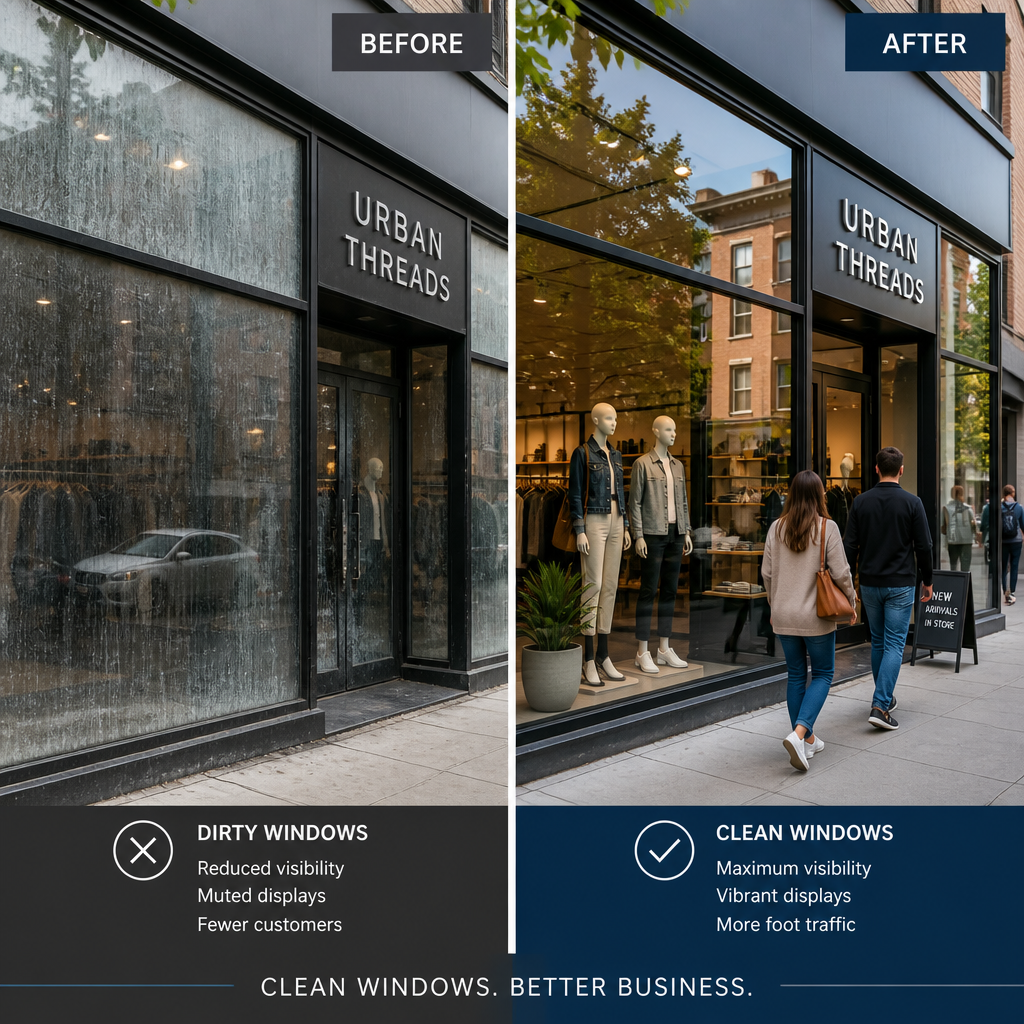
Clean windows maximize natural light penetration, creating bright, welcoming interiors that are visible from the outside. This transparency quite literally opens a business to the community, inviting customers to step in and explore. Dirty, streaked, or grimy windows do the opposite. They create a visual barrier that can deter potential customers and suggest poor attention to detail before anyone has exchanged a single word.
“A layer of grime, fingerprints, or water spots sends a subconscious message of neglect, whereas sparkling glass signals professionalism and attention to detail.”
This matters most in competitive commercial strips where multiple businesses compete for the same pedestrian traffic. When your storefront is visibly cleaner than the business next door, you win that comparison without saying anything. For restaurants, this effect is even more pronounced. Potential diners actively use window transparency to assess ambiance, cleanliness, and activity levels before committing to a visit. A spotless window is essentially a free preview of the experience waiting inside.

What Dirty Windows Actually Cost You
Grimy windows do not just look bad. They actively work against revenue. When potential shoppers cannot clearly see inside a retail store from the sidewalk, the psychological barrier between curiosity and entry grows. Visibility from the street is a direct driver of impulse visits. When you remove that visibility with layers of road grime, fingerprints, and environmental buildup, you remove the trigger that converts passersby into paying customers.
The Psychology Behind the Storefront
Customers make rapid unconscious assessments of businesses. A store that looks well-maintained communicates that the people running it care about quality. A neglected exterior, starting with the windows, undermines that trust. Dusty, smudged, or cloudy windows can make even a well-run business look less professional than it actually is.
This matters beyond retail. Office buildings signal credibility to clients, partners, and prospective employees the moment anyone approaches the entrance. Property managers responsible for commercial tenants know that building appearance directly affects lease renewals and tenant satisfaction. The cleanliness of the windows is one of the most visible indicators of how seriously a property is managed.
What Builds Up on Commercial Glass
Commercial glass in high-traffic environments collects contamination fast. Common culprits include exhaust deposits from vehicle traffic, pollen, urban dust, hard water mineral stains from irrigation systems or rainfall, and street-level fingerprints and smudges. In locations near construction, industrial operations, or busy roadways, the buildup accelerates. The longer these contaminants sit on glass, the harder they are to remove without professional-grade tools and solutions.
Pro tip: If your commercial property sits near a road, parking lot, or construction zone, assume your windows need professional attention more frequently than a standard schedule would suggest. Environmental exposure accumulates faster than it looks from the inside.
The Glass Protection Argument
Beyond aesthetics, there is a straightforward financial argument for regular professional commercial window cleaning that rarely gets enough attention: glass protection. Contaminants that are allowed to sit on windows do not just sit there. They bond with the surface. Hard water mineral deposits can etch into glass permanently if left untreated. Environmental acids in pollution and organic debris accelerate the degradation of glass coatings.
Regular professional cleaning protects low-E coatings and maintains the architectural glass integrity that gives commercial buildings their character. The cost of replacing etched, permanently damaged commercial glass panels is significantly higher than the cost of a scheduled cleaning programme. This is a maintenance investment that pays for itself in avoided replacement costs alone.
Pro tip: Do not wait until windows look visibly dirty to schedule a cleaning. By the time contaminants are obvious to the eye, they have often already begun the process of bonding with and degrading the glass surface. A regular maintenance schedule prevents damage rather than responding to it.
How Often Commercial Windows Need Cleaning
There is no single cleaning schedule that fits every commercial property. The right frequency depends on the type of business, the volume of foot and vehicle traffic nearby, and the local environment. Getting this right matters because both under-cleaning and over-cleaning on a rigid schedule that ignores actual conditions are inefficient uses of budget.
| Business Type | Recommended Frequency | Key Reason |
|---|---|---|
| Retail storefronts (high traffic) | Every 2 to 4 weeks | Heavy daily fingerprints, dust, and street grime visible to customers at close range |
| Restaurants and food service | Every 2 weeks | Kitchen grease and moisture combine with exterior grime; customers judge cleanliness before entering |
| Office buildings (ground-floor entrances) | Monthly | Client-facing entrances need consistent professional appearance for credibility |
| Office building facades (multi-storey) | Quarterly | Rain marks, pollen, and pollution accumulate but at a slower visible rate than street level |
| Medical and healthcare facilities | Every 2 to 4 weeks | Sanitary environment expectations extend to the exterior appearance |
| Industrial and warehouse (entrances) | Every 6 months minimum | Lower client-facing traffic, but entrance areas still represent the business professionally |
In practice, the right way to set a schedule is to assess the property honestly. A coffee shop on a busy street corner in a cold Canadian climate needs cleaning more often than a suburban insurance office. Seasonal factors also matter. Spring brings pollen and post-winter grime. Fall accumulates organic debris. A reliable commercial window cleaning provider should help you dial in the right cadence rather than apply a one-size-fits-all schedule.
DIY vs. Professional Commercial Window Cleaning
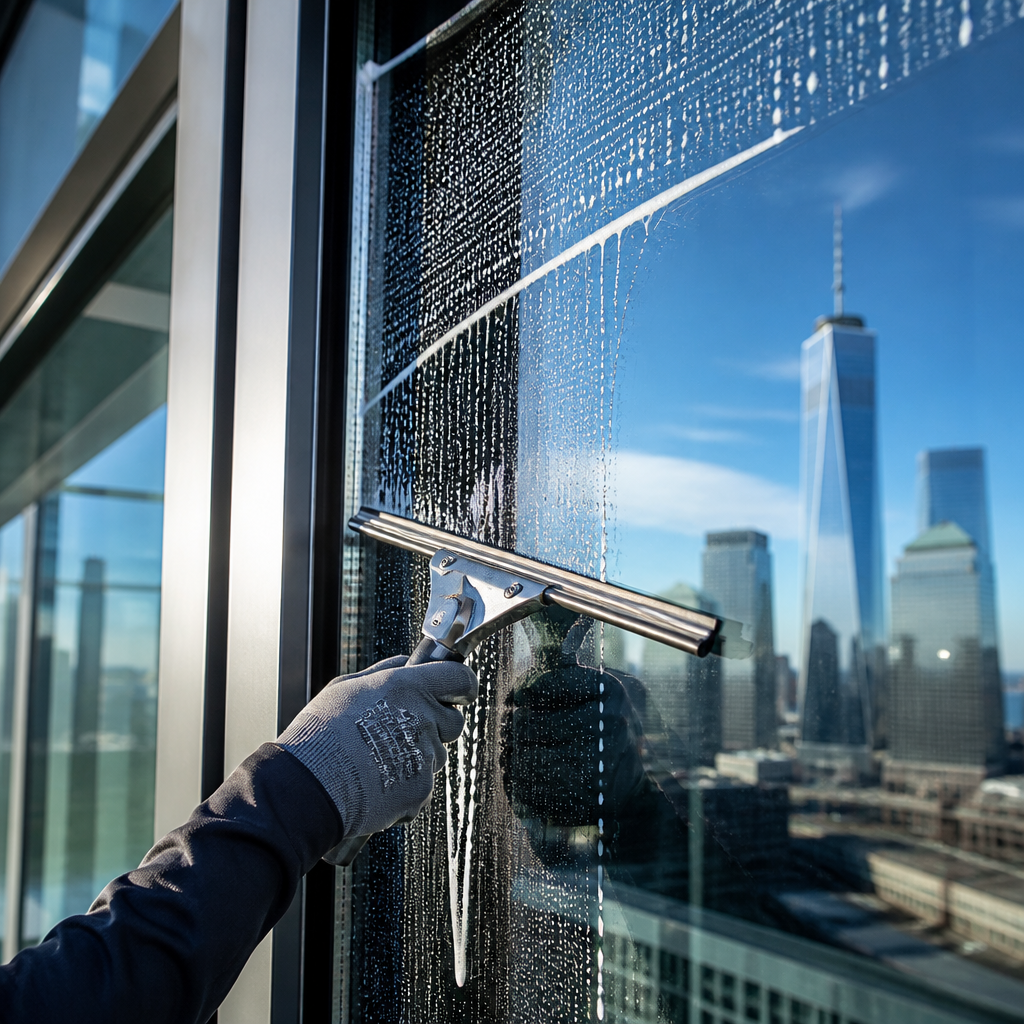
Wiping down glass with a spray bottle and a cloth is not commercial window cleaning. It is the business equivalent of running a damp cloth over a kitchen counter and calling the kitchen clean. Commercial glass cleaning requires specialized squeegees, extension tools for height, professional-grade cleaning solutions that do not leave residue, and the trained technique to work efficiently without streaks or water spots.
The practical problem with delegating window cleaning to in-house staff is consistency. Staff clean windows when they have time, which means windows get cleaned when business is slow, not on a fixed schedule based on actual maintenance needs. The result is uneven cleaning quality, missed sections, and streaks that are often more visible than the original grime because they catch light differently.
A common mistake is assuming that any visible attempt at cleaning is better than nothing. In practice, poorly executed DIY cleaning on commercial storefront glass can leave streaks, smears, and lint that actively degrade the appearance compared to simply leaving the glass alone between professional visits. The standard for commercial cleaning is streak-free, residue-free glass, and that standard requires professional tools and technique.
What a Professional Service Actually Does
Professional commercial window cleaning covers more than the glass panels themselves. A thorough commercial service includes the window frames, sills, sashes, and glass door surfaces. Street-level glass doors accumulate fingerprints and push marks constantly and are often ignored in basic cleaning routines despite being the most-touched glass surface on the property.
For multi-storey commercial buildings, professional crews use specialized access equipment and techniques that allow them to clean upper-floor exterior glass safely and effectively. Interior commercial window cleaning, particularly in offices with large glass partitions and floor-to-ceiling windows, requires different tools and scheduling considerations to avoid disrupting business operations.
A quality commercial cleaning provider will also identify early signs of glass damage, failing seals, or surface problems during the cleaning process. This kind of observational value is something a squeegee-and-spray approach from a maintenance staffer will never catch. At Performance Window Cleaning, commercial clients benefit from this attention to detail on every service visit, along with flexible scheduling that works around business hours.
Pairing Window Cleaning with Other Exterior Services
A clean set of windows against a grimy facade, stained entrance, or debris-clogged gutters undermines the effect of the window cleaning entirely. The exterior of a commercial property functions as a system. Every element contributes to the overall impression, and a weakness in any one area drags down the rest.
Power washing the building exterior removes the environmental staining and biological growth (moss, algae, mildew) that accumulates on siding, concrete, and masonry over time. Gutter and eavestrough cleaning prevents overflow damage that stains the building facade and, in winter climates, creates ice dam conditions that cause structural issues. Hand-washing of siding and entrance areas addresses the textured surfaces that a pressure washer alone cannot properly clean.
Bundling these services into a scheduled exterior maintenance programme is the most cost-effective approach for commercial property managers. It reduces the number of service visits, ensures the entire property presents consistently well, and allows a single trusted provider to track the property’s condition over time. Performance Window Cleaning offers commercial window cleaning alongside power washing, gutter cleaning, and exterior washing services that can be packaged to cover the full commercial exterior in a single coordinated visit.
Frequently Asked Questions
How often should a retail storefront have its windows professionally cleaned?
High-traffic retail storefronts generally need professional exterior window cleaning every two to four weeks. The glass on a busy retail front collects fingerprints, dust, and street grime quickly, and the standard of cleanliness expected by customers at close range is higher than for other commercial property types. Between professional visits, staff should spot-clean obvious smudges on glass doors and entry panels.
Does commercial window cleaning include interior windows?
Yes, most professional commercial window cleaning services offer both interior and exterior cleaning. Interior commercial cleaning is typically scheduled less frequently than exterior work because interior glass does not face the same environmental contamination. However, offices with client-facing reception areas, glass partitions, and showroom windows benefit from regular interior cleaning as part of a complete professional appearance.
Can dirty windows actually damage the glass permanently?
Yes. Hard water mineral deposits, environmental acids from pollution, and organic debris can etch into glass and degrade low-E coatings over time if they are left to accumulate. This damage is often not visible until it is too late to correct without replacing the glass. Regular professional cleaning removes these contaminants before they bond with the surface, which protects the glass and extends its lifespan.
What is the difference between storefront cleaning and regular commercial window cleaning?
Storefront cleaning typically focuses on street-level retail glass, including display windows, glass entry doors, and signage panels. Regular commercial window cleaning covers a broader scope, including all window panels on office buildings, multi-storey facades, and interior glass. For retail businesses, storefront cleaning frequency is usually higher than for general commercial window maintenance because of constant pedestrian contact and high visual importance.
Should commercial window cleaning be bundled with other exterior services?
Bundling is almost always the smarter approach for commercial properties. Clean windows next to a stained entrance, grimy siding, or overflowing gutters do not produce the intended result. Pairing window cleaning with power washing, gutter cleaning, and exterior washing ensures the entire property presents consistently well. It also reduces scheduling overhead and often delivers better value when booked through a single provider who can coordinate all services in one visit.
How do I choose a reliable commercial window cleaning provider?
Look for a provider with verifiable commercial experience, not just residential work. Commercial glass, particularly on multi-storey buildings or properties with specialty coatings, requires different tools and knowledge than residential window cleaning. Confirm they carry proper insurance for commercial work, offer flexible scheduling around business hours, and can provide references from comparable commercial clients. A provider who asks about your specific property type and traffic patterns before quoting is taking the job seriously.
If you manage a commercial property and have opinions on what makes the difference between a good and bad exterior cleaning experience, share them in the comments below.
We would love your feedback and any insights you would share with others. What perspective would you add?
References
- How clean commercial windows improve business image and customer confidence
- Why office and storefront window cleaning matters for business performance
- How often commercial businesses should schedule window cleaning by property type
- Why storefront window cleaning is a critical investment for retail businesses
- How storefront window cleaning boosts retail sales and visual appeal