
Most homeowners try DIY window cleaning at least once. A bucket, some dish soap, a squeegee from the hardware store, and an afternoon that ends in streaks, aching shoulders, and a window that somehow looks worse than before. The question is not whether you can clean your own windows. The question is whether it is worth it, and whether the result is actually good. This article breaks down the real costs, risks, and outcomes of both approaches so you can make a decision that fits your home, your schedule, and your standards.
Table of Contents
- Quick Takeaways
- What DIY Window Cleaning Actually Involves
- The Real Cost of DIY vs. Professional Window Cleaning
- Quality and Results: An Honest Look
- Safety Risks That Most Homeowners Underestimate
- Comparison Table: DIY vs. Professional Window Cleaning
- When DIY Makes Sense and When It Does Not
- What to Expect From a Professional Service
- Frequently Asked Questions
- References
Quick Takeaways
| Key Insight | Explanation |
|---|---|
| DIY costs more than people realize | Once you factor in supplies, equipment, and your time, DIY window cleaning is rarely as cheap as it looks. |
| Streaks are a technique problem, not a product problem | Most DIY streaking comes from incorrect squeegee angle and using too much soap, not from cheap cleaning solutions. |
| Height changes everything | Ground-floor windows are manageable for most homeowners. Second-storey and above carry genuine fall risks that professionals are trained and insured to handle. |
| Professional cleaning frequency pays off | Annual or bi-annual professional cleaning extends window lifespan by removing corrosive mineral deposits and oxidation that DIY methods often miss. |
| Window cleaning cost varies by scope, not just size | A professional quote accounts for window type, number of panes, accessibility, screen condition, and add-on services like gutter or pressure washing. |
| Insurance matters more than most homeowners think | If a DIY cleaning attempt results in a broken window or a fall injury, homeowner insurance may not cover the full loss. |
| Bundling services saves money | Booking window cleaning alongside gutter cleaning or power washing in one visit typically reduces the per-service cost significantly. |
What DIY Window Cleaning Actually Involves
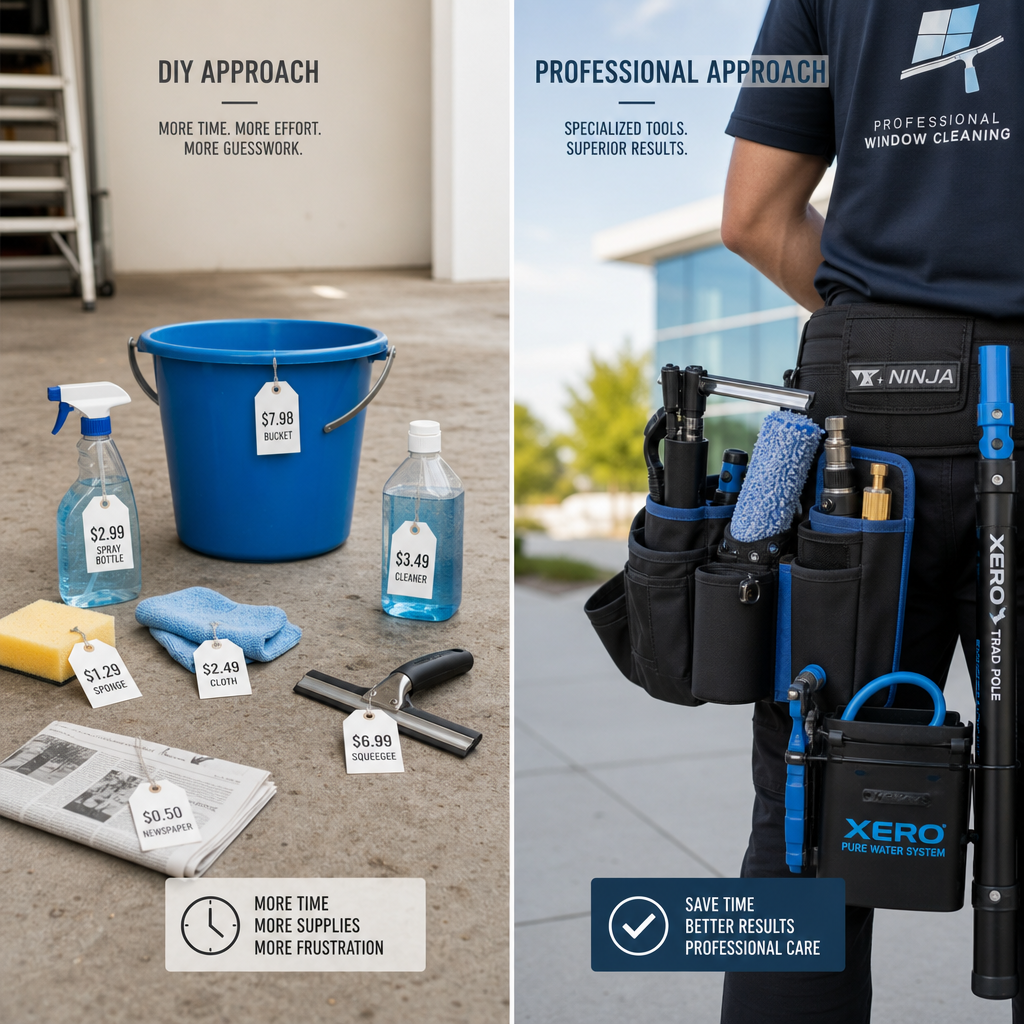
DIY window cleaning sounds simple. In practice, doing it properly requires more preparation and skill than most tutorials admit. You need a quality squeegee (not the $4 grocery store version), a scrubber or T-bar applicator, a dedicated window cleaning solution or a correctly mixed dish-soap-and-water ratio, lint-free cloths or a chamois, and a ladder if your home has more than one storey. That is before you account for screens, tracks, frames, and the outsides of windows that face a garden or driveway covered in debris.
A common mistake is using paper towels or standard household spray cleaners. Paper towels leave lint. Most spray cleaners contain ammonia or alcohol that leaves a film, especially in direct sunlight. The result is a window that looks clean indoors but shows every smear the moment light hits it at an angle.
The Time Commitment Is Consistently Underestimated
For a standard two-storey home with 20 to 25 windows, a thorough DIY window cleaning session takes most homeowners between four and six hours. That estimate assumes you already own all the right equipment, the weather cooperates, and you are comfortable on a ladder. First-timers often stretch this to a full day, and the results still fall short of what a trained crew achieves in under two hours.
If you are cleaning windows because you are listing your home for sale or preparing for a special event, the time pressure alone makes professional window cleaning the more rational choice for most people.
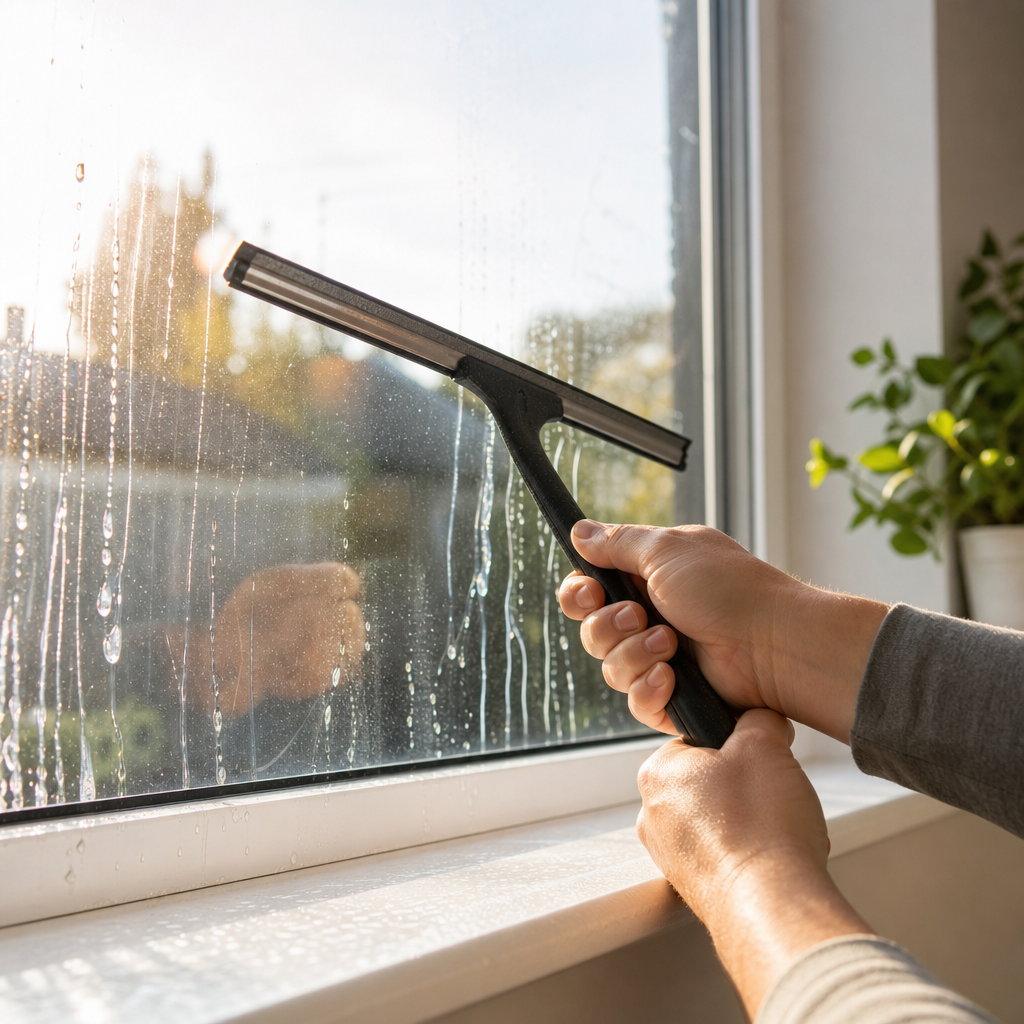
Pro tip: If you are committed to DIY window cleaning, clean on a cloudy day rather than in direct sun. Sunlight dries the cleaning solution before you can squeegee it off, which is the single biggest cause of streaks on exterior windows.
The Real Cost of DIY vs. Professional Window Cleaning
Window cleaning cost comparisons usually ignore what economists call opportunity cost, meaning the value of the time you spend doing the task yourself. Let us run the numbers honestly.
Upfront DIY Equipment Costs
A basic but functional DIY window cleaning kit includes: a professional-grade squeegee ($20 to $40), a T-bar scrubber ($15 to $25), a telescoping pole for upper windows ($30 to $80), a bucket ($10), and cleaning solution ($10 to $20 per season). That is a minimum investment of $85 to $175 before you even start. Cheap versions of these tools produce cheap results, which is why the $10 squeegee from a big-box store almost always ends in frustration.
Equipment also wears out. Squeegee rubber degrades and needs replacing every season or two. Telescoping poles bend or corrode. If you clean windows twice a year, your annualized equipment cost is not zero after year one.
What Professional Window Cleaning Actually Costs
For a standard residential home in Canada, professional window cleaning typically ranges from $150 to $400 depending on home size, number of windows, and whether interior cleaning is included. Commercial properties are priced differently, usually per pane or per square foot. Services like those offered by Performance Window Cleaning often include screens, frames, sills, and tracks as part of the package, which adds measurable value that a straight price comparison misses.
When you bundle window cleaning with gutter cleaning or power washing in a single service visit, the combined cost per service drops. In practice, a homeowner who books all exterior cleaning services at once typically pays 15 to 25 percent less per individual service than booking each separately.
“Consumers consistently underestimate the true cost of DIY home maintenance when they fail to account for time, equipment depreciation, and the cost of fixing mistakes.” – Consumer Reports Home Maintenance Research Panel
Quality and Results: An Honest Look
The results gap between DIY and professional window cleaning is real and visible. A trained window cleaner using professional-grade tools and solution on a consistent squeegee path will produce a streak-free result in one pass. Most homeowners, even with good equipment and motivation, need multiple passes and still see smearing in certain light conditions.
Beyond aesthetics, professional cleaning addresses issues that DIY misses entirely. Hard water mineral deposits, oxidation on aluminum frames, paint overspray, and adhesive residue from stickers all require specific techniques or specialized products. Scrubbing at these with a standard scrubber often scratches the glass. In practice, most DIY attempts simply clean the surface dirt without touching these deeper problems.
Interior vs. Exterior: Where DIY Performs Better
Interior window cleaning is the one area where DIY performs reasonably well. Interior glass is protected from weather, hard water, and oxidation. A microfiber cloth and a quality glass cleaner will get interior windows genuinely clean without much risk. This is a legitimate case where DIY saves money without sacrificing much quality.
Exterior windows are a different situation. Exposure to rain, construction dust, hard water from sprinkler systems, bird debris, and algae growth creates a level of contamination that requires proper agitation tools, correct solution concentration, and technique. This is where the quality gap between DIY and professional cleaning is most pronounced.
Safety Risks That Most Homeowners Underestimate
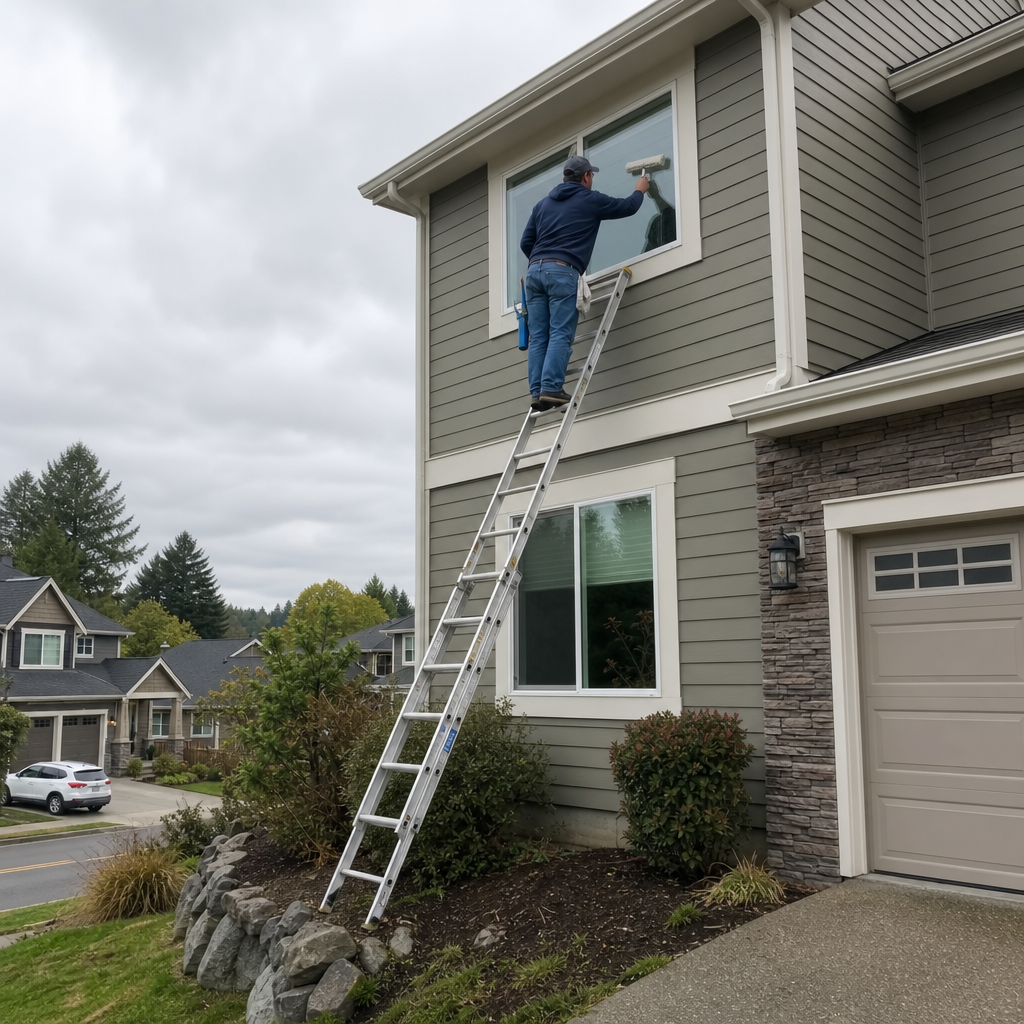
Falls from ladders are among the most common causes of serious home injury in North America. According to the U.S. Consumer Product Safety Commission, ladders are involved in approximately 164,000 emergency room visits annually in the United States. Canadian data from the Public Health Agency of Canada shows similar patterns for residential fall injuries. Most of these incidents happen to healthy adults doing routine maintenance tasks, not people who are reckless or inexperienced.
Cleaning second-storey or higher windows from a ladder while holding a wet squeegee and a bucket is objectively high-risk. The surface is wet, the ladder must be repositioned repeatedly, and the task requires both hands, which means you are not always maintaining three points of contact as safety guidelines require.
Liability and Insurance Considerations
Professional window cleaners carry liability insurance and Workers’ Compensation coverage. If a professional cleaner is injured on your property during a booked job, your homeowner liability exposure is limited. If you fall and injure yourself, your health coverage applies, but the lost productivity, recovery time, and any property damage from the fall are on you.
A broken window during DIY cleaning, whether from improper technique, tool slippage, or a pressure washing angle that is too aggressive, is also out of pocket. Professional services carry coverage for accidental damage during the job, which is a concrete financial protection that the DIY route does not offer.
Pro tip: If you are evaluating professional window cleaning services, ask directly whether they carry current liability insurance and WCB coverage. Any reputable company should confirm this without hesitation. Performance Window Cleaning has carried this coverage since 2008, which is a baseline expectation, not a premium feature.
Comparison Table: DIY vs. Professional Window Cleaning
| Factor | DIY Window Cleaning | Professional Window Cleaning |
|---|---|---|
| Upfront Cost | $85 to $175 for starter kit | $150 to $400 per visit depending on home size |
| Time Required | 4 to 6 hours for a 2-storey home | 1 to 2 hours with a professional crew |
| Result Quality | Variable, often streak-prone on exterior glass | Consistent streak-free results, frames and tracks included |
| Safety Risk | High for second-storey windows or steep rooflines | Managed with professional equipment, training, and insurance |
| Hard Water and Mineral Deposits | Usually untreated or worsened by incorrect scrubbing | Treated with appropriate solutions and technique |
| Liability Coverage | None beyond personal health and homeowner insurance | Full liability and WCB coverage through the company |
| Add-On Services | Requires separate effort and separate equipment | Often bundled with gutter cleaning, pressure washing, spider spraying in one visit |
When DIY Makes Sense and When It Does Not
DIY window cleaning makes sense in a narrow set of circumstances. If you have a single-storey home, fewer than ten windows, and you genuinely enjoy the task, the cost savings are real and the risk is manageable. Interior-only cleaning is also a reasonable DIY project for most homeowners at any home size.
DIY does not make sense when your home has two or more storeys, when you have not cleaned windows in over a year and there is significant buildup, when you are preparing a home for sale and first impressions matter, or when your windows show hard water staining, oxidation, or construction residue. These situations require professional tools and technique to resolve without causing damage.
The Frequency Factor
The data consistently shows that windows cleaned professionally twice a year maintain their clarity and structural integrity longer than windows cleaned irregularly by homeowners. Mineral deposits that build up on glass over six to twelve months begin etching the surface if left untreated. Once etching occurs, the glass cannot be restored to its original clarity by cleaning alone. Professional cleaning is a maintenance investment, not just an aesthetic one.
Performance Window Cleaning offers flexible scheduling and customized maintenance packages specifically because irregular service is one of the main reasons homeowners end up needing window replacement earlier than necessary. That is a cost comparison that rarely appears in DIY vs. professional discussions, but it is a real financial consideration.
What to Expect From a Professional Service
A professional window cleaning visit from a company like Performance Window Cleaning covers more than the glass surface. A thorough service includes wiping down frames, cleaning window tracks, removing screens and cleaning them separately, and checking for visible seal failures or cracked caulking that the homeowner may not have noticed. This inspection value is something DIY cleaning never provides.
Commercial clients, property managers, and real estate agents working with Performance Window Cleaning since 2008 have access to recurring service agreements that keep properties in consistent, presentable condition without the homeowner or manager having to track and schedule each visit manually. For rental properties and commercial storefronts especially, this removes a recurring administrative task from an already full plate.
What Distinguishes a Quality Professional Service
Not every window cleaning company delivers the same result. The markers of a quality service provider are: use of commercial-grade squeegees and pure water systems or correctly formulated solutions, evidence of proper insurance coverage, a clear written quote before any work begins, and technicians who work systematically rather than rushing through the job. A company established since 2008 with a track record in both residential and commercial cleaning offers something that a newer or inconsistently reviewed service cannot: demonstrated reliability over time.
When comparing services, pay attention to whether the company cleans screens and tracks as standard, whether they offer complementary services like eavestrough cleaning and power washing, and whether they will return if the result is unsatisfactory. These are the differentiators that matter, not just the base price per window.
Frequently Asked Questions
How often should I have my windows professionally cleaned?
Most residential homes benefit from professional window cleaning twice a year, typically in spring and fall. Homes near construction sites, busy roads, or with hard water sprinkler systems may need quarterly service to prevent mineral etching and buildup that becomes increasingly difficult to remove over time.
Is DIY window cleaning ever genuinely worth it?
Yes, for single-storey homes with fewer than ten windows and for interior-only cleaning at any home size. Outside of these situations, the time, equipment cost, safety risk, and quality gap make professional cleaning the more rational financial decision for most homeowners, even when the service fee looks high at first glance.
What does professional window cleaning cost for a typical house in Canada?
For a standard two-storey residential home, professional window cleaning in Canada typically costs between $150 and $400. The range depends on the number of windows, whether interior cleaning is included, window accessibility, and whether services like screen cleaning, gutter cleaning, or pressure washing are added. Bundling multiple exterior services in one visit usually reduces the effective cost per service by 15 to 25 percent.
Can I use a pressure washer to clean windows?
Pressure washing windows directly is risky and generally not recommended for DIY attempts. Too much pressure can crack glass, force water behind frames, damage seals, and strip caulking. Professional exterior cleaning services use pressure washing for siding, driveways, and decks, but use low-pressure or no-pressure methods with appropriate tools for glass surfaces specifically.
What should I ask a window cleaning company before hiring them?
Ask whether they carry current liability insurance and WCB coverage, what is included in the quoted price (screens, tracks, frames, interior vs. exterior), whether they have experience with your specific window type, and what their process is if you are not satisfied with the result. A company that cannot answer these questions clearly should not be trusted with access to your home or commercial property.
Why do my windows streak after DIY cleaning?
Streaking is almost always caused by one of three things: too much soap in the solution leaving a film, cleaning in direct sunlight where the solution dries before you can squeegee it off, or using worn squeegee rubber that smears rather than wipes. Switching to a diluted dish soap mix (two drops per litre of water), cleaning on an overcast day, and replacing squeegee rubber each season eliminates most DIY streaking problems.
What has been your experience with DIY window cleaning versus hiring a professional service? We would genuinely like to hear what made the difference for you.
References
- Statista home services market research and consumer spending data for cleaning industries
- Forbes home improvement cost guides and contractor hiring advice for homeowners
- Public Health Agency of Canada data on residential fall injuries and ladder safety statistics
- U.S. Consumer Product Safety Commission ladder-related injury data and home safety guidelines
- HomeAdvisor national average cost data for professional window cleaning and exterior home services