
For most homeowners, eavestrough cleaning in Fenwick is the job that gets postponed until a November storm makes it urgent. By then the trough is packed with wet leaves, the downspout is holding a plug of grit, and water is pouring over the edge onto the ground beside the house, the porch, or the driveway. On a rural property the problem is harder to spot, because the gutter you forget is usually the one you can’t see from the kitchen window. This checklist covers what to clear, what to check, and how to work safely when you’re the only person on the lot.
Table of Contents
- Quick Takeaways
- Why Late Autumn Is the Right Window
- What Rural Properties Put in Eavestrough
- Step-by-Step Late-Season Checklist
- Downspouts and Drainage Away From the House
- Rural Safety: Ladders, Soft Ground, and Working Alone
- DIY, Hand Service, and Professional Cleaning Compared
- Fall Inspection Items to Add to the Checklist
- Frequently Asked Questions
- References
Quick Takeaways
| Key Insight | Explanation |
|---|---|
| Book after the bulk of leaf drop | Late autumn, once most leaves are down and before the first hard freeze, is the window that works best for rural eavestrough cleaning. |
| Trees mean a second visit | Maples, oaks, and pines keep dropping debris after the main leaf fall, so a light spring check is worth planning if your lot is wooded. |
| Flush the downspouts, not just the trough | A clean trough does nothing if the downspout is blocked at the elbow or the outlet. Test every downspout with water. |
| Check where the water lands | Water should leave the house and run onto sloped ground, not onto the foundation, a window well, or the path to the door. |
| Inspect hangers while you’re up there | Loose hangers and failed seams are cheap to fix in November and expensive to fix after a snowfall adds weight. |
| Set up for uneven ground | Soft soil and sloped lawns move a ladder under load. Use a firm, level base and never work alone on a long run. |
Why Late Autumn Is the Right Window
Kärcher’s gutter guide recommends cleaning gutters at least once a year, and notes that trees or a wooded area nearby can mean more than that. It names late autumn as the best time, after the leaves have fallen but before the first frost and snowfall. Most rural properties with any tree cover fit that description, which makes the second half of autumn the right time to book your eavestrough cleaning.
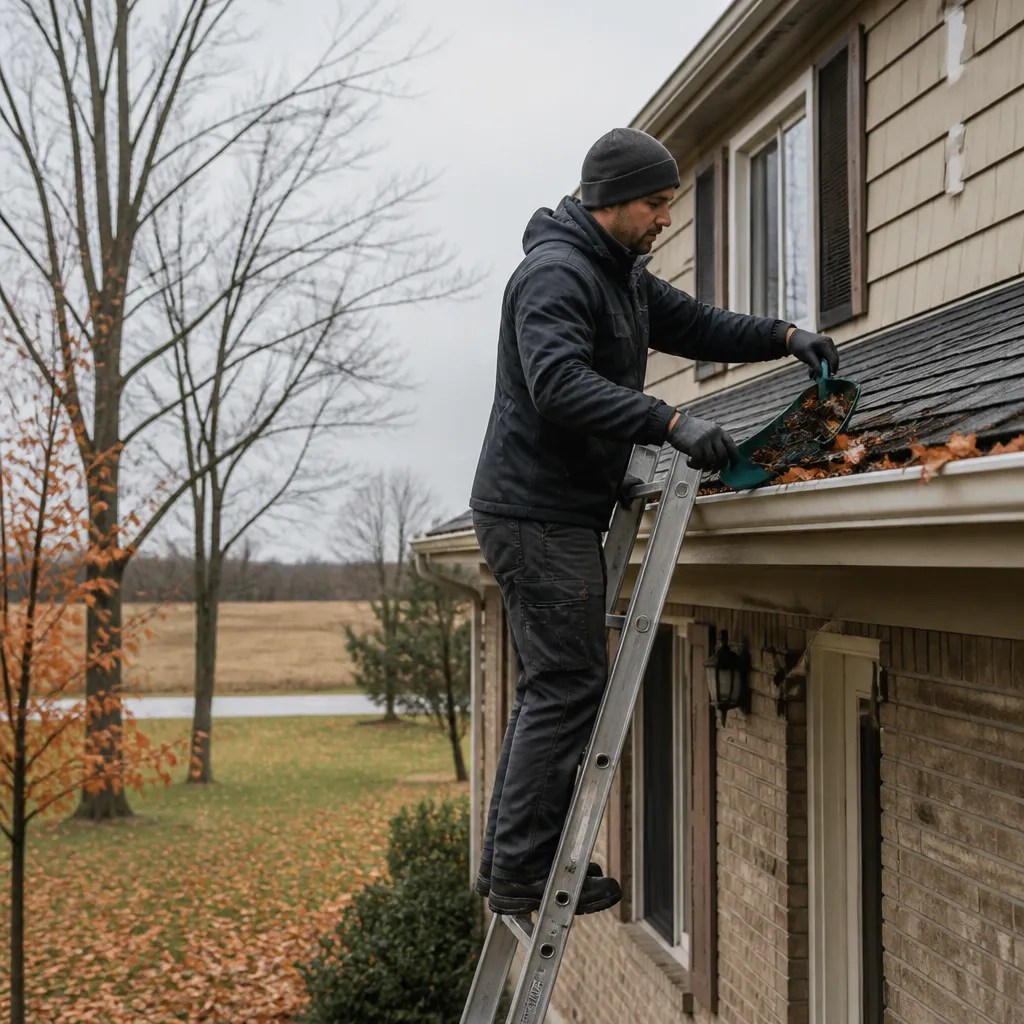
Waiting for spring is the common mistake. COUNTRY Financial’s spring home maintenance checklist notes that one in four homeowners in its survey have experienced property damage from severe weather or natural disasters, and it recommends clearing gutters and downspouts so rain drains freely instead of backing up. The same logic applies in autumn. A trough left full through winter holds moisture against the fascia, rots the leaves into a dense mat, and adds weight at the hangers once snow sits on top.
In practice, we schedule the job once the bulk of leaf drop is over, then recheck if a windy week follows. Waiting until every last leaf is down means working in the cold, on wet ladders, with a short daylight window. Booking early gives you a dry day to work with and time to fix anything the cleaning uncovers.
On a rural lot, the gutter you forget is almost always the one that drains onto the gravel, the walkway, or the foundation corner you never look at.
Pro tip: Walk the perimeter after your first heavy rain of the season and look for water landing where it shouldn’t. That spot tells you which downspout is blocked before you climb anything.
What Rural Properties Put in Eavestrough
The debris on a rural property differs from what collects on a small suburban lot. Larger lots mean more overhanging branches, more open ground for debris to blow across, and more dust coming off unpaved surfaces. Knowing what sits in your trough tells you how many passes it needs and which downspout is likely to give you trouble.
Maple and oak leaves
Broad leaves are the main load in most years. Maple leaves are flat and mat together when wet, so they seal the bottom of the trough and hold water in place. Oak leaves are tougher, curl up, and tend to wedge into the outlet. Scoop them out by hand before you flush, because a wet mat will simply move the clog down the pipe.
Needles, seed pods, and catkins
Conifers and some deciduous trees keep dropping material after the main leaf fall. Pine needles are the worst offender because they form a thin layer that water runs over without draining. Seed pods and catkins are lighter, but they stick to the wet surface and collect in the corners. If your property has heavy evergreen cover, plan a second light clean in spring.
Grit from gravel and unpaved drives
Gravel roads and driveways put fine grit into the trough through splash and wind. That grit settles in the bottom of the eavestrough and at the downspout elbow, where it hardens into a plug. Rural homes with long gravel approaches often need their downspouts flushed more than their troughs cleaned, because the trough looks fine while the outlet is packed solid.
Step-by-Step Late-Season Checklist
This is the order we follow on a typical rural job. Each step makes the next one faster, and skipping ahead usually means climbing the ladder twice. Keep the list on your phone or print it for the garage, and tick each step before you move on.
Before you touch a ladder
Check the forecast for a dry window of at least a day, and look at the ground. Wet grass, soft soil, and a slope at the foundation all make ladder work more dangerous. Clear the area under each run so you are not stepping onto a tarp of debris, then lay out a bucket, a plastic scoop, and a hose with a spray nozzle before you start.
Clearing the trough by hand
Start at the end farthest from the downspout and work toward the outlet. Use a plastic scoop or a gloved hand to lift out leaves, and drop them into a bucket rather than onto the lawn, which saves a second cleanup. Do not use a metal tool on the trough, because it scratches the finish and gives moisture a place to sit. Once the loose debris is out, the trough should look empty, not just emptier.
Pro tip: Wear waterproof gloves, not cotton work gloves. Cotton soaks through within minutes and gets cold fast, which makes the last third of a run miserable and careless.
Flushing the trough
Run the hose from the far end, moving water toward the outlet. Watch the flow at the downspout. If water pools at the far end, a joint is low or a section sags, and that becomes a repair note for later. Flushing also shows where sediment has settled, which gives you the list of downspouts to clear more thoroughly.
Downspouts and Drainage Away From the House
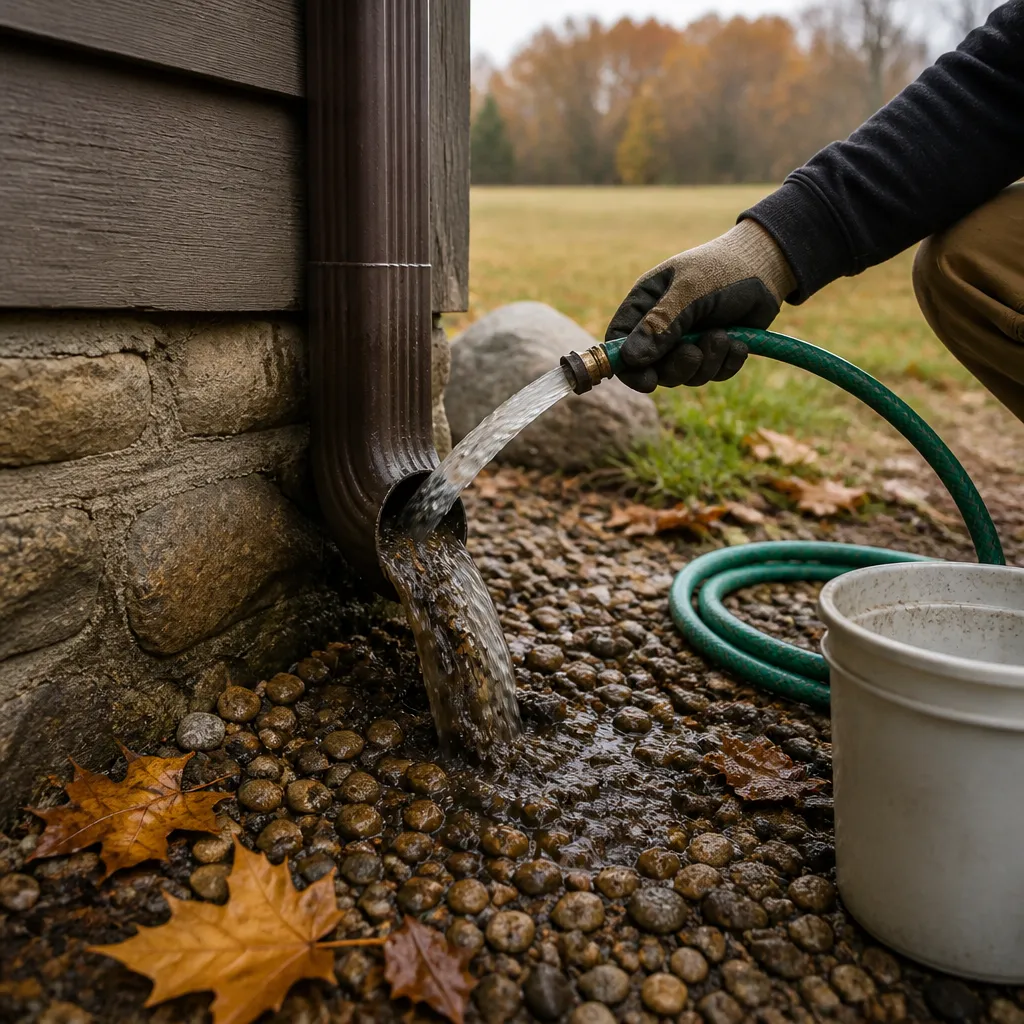
A clean trough does nothing for you if the downspout is plugged. On rural properties the downspout is often the weakest part of the system, because it runs a long way down the wall, bends at the elbow, and ends at the ground where grit and leaves collect. Treat the downspout as a separate job, not a footnote to the gutter clean.
Flushing from the top down
Remove the top elbow if you can, or insert the hose into the opening at the top and run water at full pressure. A plug at the elbow usually clears within seconds once you can see it. If water backs up at the top, the blockage sits in the first few feet, and you can probe it with a flexible rod rather than forcing the hose.
Pro tip: Keep a length of stiff wire or a flexible drain rod in the garage. A rod clears a packed elbow in a few minutes, while a hose alone can just push the plug further into the pipe.
Checking the outlet at grade
Look at where each downspout discharges. Water should leave the house and land on ground that slopes away, not on the foundation, a window well, or the path to the front door. If the outlet is buried under mulch or gravel, lift the material and clear the spot so the water has an exit.
Splash blocks and extensions
A splash block or a flexible extension moves water away from the wall. Flexible extensions are easy to pull out before a hard freeze and put back in spring, while rigid ones suit a permanent fixture. Whichever you choose, make sure it points away from the foundation and sits where a lawnmower or snowblower won’t catch it.
Rural Safety: Ladders, Soft Ground, and Working Alone
Rural properties carry more risk than most people expect. The house may be a long walk from the nearest neighbour, the ground may be soft or uneven, and the ladder may be the only thing between you and a fall onto gravel. Plan the job around those conditions before you start.
Setting up on uneven ground
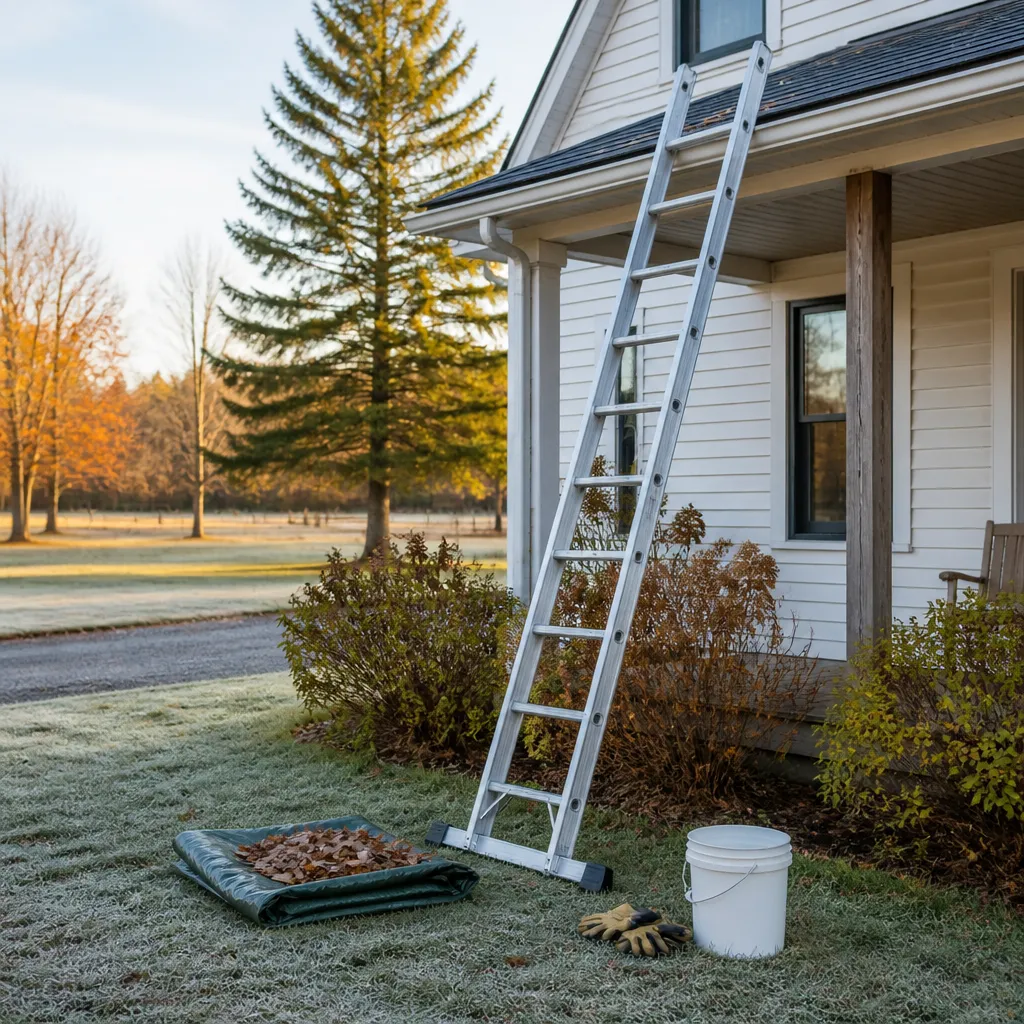
Ladder feet should sit on firm, level ground. Soft soil, wet grass, and sloped lawns shift under load, and a ladder that settles even a few centimetres can throw you off balance at the top. Use levelling feet or a stable base if you have them, and never stand on the top rung or the step directly below it.
Why you should not work alone
A second person does two jobs: they steady the base, and they can call for help if something goes wrong. If you cannot get a helper, keep your phone on you, tell someone where you are working, and avoid reaching sideways from the ladder. Reaching sideways is the habit behind most of the close calls we see on rural jobs, so move the ladder instead.
Working around wet weather and short days
Late autumn daylight fades quickly, and wet trough sections are slippery. Stop before dusk, and never work on a ladder in rain or right after a storm. If weather forces a reschedule, a dry day later in the week is a better plan than finishing in a rush.
DIY, Hand Service, and Professional Cleaning Compared
Homeowners usually choose between three approaches. Each one works, but each fails in a different place. Kärcher’s guide recommends professional gutter cleaning tools over a ladder, bucket, and brush, and describes the hand method as labour intensive. The table below shows where each approach fits on a rural property.
| Approach | Best for | Main trade-off |
|---|---|---|
| DIY with ladder, scoop, and hose | Single-storey homes with short runs and little tree cover | Slow on long runs, and the ladder work carries the most risk |
| Hose-and-flush only | Properties cleaned last season that have light debris | Misses packed leaves and grit in the trough, so downspouts can still block |
| Full professional cleaning with flush and visual check | Two-storey homes, heavy tree cover, and properties with gravel approaches | Costs more than a DIY job, so it pays off most where the debris load is highest |
Our view is that DIY works well for a small, low-debris house, but most rural properties are not that house. The hose-only approach is the trap. It makes the trough look clear while the downspout stays packed, and the first real storm exposes the gap.
The professional route makes sense when height, tree cover, or a long run makes the job unpleasant. The one thing to insist on is a flush and a visual check of every outlet, not just a scoop of leaves. Ask whether downspouts are included in the quote before you book.
Fall Inspection Items to Add to the Checklist
Cleaning exposes problems that were hidden under the debris. Use the visit to inspect the whole system, because a sagging section or a loose hanger is far cheaper to fix in November than after a snowfall. COUNTRY Financial’s checklist also recommends clearing roof valleys of leaves and branches, since debris there feeds straight into the eavestrough. Look up at the roof while the ladder is already in place.
Hangers and fasteners
Check each hanger for a bend, a loose screw, or a gap between the bracket and the fascia. Give the trough a firm push by hand. If it moves more than a little, the hangers are the problem, and they should be tightened or replaced before winter.
Seams, joints, and end caps
Look for drips at the seams, especially at corners and at joints where two sections meet. Water staining down the siding below a joint usually means a failed seal. End caps loosen over time, and a missing cap sends water off the end of the run instead of into the downspout.
Fascia and soffit staining
Dark streaks or soft spots on the fascia board show that water has been overshooting the trough. Note any staining now, then repair it in spring once the wood is dry. Staining below the trough is often the first sign that a downspout is not carrying its load.
Frequently Asked Questions
How often should eavestrough be cleaned on a rural Fenwick property?
Once a year is the minimum. Kärcher’s guide notes that trees or a wooded area nearby can mean more than one cleaning a year, so a wooded lot may need a late-autumn visit plus a light spring check for needles and seed pods.
When is the best time for late-season eavestrough cleaning?
The best window is after most leaves have fallen and before the first frost and snowfall. Book once the bulk of leaf drop is done, then aim for a dry day so the trough and downspouts are empty before freezing weather arrives.
Is gutter cleaning the same as eavestrough cleaning?
They describe the same job: clearing the channel along the edge of the roof that carries rainwater to the downspouts. Eavestrough is the more common term in Canada, which is why local homeowners search for it, but the cleaning steps are identical.
Can I clean eavestrough myself, or should I hire someone?
You can do it yourself on a single-storey home with short runs and no heavy tree cover. Once height, debris load, or a gravel approach makes the job long or risky, a professional visit with a proper flush is usually the better value. Either way, do not skip the downspouts.
What happens if eavestrough is not cleaned before winter?
A packed trough holds water and debris through freezing weather, which adds weight to hangers and can damage the fascia. Blocked downspouts send water over the edge and toward the foundation, and the thaw in spring is when that damage shows up.
Does eavestrough cleaning include the downspouts?
It should. A clean trough with a blocked downspout still fails in the first heavy rain. Ask whether the quote includes flushing each downspout and checking its outlet, and do not accept a scoop-only job as complete.
What tree or grit problem gives your rural property the most trouble each autumn, and how do you handle it?