
Every fall in Hamilton, the same thing happens. Leaves pile up in eavestroughs faster than most homeowners expect, water backs up against fascia boards, and by the time the first freeze hits, the damage is already underway. Eavestrough cleaning in Hamilton is not an optional chore you can shuffle off until spring. The Niagara Escarpment, the Dundas Valley tree canopy, and Hamilton’s significant stock of mature urban trees create one of the most demanding gutter environments in southern Ontario. If your eavestroughs are blocked going into November, you are setting up your home for ice dams, foundation water intrusion, rotted soffits, and a repair bill that dwarfs the cost of a cleaning.
Table of Contents
- Quick Takeaways
- Why Hamilton Is Particularly Hard on Eavestroughs
- Signs Your Eavestroughs Need Cleaning Now
- What Happens When You Skip Fall Cleaning
- Eavestrough Cleaning Methods Compared
- How to Prepare Your Home for the Cleaning
- Fall Eavestrough Maintenance Checklist for Hamilton Homeowners
- Cost of Eavestrough Cleaning in Hamilton
- Frequently Asked Questions
- References
Quick Takeaways
| Key Insight | Explanation |
|---|---|
| Clean after the main leaf drop, before hard frost | In Hamilton, the optimal window is typically the first two weeks of November, after peak leaf fall but before overnight temperatures lock into consistent freezing. |
| The Dundas Valley and Escarpment areas generate the most debris | Homes near Cootes Paradise, Westdale, and Dundas face heavier maple and oak leaf loads than lower-city properties, often requiring cleaning twice in fall alone. |
| Clogged eavestroughs cause ice dams, not just overflow | Backed-up water that freezes expands inside the trough and under shingles, causing structural damage that a simple cleaning cannot fix after the fact. |
| Downspout blockages are the most common missed problem | A trough can look clean from the ground while a packed downspout sends water pouring back over the edge. Always flush downspouts, not just clear the channel. |
| Professional cleaning reveals repair needs you cannot see | Sagging sections, separated joints, and failed sealant are typically spotted during a cleaning visit. Catching these in fall is far cheaper than an emergency repair in January. |
| Hamilton’s pre-1985 housing stock has undersized troughs | Older Hamilton homes often have 4-inch troughs that cannot handle the volume of fall rainfall combined with leaf debris, making regular cleaning even more important. |
| Foundation damage is the costliest downstream consequence | When overflowing water saturates the soil around your foundation repeatedly, it leads to hydrostatic pressure, cracking, and basement moisture problems that cost far more than a cleaning schedule ever would. |
Why Hamilton Is Particularly Hard on Eavestroughs
Hamilton is not a generic Ontario city when it comes to eavestrough stress. The city sits at the base of the Niagara Escarpment, which the United Nations Educational, Scientific and Cultural Organization (UNESCO) has designated a World Biosphere Reserve. That designation tells you something useful about the scale of the urban forest. Neighbourhoods like Westdale, Dundas, Ancaster, and the areas bordering Cootes Paradise have dense, mature canopies of maples, oaks, and other deciduous species that drop enormous volumes of organic debris from mid-September through late November.
The Escarpment itself creates a weather dynamic that amplifies the problem. Properties on “the Mountain” receive different precipitation patterns and wind exposure than lower-city homes, meaning debris accumulation is less predictable. What this means practically: a homeowner in Dundas may need to clear their eavestroughs twice during fall, once after the early leaf drop in October and again after the main drop in November. A home in the East End near the industrial corridor may only need one visit, but that visit still matters.
Hamilton’s housing stock adds another layer. A significant portion of the city’s residential properties were built before 1985, many with original 4-inch eavestroughs that were not sized for modern rainfall intensity events. As climate-related rainfall becomes more variable, those undersized troughs overflow faster when even partially blocked.
Fall in southern Ontario is the season when your eavestroughs do the heaviest work. As those leaves fall, troughs clog up fast. If they are not cleared before the snow and ice arrive, you risk leaks, ice dams, destroyed eavestroughs, and water damage that can spread from your roof right down to your foundation.
Signs Your Eavestroughs Need Cleaning Now
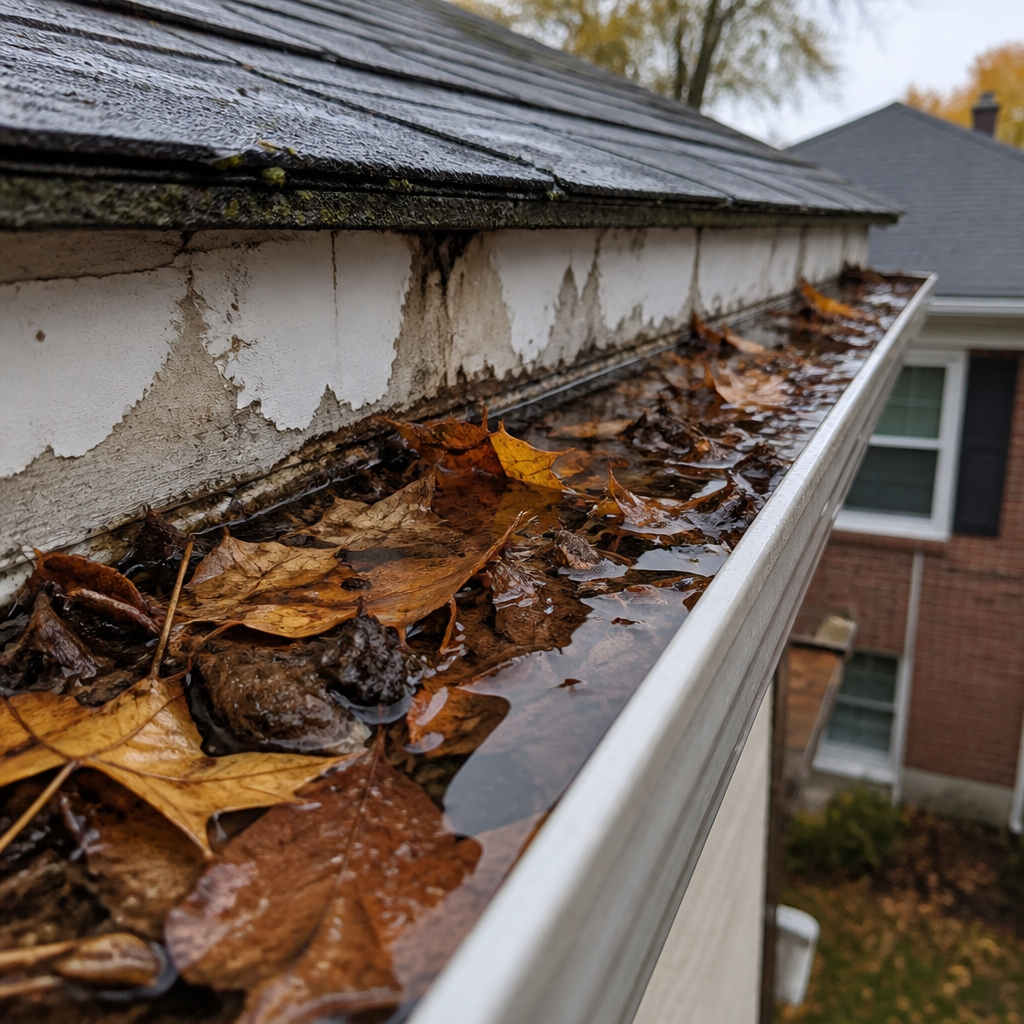
Do not wait for visible overflow to tell you your troughs are blocked. By the time water is cascading over the edge during a rainstorm, the clog has usually been building for weeks and the standing water behind it has already started working on your fascia boards.
What to look for from the ground
Walk around your home after a rainstorm and watch the eavestroughs. Water should be exiting through downspouts at a steady rate during and after rainfall, not sitting in the channel, not pouring over the front lip, and not dripping through joints. Any of those patterns indicates a partial or full blockage.
Look at the fascia boards behind the trough. Staining, soft spots, or paint peeling away from the wood directly behind the channel is a sign that water has been sitting against the fascia long enough to begin rot. This is damage that a cleaning will not reverse, but stopping the cause prevents it from worsening.
What to look for after the leaves come down
Visible debris mounding above the trough lip is the obvious sign. But look also for plant growth. Compacted organic matter in a trough that has gone a full season without cleaning will begin to support weed growth, and those roots work their way into joints and seams. If you see green sprouting from your gutters, the system needs immediate attention.
Check the soil around your downspout discharge points. If the ground is consistently saturated after rainfall, even when surrounding areas are not, the downspout is either blocked and sending water backward or is discharging in an area with no runoff path, which directs water toward your foundation.
Pro tip: Check your basement walls and window wells after every significant October or November rainstorm. Basement seepage that appears in fall is often traced back to eavestrough overflow or a blocked downspout, not a foundation crack. Fixing the eavestrough fixes the seepage.
What Happens When You Skip Fall Cleaning
Skipping fall eavestrough maintenance in Hamilton is not a neutral decision. It is a decision to accept a specific set of risks. Understanding those risks precisely makes the case for cleaning more compelling than any general reminder about “home maintenance.”
Ice dams and roof damage
When a clogged eavestrough holds standing water going into December, that water freezes. The expanding ice pushes against the trough, pulls it away from the fascia, and, more damaging, works its way under the bottom course of shingles. When the roof warms from interior heat, partial thaw creates a cycle where meltwater backs up behind the ice dam and penetrates the roof deck. The interior ceiling staining and insulation damage from this process often appears in January or February, long after the fall cause is forgotten.
Fascia and soffit rot
Standing water in an eavestrough sits against the fascia board continuously. Wood fascia begins to soften and rot within a single season of this exposure. Once rot sets into the fascia, the eavestrough has no solid surface to anchor to, and the entire section needs replacement, not just cleaning. Fascia replacement in Hamilton typically costs several times more than a professional cleaning visit.
Foundation water intrusion
Overflow from blocked eavestroughs discharges directly at the base of the exterior wall, saturating the soil around the foundation. Repeated saturation builds hydrostatic pressure against foundation walls. This is a primary cause of basement moisture issues in Hamilton’s older housing stock. The foundation itself may be sound, but the water management above it is failing.
Eavestrough Cleaning Methods Compared
There is more than one way to clear a trough, and the method matters for both effectiveness and the condition you leave the system in. Here is a direct comparison of the three approaches Hamilton homeowners typically consider.
| Method | Best For | Key Limitations |
|---|---|---|
| DIY hand clearing and garden hose flush | Single-storey homes with moderate leaf load and easy ladder access | Does not flush downspouts effectively. Misses debris packed in joints and elbows. Risk of ladder falls, especially on Escarpment or Mountain properties with uneven ground. Most homeowners underestimate how much debris is left behind. |
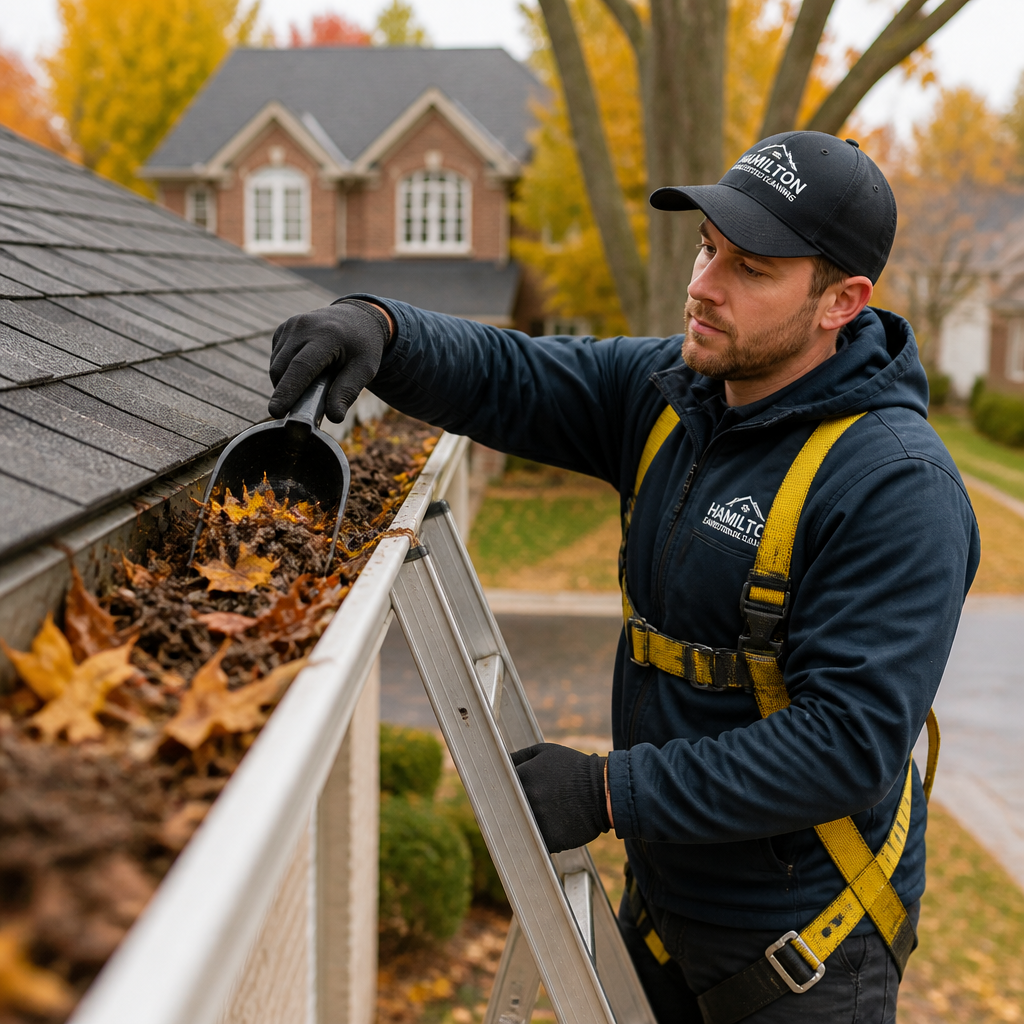
| Professional hand cleaning with pressure flush | Any residential home, especially two-storey, treed properties, and older homes with multiple downspouts | Requires scheduling in advance, particularly in October and November when demand peaks in Hamilton. Minor wait times during the fall rush are normal. This is the method that most reliably clears downspouts and identifies joint failures. |
| Gutter guard installation (as a long-term solution) | Properties near Dundas Valley, Westdale, or Cootes Paradise with very high annual debris load | Upfront cost is higher than a single cleaning. Quality varies significantly. Even well-installed guards still require periodic inspection and occasional clearing of the guard surface itself. Not a substitute for the initial fall cleaning while guards are being considered. |
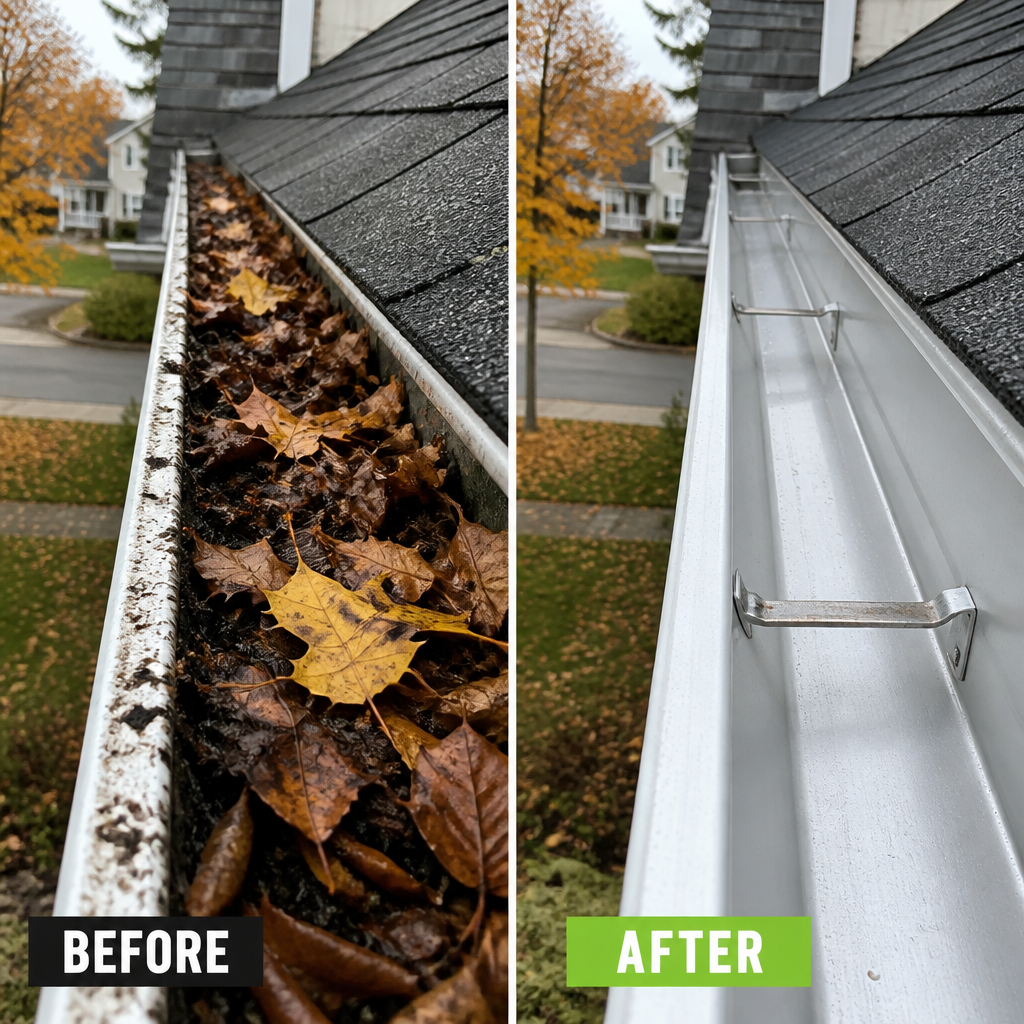
The honest answer for most Hamilton homeowners is that professional hand cleaning with a proper pressure flush of the downspouts is the most reliable single option. It clears what you cannot see from below, confirms the system is draining freely, and gives you a chance to learn about any structural issues before they worsen over winter.
Pro tip: Schedule your fall eavestrough cleaning appointment in September or early October before the peak leaf drop. Most professional cleaning services in Hamilton see their booking windows fill up in late October, and waiting until November means competing for limited availability during the exact weeks when cleaning is most urgent.
How to Prepare Your Home for the Cleaning
Getting the most out of a professional eavestrough cleaning visit takes a small amount of preparation on your part. None of it is complicated, but skipping it wastes time and can leave the crew working around avoidable obstacles.
Clear access around the perimeter
Move vehicles out of the driveway and away from the sides of the house. Technicians need clear ladder placement at multiple points around the building. Parked vehicles, garden furniture, and stored equipment along the foundation all create access problems that slow the job and, in some cases, prevent a clean from being completed safely.
Note problem areas you have observed
If you have noticed overflow at a specific corner, a section that sags visibly, or a downspout that seems to be draining slowly, note those locations before the crew arrives. A good technician will identify these independently, but pointing them out directly speeds up the inspection process and ensures nothing is attributed to a different section of the system.
Know where your downspouts discharge
Underground downspout extensions are common in Hamilton’s older neighbourhoods and are among the most common causes of blocked drainage. If your downspouts disappear into a buried pipe at grade, let the cleaning crew know. Those underground connections need to be checked for blockage separately, and not every crew checks them automatically unless instructed.
Fall Eavestrough Maintenance Checklist for Hamilton Homeowners
Use this as a practical sequence for fall, not just a list of tasks. The order matters because some problems cannot be properly assessed until earlier steps are completed.
- September: Book your professional cleaning appointment. Do not wait for leaves to fall before scheduling.
- Early October: Walk the perimeter after the first significant rainfall and check for visible overflow or staining.
- Mid to late October: First professional cleaning, particularly if your property has heavy early leaf drop from maple or oak trees (common in Dundas, Westdale, Ancaster, and Flamborough).
- Early to mid-November: Second cleaning or at minimum a professional inspection after the main leaf drop has finished. This is the critical window before overnight temperatures in Hamilton consistently drop to freezing.
- During the cleaning visit: Ask the technician to confirm that all downspouts are flushing freely and that no joints or fasteners are showing signs of failure.
- After cleaning: Check that downspout extensions direct water at least 1.5 metres away from the foundation. Reposition any splash blocks or extensions that have shifted over the summer.
- November through March: After major snowfall events, check for visible ice buildup in troughs or along the roofline. Ice that is thicker than the trough itself usually means water is backed up and re-freezing.
Pro tip: If you have power washing done on your home’s exterior in the same service season, coordinate it before your eavestrough cleaning. Power washing loosens debris on siding and around rooflines, some of which lands in the troughs. Cleaning eavestroughs after a power wash, not before, means you remove everything in a single visit.
Cost of Eavestrough Cleaning in Hamilton
Pricing for eavestrough cleaning in Hamilton in 2026 generally ranges from roughly $150 to $375 for most single-family homes, depending on the size of the home, the number of storeys, and the complexity of access. Bungalows in the lower city and East End typically land at the lower end of that range. Two-storey homes in Ancaster or Dundas, where tree debris is heavier and access is more complex, fall toward the middle to upper end. Properties on the Mountain or along the Escarpment with significant grade changes can push beyond that range.
Annual maintenance plans offered by some providers, covering two visits (spring and fall), typically work out to a lower per-visit cost than booking individual appointments. Given Hamilton’s leaf load, two visits per year is the right minimum for most properties with significant tree coverage nearby. For homes near Cootes Paradise or the Dundas Valley corridor, even that minimum may not be enough if you experience heavy early leaf drop in October.
The most important thing to understand about cost is what it is preventing. Fascia replacement, soffit repair, ice dam damage remediation, and foundation waterproofing are each substantially more expensive than any cleaning schedule. The math is straightforward: the cleaning is not a cost, it is cost avoidance.
Performance Window Cleaning serves Hamilton homeowners with professional eavestrough and gutter cleaning as part of a full exterior maintenance program. If you are looking at the fall season and wondering what else needs attention beyond the troughs, the team also handles power washing of driveways and walkways, home detailing including hand-washed siding and entrances, and bug and spider web removal. Bundling services in a single visit means your property gets a comprehensive review in the weeks when that review matters most.
Frequently Asked Questions
How often should Hamilton homeowners clean their eavestroughs?
Twice a year is the standard recommendation for most Hamilton homes: once in late spring after seed drop, and once in fall after the main leaf drop but before consistent overnight freezing. Homes near Dundas Valley, Cootes Paradise, Westdale, or any property surrounded by mature deciduous trees may need a third visit in early October to manage the earlier portion of leaf fall.
What is the best time in fall to clean eavestroughs in Hamilton?
The first two weeks of November are the optimal window for most Hamilton properties. By then, the majority of leaf fall from maples and oaks is complete, but overnight temperatures have not yet locked into consistent freezing. Cleaning in this window removes the full season’s debris before freeze-thaw cycles can turn standing water and organic matter into ice and rot. If your property has heavy early leaf drop, a first pass in mid to late October makes sense, followed by a final check in November.
Can I clean my own eavestroughs, or should I hire a professional?
Single-storey homes on level ground are manageable for a careful homeowner using a properly secured ladder, gloves, and a garden hose with strong pressure. Two-storey homes are a different situation. The risk of a ladder fall on uneven terrain, especially on Mountain or Escarpment properties, makes professional cleaning the safer and more practical choice. Beyond safety, professionals flush downspouts properly, check joint integrity, and identify repair needs that most homeowners miss during a DIY attempt.
What damage does a blocked eavestrough cause in winter?
Blocked eavestroughs in winter lead to ice dams, which form when standing water in the trough freezes, expands, and works under the bottom course of roof shingles. When the roof deck warms from interior heat, meltwater behind the dam has nowhere to go except through the roof structure. This produces interior ceiling damage, insulation saturation, and in severe cases, structural deck damage. Fascia rot from prolonged water contact and foundation water intrusion from overflow are the other primary winter consequences of an uncleared system.
Do gutter guards eliminate the need for eavestrough cleaning in Hamilton?
No. Gutter guards reduce the frequency and volume of cleaning required, but they do not eliminate it. Seed pods, shingle granules, and fine organic matter pass through or accumulate on top of even high-quality guard systems. Hamilton’s heavy fall leaf loads also push some systems to their design limits, particularly in treed areas near the Dundas Valley or Cootes Paradise. Guards are a worthwhile investment for the right property, but they need to be paired with periodic inspection and clearing, not used as a reason to stop thinking about the system entirely.
How do I know if my downspouts are blocked even after the troughs look clear?
Run a garden hose at full pressure into the eavestrough near a downspout and watch the discharge at ground level. If water exits slowly, backs up in the trough, or does not appear at all at the downspout base, you have a blockage in the downspout or its underground extension. This is one of the most common problems that gets missed in a basic DIY cleaning, because the trough itself can look clear while the vertical pipe below it is packed with compacted debris from the previous season.
Have you had your Hamilton eavestroughs cleaned this fall, or discovered a problem after the first big rainstorm? Share what you found and how you handled it in the comments.
References
- Fall eavestrough maintenance guide for southern Ontario homeowners: why cleaning before winter matters
- 2026 eavestrough cleaning cost breakdown for Hamilton, Ontario by home type and neighbourhood
- Eavestrough cleaning in Hamilton Ontario: when to clean, what to look for, and how to protect your home
- Niagara Escarpment ecology and Hamilton’s urban forest: local geology and tree canopy context