
Most homeowners install gutter guards hoping to never touch their eavestroughs again. The reality is far less convenient. Clogged eavestroughs cause an estimated $13,000 or more in water damage repairs per incident, according to the Insurance Information Institute, yet gutter guard systems fail to prevent debris buildup in the majority of real-world conditions. If you have been weighing whether to invest in professional eavestrough cleaning or install gutter guards and forget about it, this breakdown will give you the honest answer the product manufacturers will not.
Table of Contents
- Quick Takeaways
- Why Eavestroughs Matter More Than Most People Think
- How Professional Eavestrough Cleaning Actually Works
- Gutter Guards Explained: Types, Costs, and Real Performance
- Side-by-Side Comparison: Eavestrough Cleaning vs. Gutter Guards
- What Actually Fails in Practice
- The Best Approach for Canadian Homes and Businesses
- Frequently Asked Questions
- References
Quick Takeaways
| Key Insight | Explanation |
|---|---|
| Gutter guards do not eliminate maintenance | All gutter guard types still require periodic cleaning. Fine debris, seed pods, and shingle grit pass through or accumulate on top of every guard style. |
| Professional cleaning twice per year is the baseline standard | Spring and fall cleanings address the two heaviest debris seasons. Skipping one cycle allows compaction that leads to overflow and fascia rot. |
| Micro-mesh guards perform best but are not a complete solution | Micro-mesh blocks most large debris but still requires annual inspection and flushing. Cost runs $15 to $30 per linear foot installed. |
| Water damage from neglected eavestroughs is preventable | Overflowing eavestroughs saturate fascia boards, cause foundation seepage, and damage landscaping. Regular cleaning stops all three outcomes. |
| Guard installation does not void the need for gutter maintenance entirely | Many warranty claims are denied because homeowners assumed guards made maintenance unnecessary. Guards reduce frequency, not responsibility. |
| Canadian climate creates unique debris and ice dam challenges | Pine needles, maple keys, and freeze-thaw cycles stress every guard type. Annual professional inspection matters more in colder climates. |
| Combining cleaning with a guard is the most cost-effective long-term plan | A professionally cleaned eavestrough paired with a quality micro-mesh guard reduces cleaning frequency without eliminating the professional relationship entirely. |
Why Eavestroughs Matter More Than Most People Think
Eavestroughs are not decorative trim. They are the drainage infrastructure that routes hundreds of gallons of rainwater away from your foundation, siding, and landscaping every time it rains. When they fail, water finds the path of least resistance, and that path usually runs straight into your fascia boards, basement, or garden beds.
A standard Canadian home with a 1,500 square foot roof surface sheds roughly 900 gallons of water per inch of rainfall. That volume needs to go somewhere specific. Without properly functioning eavestroughs, it goes everywhere damaging.
The problem compounds in climates like British Columbia and Alberta, where spring melt and heavy fall rain overlap with decomposing leaf matter inside the trough. Wet, packed debris weighs significantly more than dry leaves, and that weight stresses gutter hangers and seams over time.

How Professional Eavestrough Cleaning Actually Works
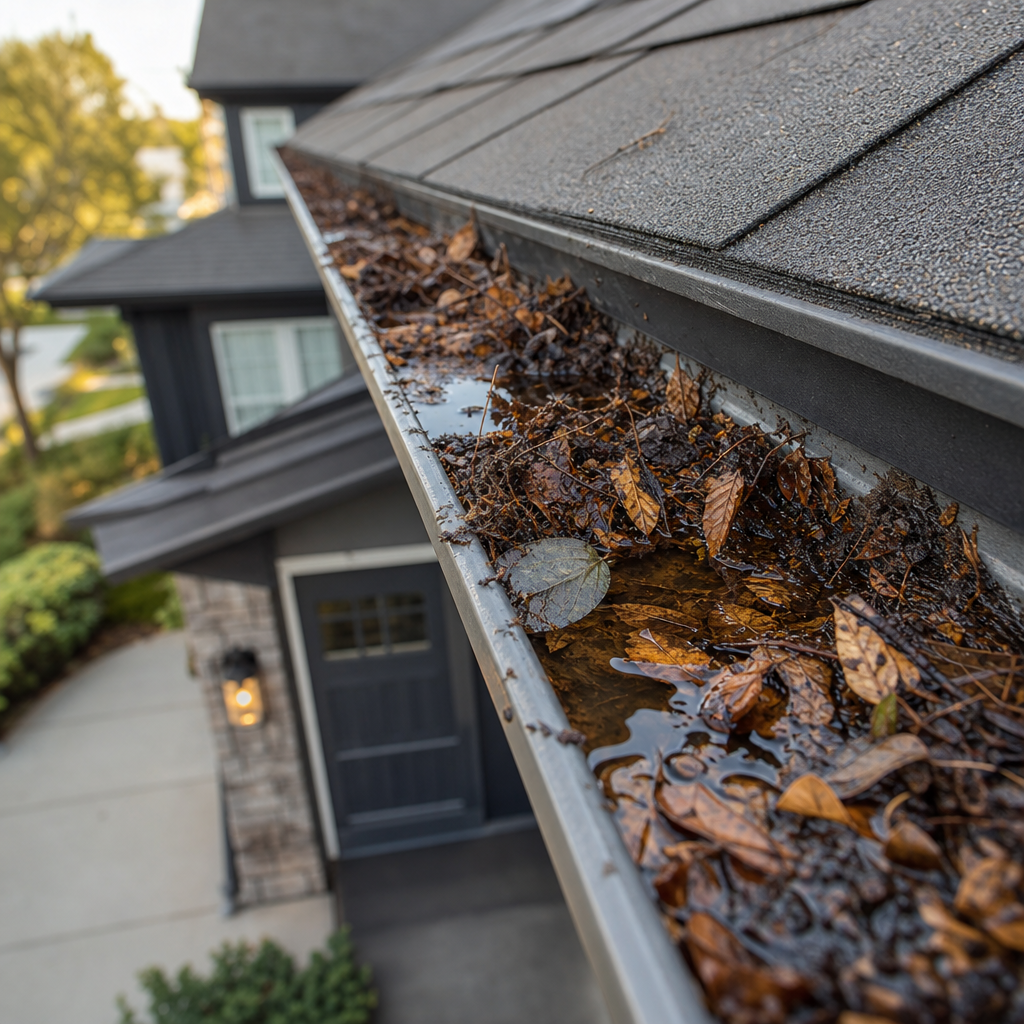
A professional eavestrough cleaning is not simply scooping out leaves. Done properly, it involves clearing all debris by hand or with a blower, flushing the entire trough system with water to confirm flow, checking downspout outlets for blockages, and inspecting seams, hangers, and end caps for early signs of damage.
What Gets Missed in DIY Cleaning
A common mistake is using a garden hose to flush debris toward the downspout without removing the bulk first. This compacts debris into the downspout elbow and creates a blockage below the visible line. DIY cleaning also rarely includes a physical inspection of hanger spacing or sealant condition at joints.
At Performance Window Cleaning, the team has been doing this since 2008 and consistently finds that homes cleaned only by the homeowner have compacted blockages at downspout bends that cause silent overflow during heavy rain events. The water appears to drain but is actually backing up and spilling over the back edge of the trough closest to the fascia.
Cleaning Frequency That Actually Protects Your Home
The industry standard is twice per year: once in late spring after seed pods and early leaf drop finish, and once in late fall after deciduous trees have fully shed. Homes within 50 feet of mature trees, particularly maples, oaks, and cedars, often need a third cleaning in midsummer.
Pro tip: Book your fall eavestrough cleaning after the majority of leaves have dropped in your area, not before. Cleaning too early means a second round of debris accumulates before winter, which is the worst time for an undetected blockage to sit and freeze.
Gutter Guards Explained: Types, Costs, and Real Performance
The gutter guard market is enormous and confusing. Products range from $0.50 foam inserts to $30 per linear foot professional micro-mesh systems, and the performance gap between them is not proportional to the price in every case. Understanding what each type actually does in real conditions is the only way to make an informed decision.
Foam Inserts
Foam inserts sit inside the trough and are meant to block debris while letting water pass through. In practice, they become a growing medium for moss, seeds, and fine grit within one to two seasons. They are nearly impossible to clean once clogged and end up being replaced, not serviced. Avoid them.
Screen and Mesh Guards
Basic screen guards at $1 to $3 per linear foot block large leaves but allow small debris like pine needles, shingle granules, and seed fragments through the mesh openings. They also sag over time when filled with standing water and debris weight. They reduce cleaning frequency marginally but do not eliminate it.
Micro-Mesh Guards
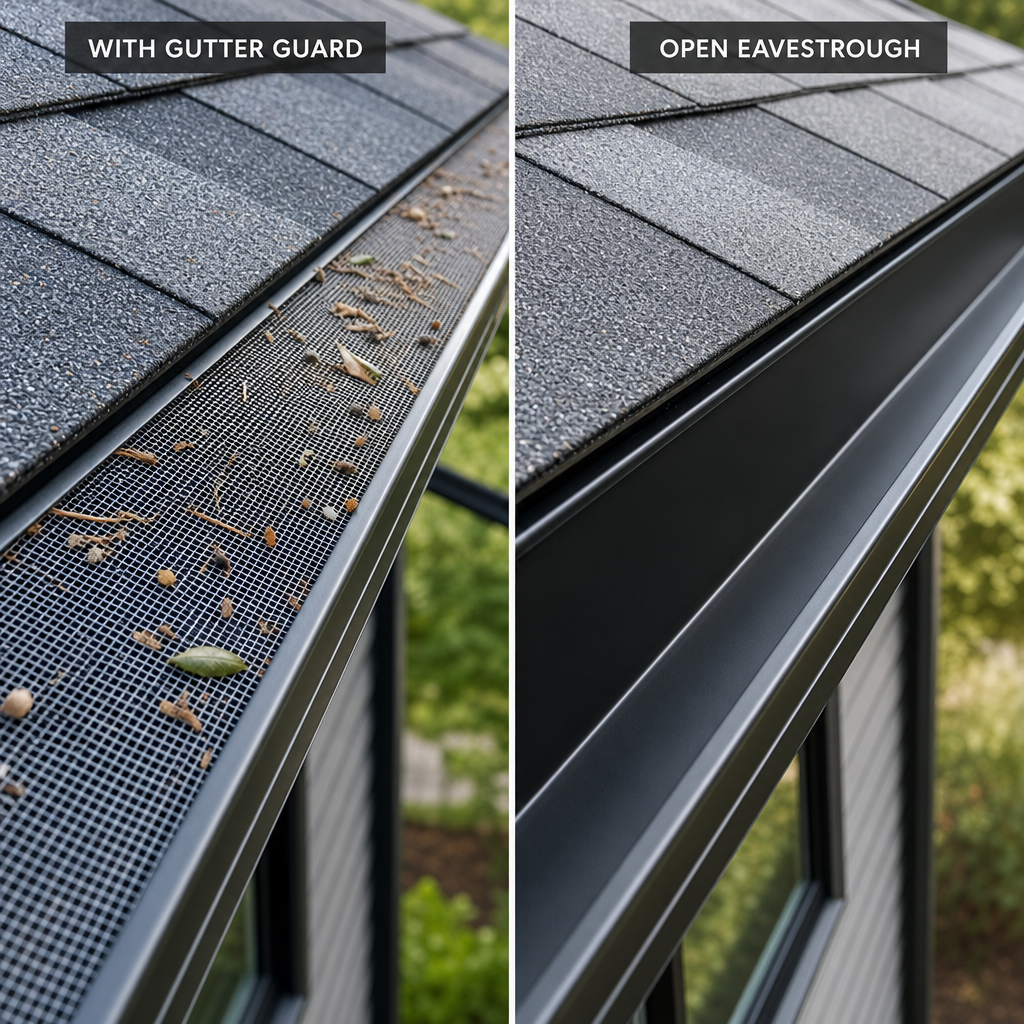
Micro-mesh systems are the most effective option currently available. They use a fine stainless steel mesh layer over an aluminum frame that blocks debris as small as shingle granules while allowing water to pass through efficiently. Brands like LeafFilter and MasterShield fall into this category. Installation costs run $15 to $30 per linear foot depending on roof pitch and linear footage.
Even micro-mesh systems need annual flushing and inspection. Surface tension from heavy rainfall can cause water to sheet over the top of the mesh rather than penetrate it, which is called the overshoot problem. This is a well-documented failure mode in high-rainfall events.
Reverse Curve and Helmet-Style Guards
Reverse curve guards are aggressively marketed but perform poorly in real Canadian conditions. They rely on water surface tension to follow the curve into the trough while debris falls away. During heavy rain, they allow water to overshoot entirely. In dry periods, debris sits on the curved surface and bakes on. They require professional removal to clean the trough underneath, which immediately undermines their advertised value.
Side-by-Side Comparison: Eavestrough Cleaning vs. Gutter Guards
This table reflects real-world performance across the most common scenarios Canadian homeowners and property managers face, not manufacturer claims.
| Factor | Professional Eavestrough Cleaning (Twice Per Year) | Micro-Mesh Gutter Guards (With Annual Inspection) |
|---|---|---|
| Annual cost (average home) | $150 to $300 per year | $1,500 to $3,000 upfront plus $75 to $150 annual inspection |
| Debris removal effectiveness | Complete removal every service visit | Significantly reduced accumulation, but not zero |
| Damage detection | Every visit includes inspection of seams, hangers, and downspouts | Requires dedicated inspection visit to see trough condition underneath |
| Ice dam interaction | Clean troughs freeze and thaw more predictably | Guards can trap ice and increase ice dam formation at eave edge |
| Maintenance responsibility | Handled entirely by service provider | Homeowner must monitor for overshoot and surface debris |
| Long-term ROI | Consistent and predictable, no large upfront expense | Positive only if guards last 10 or more years and reduce service calls |
“No gutter protection system eliminates the need for maintenance. The homeowners who experience the least water damage are those who treat gutter care as a routine service, not a one-time fix.” – National Association of Home Inspectors guidance on exterior drainage maintenance
What Actually Fails in Practice
In practice, the failures follow predictable patterns. Homeowners install guards and stop scheduling cleanings. Two or three years later, they notice water pouring over the trough edge during rain or fascia boards that have gone soft. By the time it is visible damage, the repair cost far exceeds what several years of professional cleaning would have cost.
The data consistently shows that gutter-related water intrusion claims cluster around homes with guards that were not maintained, not homes where professional cleaning was performed regularly without guards. This is not an argument against guards. It is an argument against the belief that guards replace professional service entirely.
The Specific Debris Problems Guards Cannot Solve
Shingle granules are the silent destroyer of eavestrough systems. Every asphalt roof sheds granules continuously, accelerating during the first five years and during extreme weather. These granules are too fine for any practical guard mesh to stop and accumulate at the low point of every trough run. Over time they restrict flow, abrade sealant at joints, and contribute to corrosion in aluminum troughs.
Pine needles present a second problem unique to properties with conifer trees. Their length and rigidity allow them to bridge across screen-style guards and mat together on top of micro-mesh surfaces, restricting water penetration. Properties with significant pine tree coverage should plan for at minimum one professional cleaning per year regardless of guard type installed.
Pro tip: When assessing whether gutter guards are worth the investment for your property, count the number of trees within 40 feet of your roofline and identify the species. More than three mature deciduous trees or any conifers within that radius means guards will require more maintenance than their marketing suggests.
The Best Approach for Canadian Homes and Businesses
The honest recommendation is not either-or. The most effective and cost-efficient gutter maintenance plan for most Canadian residential and commercial properties combines professional eavestrough cleaning with a quality micro-mesh guard system, while maintaining at least an annual professional inspection even after guard installation.
For properties without significant tree coverage, guards can reduce professional cleaning from twice per year to once per year. For heavily treed properties, guards reduce the volume of debris but do not meaningfully reduce service frequency. For commercial properties and rental buildings, guards introduce a maintenance variable that property managers need to track actively, which often makes a simple twice-yearly professional cleaning contract easier to manage.
What Performance Window Cleaning Recommends
Since 2008, Performance Window Cleaning has serviced eavestroughs on properties ranging from single-family homes to commercial buildings across the region. The pattern is consistent: properties that receive professional cleaning twice per year with periodic gutter flushing and downspout inspection have dramatically fewer water damage incidents than properties relying on guards alone.
If budget is the limiting factor, two professional cleanings per year outperform a one-time guard installation with no follow-up maintenance, every time. The cleaning approach also has the advantage of catching early problems like sagging hangers, open seams, and cracked end caps before they become expensive repairs.
Frequently Asked Questions
How often should eavestroughs be professionally cleaned?
The standard recommendation is twice per year, in late spring and late fall. Properties with heavy tree coverage, particularly conifers or multiple mature maples within 40 feet of the home, often benefit from a third cleaning in midsummer. Commercial properties with large roof areas and multiple downspouts should also consider quarterly inspections to catch debris accumulation before it becomes a blockage.
Do gutter guards really work, or are they mostly marketing?
Micro-mesh gutter guards genuinely reduce debris accumulation and can extend the interval between professional cleanings. Foam inserts and basic plastic screen guards are largely ineffective and often create new problems like moss growth and debris compaction inside the trough. Reverse curve or helmet-style guards perform poorly in heavy rain and are the most aggressively marketed with the weakest real-world results. The honest answer is that guard quality varies enormously and none of them eliminate the need for maintenance entirely.
What happens if you never clean your eavestroughs?
Neglected eavestroughs overflow during rain events, saturating the fascia boards and soffit behind the trough. Fascia rot is the first visible consequence, typically appearing within two to three years of consistent overflow. Foundation seepage follows when overflow runs down the siding and pools against the foundation rather than being directed to downspout extensions. Landscaping erosion and basement moisture are the next consequences. Cumulative repair costs routinely exceed $5,000 to $15,000 and can exceed $30,000 when foundation waterproofing is involved.
Can I clean my own eavestroughs instead of hiring a professional?
Homeowners can handle basic debris removal if they are comfortable working on a ladder and have the right tools. The limitation of DIY cleaning is that most homeowners do not flush the full trough and downspout system with enough water pressure to confirm clear flow, and they rarely inspect hanger condition, sealant integrity, or downspout elbow blockages. A professional cleaning includes these checks as standard, which is what makes the service worth the cost beyond just the debris removal itself.
Will gutter guards void my eavestrough warranty?
Some eavestrough manufacturers specify that aftermarket products installed inside or over the trough can void the trough warranty. This is particularly relevant for snap-in foam inserts and certain screen systems that create standing water conditions. Before installing any guard system, check the warranty documentation for your existing eavestroughs. Micro-mesh systems installed over the top of the trough by professional installers are less likely to conflict with trough warranties, but confirmation in writing from the installer is the only reliable protection.
How much does professional eavestrough cleaning cost in Canada?
Professional eavestrough cleaning for a standard single-family home typically ranges from $75 to $200 per visit depending on linear footage, roof pitch, number of stories, and the volume of debris present. Twice-yearly service contracts often include a small discount over individual visit pricing. Commercial properties are priced by linear footage and complexity. Properties that have not been cleaned in several years often incur a one-time additional charge for heavy debris removal at the first visit.
If you have had gutter guards installed or are currently weighing whether to book a professional eavestrough cleaning, share your experience below. What worked, what did not, and what do you wish you had known before making the decision?
References
- United States Environmental Protection Agency guidance on stormwater and residential drainage management
- National Association of Certified Home Inspectors resources on exterior drainage and eavestrough inspection standards
- Statista data on home improvement and exterior maintenance spending trends in North America
- Forbes Home coverage of gutter guard product reviews and cost analysis for homeowners
- HGTV editorial guidance on residential gutter maintenance schedules and seasonal exterior care