
Rural properties in Fenwick, Ontario come with a specific kind of grime problem that most generic cleaning guides simply do not address. Sitting in the Niagara Region within the Town of Pelham, Fenwick homes are surrounded by farmland, mature tree lines, and the kind of organic debris that builds up fast and punishes neglect hard. If your soffits are laced with spider webs, your gutters are packed with leaf matter from nearby windbreaks, and your siding wears a stubborn green film every spring, you are not alone. Exterior cleaning in Fenwick, Ontario requires a rural-specific approach because the challenges here are simply different from those facing homeowners in more urbanized areas. This guide is written for Fenwick homeowners who want to protect their investment and keep their properties looking sharp through every Ontario season.
Table of Contents
- Why Rural Properties Need a Different Cleaning Approach
- Quick Takeaways
- Seasonal Exterior Cleaning Calendar for Fenwick Homeowners
- Gutter and Eavestrough Cleaning in a Tree-Heavy Environment
- Siding, Algae, Mould, and Soft Washing: What Rural Homes Face
- Power Washing: Driveways, Decks, and Walkways
- Bug, Spider Web, and Pest Control for Rural Exteriors
- Window Cleaning for Rural Ontario Homes
- Cleaning Method Comparison
- Frequently Asked Questions
- References
Why Rural Properties Need a Different Cleaning Approach
Fenwick is a compact rural community in the Niagara Region, embedded in agricultural land with mature vegetation and proximity to the Niagara Escarpment corridor. That geography creates a very particular exterior cleaning environment. Properties here tend to sit on larger lots with significant tree coverage and farmland dust exposure, meaning that the organic load landing on your home every season is dramatically higher than what accumulates on a subdivision property in a more urban setting.
The combination of field dust, pollen, tree sap, leaf debris, and high moisture levels from the region’s agricultural landscape means that algae, mould, and mildew develop faster and cling harder to siding, soffits, decks, and window frames. Neglecting even one cleaning season on a rural Fenwick property can mean the difference between a quick wash-down and a serious remediation job.
Rural homes also face a pest pressure that urban homes simply do not. Spiders, wasps, and other insects move freely between field and structure. Web buildup on eaves, soffits, entrances, and window frames happens within weeks of a clean, not months. Ticks and mosquitoes are a genuine seasonal concern for properties near agricultural fields and wooded lot lines. A cleaning plan that ignores pest-related exterior buildup is an incomplete plan.
Quick Takeaways
| Key Insight | Explanation |
|---|---|
| Clean gutters at least twice a year | Fenwick’s tree coverage and proximity to agricultural fields means gutters clog faster. Spring and fall cleanings are the minimum for rural properties. |
| Algae grows faster in shaded, moist rural conditions | The Niagara Region’s moisture levels and tree canopy overhead accelerate green film growth on siding. Waiting too long means harder removal and potential surface damage. |
| Spider and insect webs need removal every season | Rural proximity to fields and wooded lot lines means heavy web and nest buildup on eaves, soffits, and window frames. This is not a once-a-year job. |
| Power washing is not the right method for all surfaces | High pressure damages vinyl siding and older wood. Soft washing with appropriate solutions protects surfaces while eliminating organic growth. |
| Window cleaning requires a full-system approach | Cleaning glass without cleaning sills, tracks, and screens leaves grit behind that accelerates glass scratching and seal degradation. |
| Fall is the most critical cleaning window | Getting gutters, windows, and siding clean before freeze-up prevents ice damming, mould overwintering, and spring damage. |
| Home detailing protects more than just appearance | Hand-washing siding, doors, and entrances removes the fine agricultural dust and organic film that degrades paint, caulking, and wood finishes over time. |
Seasonal Exterior Cleaning Calendar for Fenwick Homeowners
Rural Ontario homes do not follow the same seasonal cleaning rhythm as city homes, and Fenwick is no exception. The area experiences sharp transitions between seasons, with spring bringing heavy pollen loads from surrounding orchards and fields, summer delivering heat that bakes organic film onto surfaces, fall dumping significant leaf and seed debris into gutters, and winter creating freeze-thaw conditions that stress every exterior surface.
Spring Cleaning Priorities (April to June)
Spring is the first critical window. Once temperatures are consistently above 5°C and there is no freeze overnight, exterior cleaning becomes both safe and effective. The priority order for Fenwick properties in spring is: gutters and eavestroughs first, then siding, then windows, then driveways and walkways.
Spring gutter cleaning clears the debris left by fall leaf drop and winter storms. Do not skip this step, because blocked gutters during spring rains push water behind fascia boards and into soffits, which creates exactly the moist, dark conditions that feed mould growth on siding. After clearing the gutters, a full siding inspection and wash-down will reveal the winter’s damage, including the early green film that starts developing as soon as moisture levels rise.
Pro tip: Book your spring exterior clean after the main pollen dump settles, typically mid-May in the Niagara Region. Cleaning too early means a fresh pollen coat lands on clean glass and siding within a week, which wastes the visit.
Fall Cleaning Priorities (September to November)
Fall is arguably the more important of the two main cleaning seasons for Fenwick rural properties. Gutters need to be cleared after the major leaf fall is complete but before the ground freezes. Blocked gutters in winter cause ice dams, and ice dams cause roof and soffit damage that is expensive to repair.
Windows cleaned in fall benefit from a full season of clearer light through winter. Siding washed in fall removes the summer’s accumulated organic film before it freezes in place and becomes harder to address in spring. This fall-clean approach is the single most protective step a Fenwick homeowner can take for the long-term health of their home’s exterior.

Gutter and Eavestrough Cleaning in a Tree-Heavy Environment
Eavestrough cleaning is where rural Fenwick homeowners most often underestimate the workload. Properties with mature trees on or adjacent to the lot line deal with a constant cycle of leaf matter, seed pods, sap, and organic sludge accumulating in gutters. On a standard suburban property, twice-yearly cleaning is usually enough. On a property surrounded by mature maples, walnuts, or evergreens, three cleanings per year may be needed.
The signs of a blocked eavestrough are easy to read if you know what to look for. Water overflowing at a fixed point during rain, streaking on siding directly below a gutter section, and visible plant growth sprouting from gutters are all indicators that cleaning is overdue. In Fenwick’s clay-heavy soil conditions, the moisture from overflowing gutters also softens the ground near the foundation, creating a drainage problem that compounds quickly.
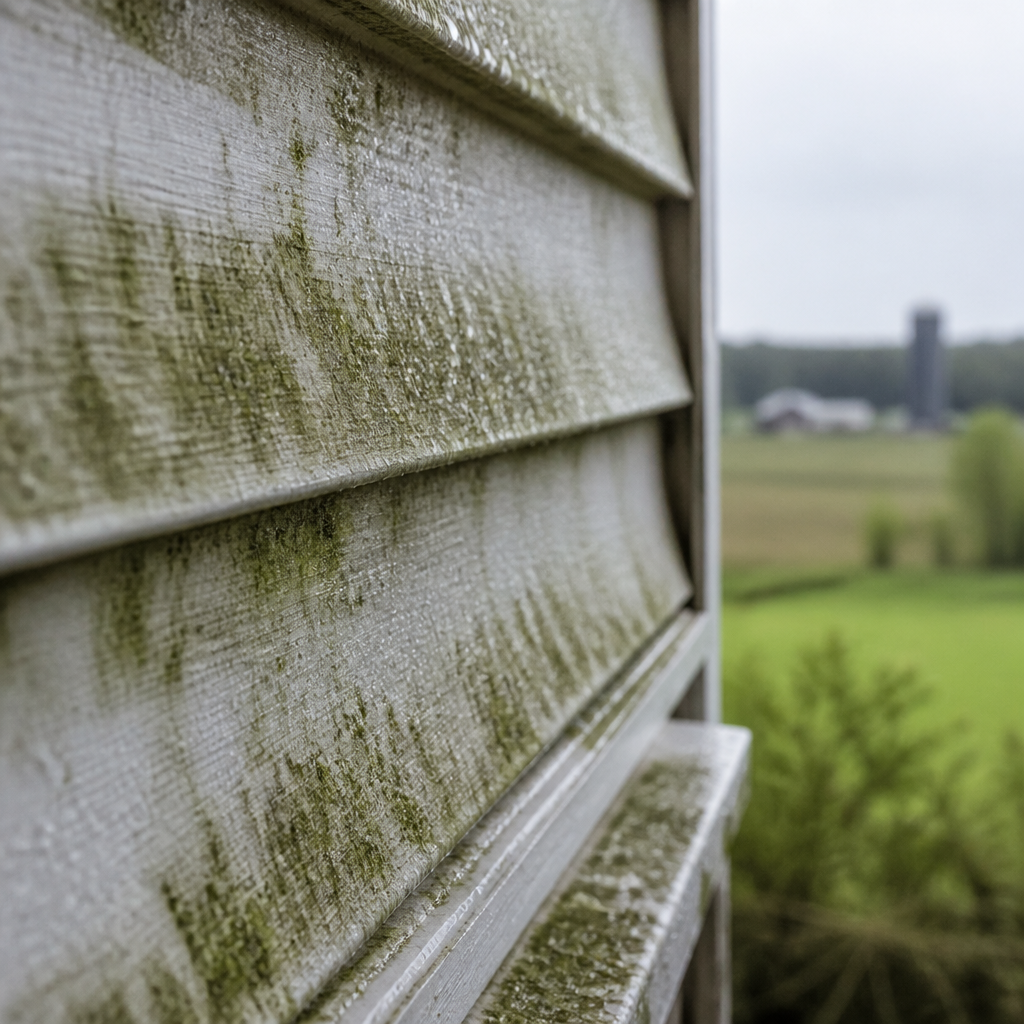
Overflowing gutters are a primary cause of moisture-driven algae growth down siding faces. The connection between neglected gutters and siding degradation is direct, not speculative.
Proper eavestrough cleaning on a rural property means removing all debris from the gutter channel, flushing the downspout to confirm it is clear, and inspecting the hangers and end caps while the ladder is up. A cleaning that does not include a downspout flush is only half a job. Blocked downspouts are just as damaging as blocked gutters because water backs up and has nowhere to go during a heavy rain event.
Pro tip: After any significant summer storm, walk your property and look up at your gutters. Storms pull leaf matter and debris from surrounding trees and can partially block a gutter in a single event, even if you cleaned in spring. A mid-summer inspection costs nothing and can prevent real damage.
Siding, Algae, Mould, and Soft Washing: What Rural Homes Face
The green and black film that develops on siding is one of the most common exterior complaints from rural Ontario homeowners, and Fenwick properties are particularly susceptible. The Niagara Region’s moisture levels, combined with the shade created by mature trees and agricultural vegetation, create near-ideal conditions for algae and mould to establish on north-facing walls and in areas that do not get full afternoon sun.
Algae and mould are not just cosmetic problems. Left untreated, they trap moisture against siding surfaces and accelerate the breakdown of paint, caulking, and in some cases the siding substrate itself. On wood or engineered wood siding, the damage timeline is faster. On vinyl, the cosmetic impact comes first, but mould in tight spaces like corner trim, window channels, and soffit joints can still cause structural moisture issues.
Soft Washing vs. Pressure Washing for Siding
The most common mistake rural homeowners make when tackling siding themselves is using high-pressure washing. High pressure removes surface grime but does not kill the biological organisms causing the growth, meaning the green film returns faster. It can also drive water behind siding panels, into gaps around window frames, and under soffit panels, creating internal moisture problems worse than the original staining.
Soft washing uses lower water pressure combined with appropriate cleaning solutions that kill algae and mould at the root. The result lasts longer and does not risk surface or structural damage. For Fenwick homeowners with vinyl, fiber cement, or wood siding, soft washing is the correct method for biological growth removal.
Power Washing: Driveways, Decks, and Walkways
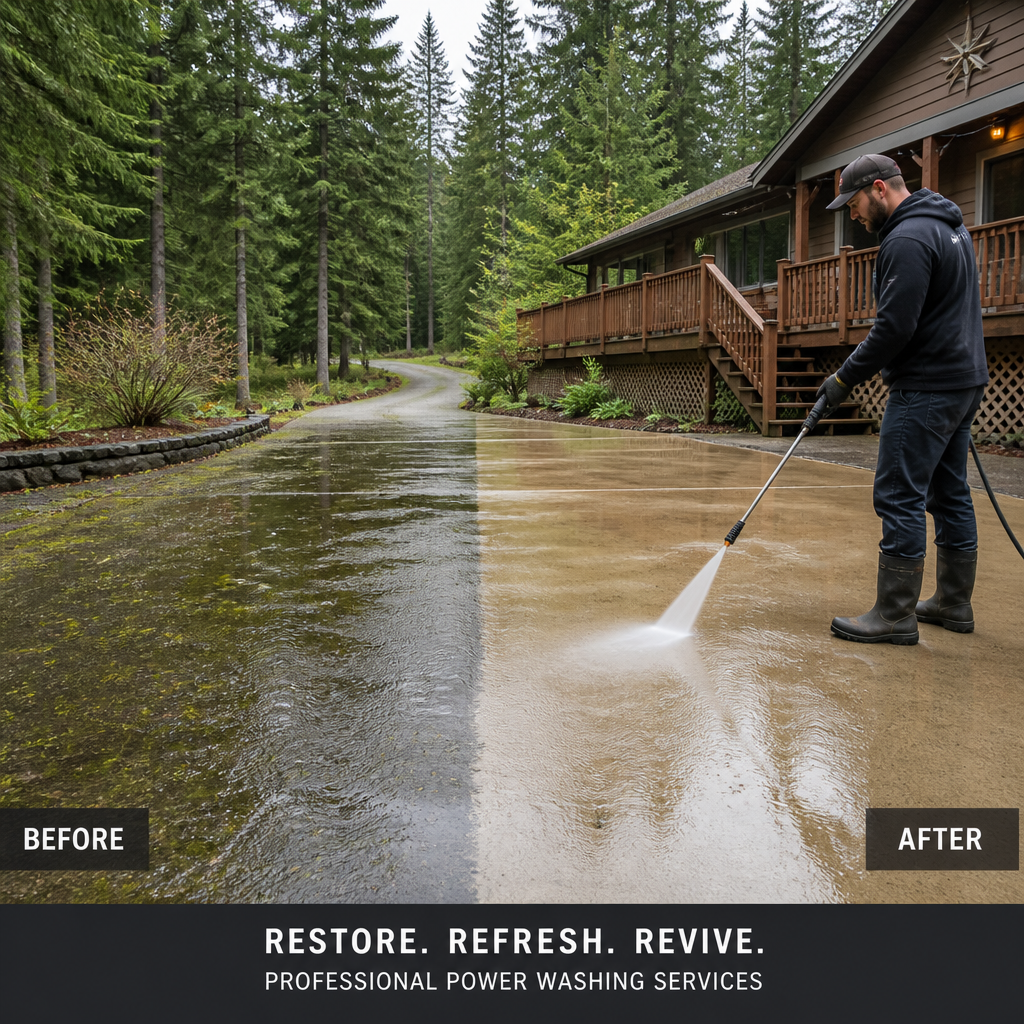
Power washing is the right tool for hard surfaces. Concrete driveways, paved walkways, and wooden or composite decks accumulate a very specific kind of grime in a rural environment: a combination of agricultural dust, organic debris, and moisture-driven discoloration that makes surfaces look far older than they are. On a Fenwick property where a gravel road or farm access lane runs nearby, that dust load is even higher.
Concrete driveways and walkways benefit from annual power washing, ideally in spring to remove winter salt and grit before it continues to pit and degrade the surface. Decks need pressure washing calibrated to the deck material. Composite decks require lower pressure than wood, and wood decks require careful technique to avoid raising the grain or leaving streaking marks. A common mistake is using a standard fan tip on a wood deck and running it too slowly, which leaves visible track lines in the wood surface.
For Fenwick properties with long paved driveways, surface staining from organic matter falling from overhanging trees is a persistent issue. Tannins from walnut trees, in particular, leave dark staining on concrete that requires appropriate pre-treatment before pressure washing to lift effectively. Knowing what is causing the stain shapes how it gets cleaned.
Bug, Spider Web, and Pest Control for Rural Exteriors
This is the section that Fenwick homeowners most often discover they need after their first summer in a rural property. The insect and spider activity around rural homes in the Niagara Region is simply not comparable to what urban or suburban homeowners deal with. Fields, wooded lot lines, and the Niagara Escarpment corridor nearby all contribute to very active pest pressure throughout the warm-weather months.
Spider web buildup on eaves, soffit vents, window frames, porch ceilings, and entry doors is one of the most visible and persistent rural exterior cleaning challenges. Webs build fast, trap dust and debris quickly, and left long enough create the kind of layered, dusty buildup that is difficult to remove without marking the surface underneath. Routine web removal at least twice per season keeps this manageable.
Tick and Mosquito Control on Rural Properties
Tick and mosquito populations in rural Niagara Region properties are a legitimate health concern, not just a nuisance issue. Properties bordering fields, hedgerows, or wooded areas see the highest tick activity. Mosquito populations near standing water in ditches, low areas of the property, or even clogged gutters can reach levels that make the outdoor use of a property genuinely unpleasant from late spring through early fall.
Exterior spraying for ticks and mosquitoes, applied to the perimeter of the property and key high-activity zones, provides meaningful protection. This is a service that pairs logically with a full spring exterior clean, because addressing the biological load on the home’s surfaces and the pest activity around it in a single visit is more efficient than treating them separately.
Window Cleaning for Rural Ontario Homes
Rural windows accumulate a specific combination of grime: fine agricultural dust, pollen, insect residue, and hard water deposits from rain running through mineral-rich roof runoff. This combination leaves a haze on glass that is different in character from city pollution film, and it is often more stubborn because the mineral and organic content bonds to the glass at a molecular level over time.
Effective window cleaning on a rural Fenwick property is not just about the glass. Sills accumulate debris, dead insects, and mould that, if not cleared before washing the glass, immediately re-contaminates the clean pane. Tracks fill with grit that prevents windows from sealing properly. Screens trap pollen and fine dust that turns into a paste when wet. A complete window cleaning service addresses all four elements: glass, sills, tracks, and screens.
For interior window cleaning, the concern is different. Interior glass in rural homes often shows fine dust infiltration from gaps around older window frames, and in homes with wood-burning fireplaces or older heating systems, a light smoke film can develop on interior glass over winter. Interior cleaning paired with exterior cleaning provides a full picture of the window’s condition and makes any seal failures or crack infiltration immediately visible.
Cleaning Method Comparison
| Method | Best For | Not Recommended For |
|---|---|---|
| Soft Washing (low pressure + solution) | Vinyl siding, fiber cement siding, painted wood siding, soffits with algae or mould growth | Hard concrete surfaces, heavily stained driveways, oil stains |
| Power Washing (high pressure water) | Concrete driveways, paved walkways, stone surfaces, composite and wood decks (with correct tip and technique) | Vinyl siding, painted wood, window frames, any surface with gaps or penetrations where water intrusion is a risk |
| Hand Detailing (manual wash with appropriate solutions) | Entry doors, decorative surfaces, areas around lighting fixtures, siding in proximity to windows or trim where pressure risk is high | Large open surfaces where coverage speed matters, concrete or paved areas with heavy biological staining |
Frequently Asked Questions
How often should Fenwick homeowners clean their gutters?
At minimum, twice per year: once in late spring after the main pollen and seed drop, and once in late fall after the majority of leaves have come down but before ground freeze. Properties with heavy tree coverage directly overhead, particularly maples or walnuts, may need a third cleaning in midsummer or after major storms. The key signal is any visible overflow during rainfall, which means the system is already partially blocked.
What causes the green film on siding, and is it actually damaging?
The green film is algae, a photosynthetic organism that thrives wherever moisture and organic material are present. In Fenwick’s rural environment, it develops faster than on urban homes because of higher ambient moisture, shading from trees, and organic debris from surrounding fields and vegetation. Yes, it is damaging over time. Algae retains moisture against the siding surface, which degrades paint and caulking, and in wood-based siding can penetrate into the substrate and cause rot. Removing it promptly and addressing the underlying moisture conditions is the correct response.
Is power washing safe for all exterior surfaces on a rural home?
No. High-pressure washing is appropriate for concrete driveways, paved walkways, and decks when used with the correct nozzle and technique. It is not appropriate for vinyl siding, painted wood, window frames, or any area where water intrusion behind the surface is a risk. Soft washing with appropriate cleaning solutions is the safer and more effective method for siding and biological growth. The distinction matters because using the wrong method can create moisture damage worse than the original problem.
Why do spider webs build up so fast on rural properties?
Rural properties border the habitats that spiders actively hunt in: fields, hedgerows, wooded lot lines, and tall grass areas. Spiders follow insects, and insect activity around a rural home is significantly higher than around an urban property. Eaves, soffit vents, window frames, and porch areas provide ideal anchoring points. Web removal does not eliminate the spiders themselves, which is why pairing web removal with perimeter pest treatment produces longer-lasting results than cleaning alone.
When is the best time of year to book a full exterior clean in Fenwick?
The two most valuable timing windows are mid-May to early June, after the main pollen dump and once overnight temperatures are reliably above 5°C, and September, before leaf fall peaks and well ahead of ground freeze. The fall window is especially important because it prepares the home’s gutters, siding, and windows for winter before conditions make exterior cleaning impractical. Booking both windows in the same year provides the most complete annual protection for a rural Fenwick property.
What is home detailing, and do rural properties actually need it?
Home detailing refers to the manual hand-washing of siding, entrances, doors, and exterior surfaces using appropriate solutions and physical agitation rather than pressure or soft washing alone. Rural properties benefit from it because fine agricultural dust from surrounding fields does not always respond well to water-only methods. It embeds into textured siding and rough masonry in a way that a rinse alone does not lift. Hand detailing also allows for careful attention around window frames, trim edges, and entry doors without the risk of water intrusion that pressurized methods carry.
Have you found a particular exterior cleaning challenge on your Fenwick property that others might not expect? Share your experience in the comments, or reach out to the team at Performance Window Cleaning to talk through what your property specifically needs.
We would love your feedback and any insights you would share with others. What perspective would you add?
References
- Fenwick, Ontario community overview including geography and regional context
- How to identify and remove algae and mould from Ontario home siding
- Diagnosing and treating algae and mold stains on building exteriors
- Preventing and removing algae growth on residential siding
- Year-round guide to optimal gutter cleaning timing and frequency