
Blocked gutters are one of the most preventable causes of serious home damage in Canada, yet thousands of homeowners put off fall gutter cleaning every year until it is too late. By the time the first hard freeze arrives, debris-packed eavestroughs become ice-filled channels that crack fascia boards, saturate foundations, and force water backward under rooflines. This guide gives you a complete, step-by-step eavestrough cleaning checklist built specifically for Canadian conditions, from the timing windows that matter most to the warning signs that tell you a professional should handle the job instead of you.
Table of Contents
- Why Fall Is the Critical Cleaning Window in Canada
- Quick Takeaways
- The Complete Fall Eavestrough Cleaning Checklist
- What to Inspect While You Clean
- DIY vs. Professional Gutter Cleaning: Which Makes Sense for Your Home
- Gutter Guards and Other Add-Ons Worth Considering
- Frequently Asked Questions
- References
Why Fall Is the Critical Cleaning Window in Canada
Canadian winters are not forgiving of postponed maintenance. Fall gutter cleaning is not a preference, it is a structural necessity in any climate where temperatures drop below zero. The core problem is physics: leaves, pine needles, and organic debris pack into eavestroughs, absorb moisture, and then freeze solid when temperatures fall. That frozen mass expands, pulls hangers loose, cracks seams, and blocks any meltwater from draining during the unpredictable freeze-thaw cycles common across most of Canada.
Timing the cleaning correctly is just as important as doing it at all. Fall is the peak season for gutter cleaning, and late fall is the ideal window. You want gutters cleared after most leaves have dropped but before the first hard freeze locks debris in place. In most of British Columbia, Ontario, and the Prairie provinces, that means targeting late October through mid-November.
Homes near dense tree cover need even more attention. Homes near pine or maple trees typically need four to five cleanings per year, including seasonal cleanings plus checks after heavy storms. A single large maple overhanging a roofline can fill a 15-metre eavestrough run with enough debris in one afternoon to cause standing water overnight.
Clear your gutters after most leaves drop, but before the first hard freeze. Miss that window, and the risks stack up fast: ice buildup, fascia rot, and foundation cracks that show up in spring.
Water that cannot drain properly does not just sit in the gutter. Water cascading directly off a clogged gutter edge dumps against your home’s foundation, saturates the soil, causes settling, and can lead to basement water infiltration over time. That chain of damage, from a clogged eavestrough to a compromised foundation, is entirely preventable with one seasonal cleaning done at the right time.
Quick Takeaways
| Key Insight | Explanation |
|---|---|
| Clean after leaves fall, not before | Cleaning too early in fall means a second round of leaf drop refills the gutters before winter. Target late October to mid-November for most Canadian regions. |
| Downspouts are the most overlooked failure point | A fully cleared gutter trough is useless if the downspout is packed solid. Flush downspouts with a hose after every cleaning to confirm free flow. |
| Fascia board rot signals chronic blockage | Soft or discoloured fascia boards behind your gutters mean water has been backing up repeatedly. The eavestrough may need re-hanging as well as cleaning. |
| Downspout extensions prevent foundation damage | Water should discharge at least 1.2 to 1.8 metres away from your foundation. Short or missing extensions are a leading cause of basement seepage in Canadian homes. |
| Two storeys changes the safety equation entirely | Falls from ladders are a leading cause of serious home injury. On homes over one storey, the risk-to-reward ratio of DIY gutter cleaning shifts sharply toward hiring a professional. |
| Post-storm checks are non-negotiable | High winds can fill gutters with debris in a single afternoon. After any significant fall storm, do a visual inspection from ground level before your scheduled cleaning date. |
| Minor repairs caught during cleaning are cheap; ignored repairs are expensive | Seam re-sealing and hanger replacement cost a fraction of fascia board replacement or foundation repair. A professional cleaning should include a visual inspection of the full system. |
The Complete Fall Eavestrough Cleaning Checklist
Use this checklist as a sequential process, not a suggestion list. Each step builds on the one before it. Skipping steps in the middle, particularly the flush test and downspout check, is how homeowners end up thinking the job is done when a critical blockage is still sitting below the elbow joint of a downspout.
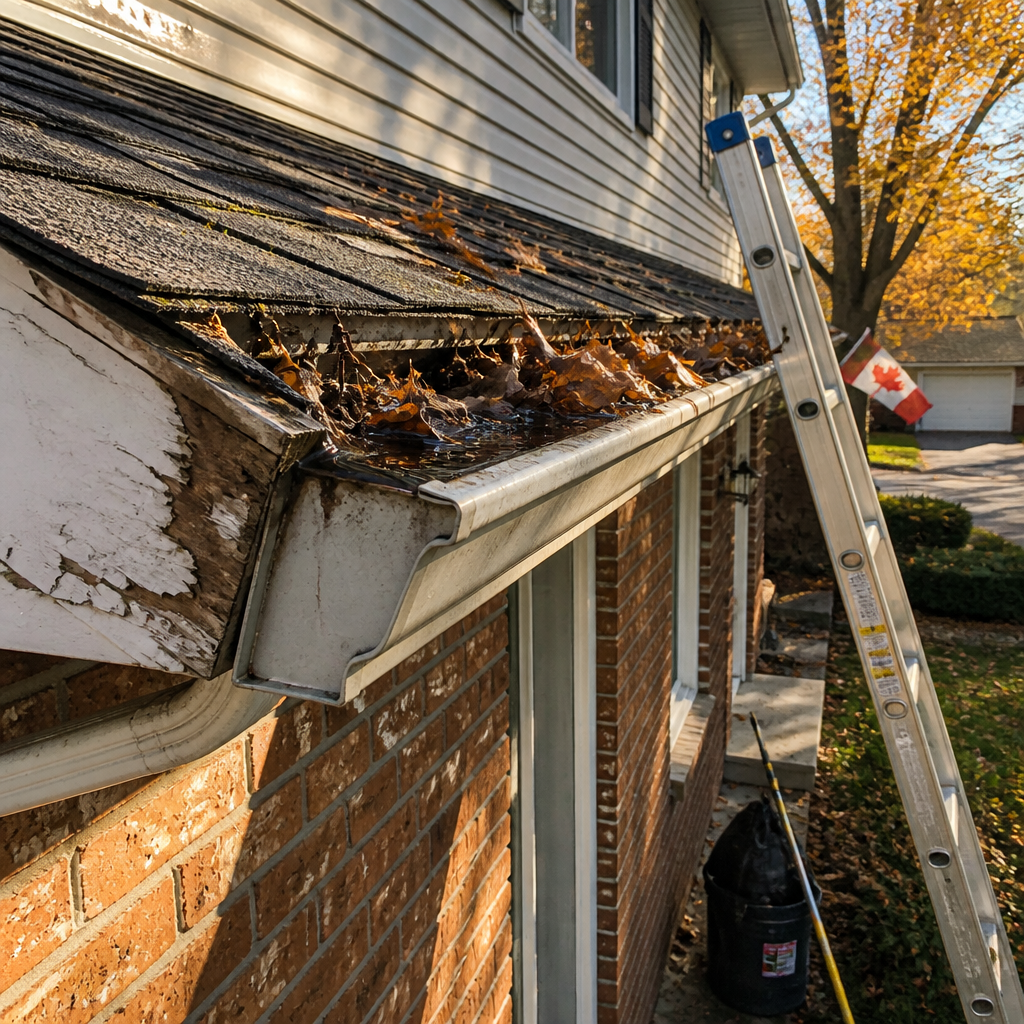

Step 1: Gather the Right Tools Before You Climb
You will need a sturdy extension ladder, work gloves rated for puncture resistance (roofing nails and sharp debris are common in gutter troughs), a gutter scoop or narrow garden trowel, a bucket or yard waste bags, and a garden hose with a spray nozzle. Do not work alone: ask a friend or family member for assistance, or hire a professional. Having a second person on the ground to stabilize the ladder and hand up tools is not optional safety theatre, it is basic fall prevention.
Pro tip: A ladder stabilizer bar that hooks over the roofline keeps your ladder from resting directly against the gutter trough. Resting an unsupported ladder against aluminum eavestrough will dent or crack it, especially on older sectional systems.
Step 2: Remove All Loose Debris from the Trough
Work from the end of the gutter run toward the downspout outlet, scooping debris into your bucket. Do not push debris toward the downspout inlet, that is the fastest way to create a packed blockage at the most critical drain point. In Ontario and British Columbia, maple keys and pine needles are common culprits that pack tightly and hold moisture far longer than dry leaves do.
Wet debris is heavier and harder to remove cleanly than dry debris, so if you can schedule the cleaning after a dry spell of a few days, the job will go faster. That said, do not delay past your timing window waiting for perfect dry weather. A slightly messy job done in time beats a perfect job done after the first frost.
Step 3: Flush the Trough and Confirm Slope
Once debris is removed, run water from a garden hose along the length of the trough toward the downspout. Watch for standing water. If you notice standing water after flushing, you may have a slope issue that needs addressing. Eavestroughs should slope toward the downspout at roughly 6 millimetres for every 3 metres of run. A sagging section loses that slope and becomes a permanent puddle that accelerates corrosion and overflow.
Step 4: Clear and Test Every Downspout
Point the hose directly down into the downspout inlet at full pressure. If water backs up immediately, the downspout is blocked. A common blockage point is the elbow at the base of the downspout where it turns away from the wall. You can often clear this with a plumber’s snake or by disassembling the elbow joint. Do not leave a blocked downspout and call the gutter trough “clean,” the entire system drains through the downspout, and a blocked one undoes everything else.
Pro tip: Check where your downspout extension discharges. Water should discharge at least 4 to 6 feet (roughly 1.2 to 1.8 metres) from your foundation. If the extension is missing, cracked, or pointed toward your home, replace it before winter arrives.
Step 5: Final Visual Inspection of the Full Run
Walk the perimeter of your home and look at the full eavestrough system from ground level. Check for sections that appear to sag or pull away from the fascia, visible rust staining or white mineral deposits on the exterior face of the gutter, and caulking or sealant that is cracked or missing at end caps and seam joints. These are repair triggers, not items to note and forget.

What to Inspect While You Clean
Cleaning and inspecting are two different tasks, but fall is the right time to do both at once. A cleaning that skips the inspection half leaves problems in place that will cost significantly more to fix after a Canadian winter runs its course on them.
Fascia Board Condition
Water backup seeps into fascia boards, softening the wood behind your gutters and creating conditions for mold, rot, and pest nesting. Press the fascia boards directly behind each gutter hanger with a screwdriver. Soft wood means the rot has started. If the rot is isolated to one section, a targeted repair is affordable. If it runs the length of the roofline, replacement becomes necessary before any new eavestrough can be properly hung.
Hanger and Bracket Integrity
Gutter hangers pull loose gradually under the weight of debris, snow, and ice. A loosened hanger is invisible from the ground but creates a low point in the trough that pools water and eventually separates the eavestrough from the fascia entirely. While you are on the ladder cleaning, physically push upward on the trough every metre or so to check that it is solidly attached. Any section that flexes, moves, or sounds hollow against the fascia needs a new hanger before winter.
Seam and Joint Sealant
Sectional aluminum eavestroughs connect at seam joints sealed with silicone or gutter caulking. That sealant dries, cracks, and shrinks over three to five years under Canadian temperature swings. Seal small cracks in eavestroughs, downspouts, and downspout extensions with silicone sealant as part of your fall maintenance. This is a 10-minute repair that prevents a leak that would otherwise saturate fascia, siding, and soil through an entire wet fall and winter season.
DIY vs. Professional Gutter Cleaning: Which Makes Sense for Your Home
This is a question where the honest answer depends on the height of your home, your comfort on a ladder, and the complexity of your eavestrough system. Single-storey bungalows with simple, straight gutter runs and no overhanging trees are reasonable DIY candidates for a homeowner who is comfortable with a ladder and has the right tools. Everything else is worth re-evaluating.
| Factor | DIY Gutter Cleaning | Professional Eavestrough Cleaning |
|---|---|---|
| Height and ladder safety | Practical on single-storey homes. Risk increases sharply on two-storey and higher. | Professionals have proper equipment, training, and safety gear for work at height. |
| Inspection depth | You can spot obvious issues, but may miss cracked sealant, loose hangers, and early fascia rot. | A trained technician identifies minor repairs before they become costly structural damage. |
| Time and convenience | Takes 2 to 4 hours for an average home, longer with heavy debris or complex rooflines. | Most residential cleanings are completed in under 2 hours with commercial equipment. |
| Combined services | Cleaning only, unless you have separate skills for repairs and power washing. | Many companies bundle eavestrough cleaning with window cleaning, power washing, and siding work in a single visit. |
| Cost | Tool and supply costs only. Hidden cost is potential injury or missed damage. | Professional eavestrough cleaning in Ontario typically runs $100 to $350 for most homes. |
Professional eavestrough cleaners work at heights daily, have the right tools and safety gear, and can complete a cleaning job quickly and efficiently, saving you time and ensuring the job is done correctly the first time. For homeowners managing multi-storey homes, complex rooflines, or properties with significant tree cover, that professional experience is worth significantly more than the service cost when measured against the risk of a fall or a missed repair that leads to winter water damage.
A company like Performance Window Cleaning, which has handled residential and commercial exterior cleaning since 2008, brings the advantage of combining eavestrough cleaning with a full exterior assessment in one visit. Gutters do not exist in isolation, and a team already on the property cleaning eavestroughs can spot issues with siding, windows, and fascia that a standalone gutter cleaning service would walk past.
Gutter Guards and Other Add-Ons Worth Considering
Gutter guards are not a replacement for cleaning, but they can reduce how often a full cleaning is necessary. The realistic benefit depends on the type of guard, the type of tree debris around your home, and the quality of the installation. Fine mesh guards handle most leaf drop well but can become clogged with pine needle debris and cottonwood seeds that leaf guards are not designed for.
Gutter guards can be installed at any time of year, but fall installation, done right after a professional cleaning, gives you the cleanest starting condition and means guards go on over a fully cleared and inspected system rather than over trapped debris.
For Canadian homes in regions with heavy snowfall, de-icing cables installed in gutters can melt ice and snow and prevent dangerous buildup when winter arrives. These are particularly worth considering for homes on the Prairies or in parts of Quebec and Ontario that receive significant ice events. They are not a substitute for fall cleaning but they do extend the protective window once freezing temperatures arrive.
Pro tip: If you are booking a fall eavestrough cleaning, ask about bundling it with a window cleaning and power washing visit before the season ends. Exterior surfaces accumulate the same organic debris, pollen, and grime that clogs gutters, and cleaning everything at once is more cost-effective than separate service calls spread across autumn.
Frequently Asked Questions
When is the best time to do fall gutter cleaning in Canada?
Late October to mid-November is the ideal window for most Canadian regions. The goal is to clean after the majority of leaves have dropped so you are not repeating the job, but before the first hard freeze locks debris in place and makes safe ladder work hazardous. Homes with heavy tree cover may benefit from an early-fall pass in September followed by a final cleaning in November.
How often do Canadian homeowners need to clean their eavestroughs?
Most homes need cleaning at minimum twice per year, once in late spring and once in fall. Homes near dense tree cover, particularly pine, maple, or cottonwood, benefit from three to four cleanings per year. After any significant windstorm, a visual inspection from ground level is worth doing regardless of your regular schedule, since high winds can fill a clean gutter in a single afternoon.
What happens if I skip fall eavestrough cleaning before winter?
Debris-packed gutters become ice-filled channels during freeze-thaw cycles. That ice expands, pulls hangers and seams apart, and forces meltwater to back up under roof shingles or overflow directly onto fascia boards and foundation soil. The resulting damage ranges from fascia rot and siding staining to basement water infiltration and, in serious cases, structural foundation damage from soil saturation. None of this is recoverable without significant repair costs.
Can I clean my gutters myself, or should I hire a professional?
Single-storey homes with straightforward eavestrough runs and a homeowner comfortable on a ladder are reasonable DIY candidates. Two-storey and higher homes change the safety equation significantly. Beyond height, professionals bring a full inspection as part of the service, catching loose hangers, cracked sealant, and early fascia rot that most homeowners walk past. For most Canadian homeowners with multi-storey homes, the combination of safety, thoroughness, and time saved makes professional cleaning the practical choice.
What should be included in a professional eavestrough cleaning service?
A proper professional service should include removal of all debris from the trough, flushing of the full system including downspouts to confirm drainage, a visual inspection of hangers, seam sealant, and fascia boards, and confirmation that downspout extensions are discharging water away from the foundation. Any company that cleans without flushing and inspecting is doing half the job.
Are there signs from the ground that tell me my gutters need cleaning right now?
Yes. Look for plants growing out of the gutter trough (organic debris has accumulated enough to support root growth), water staining or mold streaks on siding directly below gutter runs, gutters that visibly sag or pull away from the roofline, and water overflowing at the gutter face during rain rather than exiting cleanly through the downspout. Any one of these signs means the cleaning is overdue.
How much does professional eavestrough cleaning cost in Canada?
Costs vary by region, home size, and condition of the system. For Ontario specifically, professional eavestrough cleaning for most single or two-storey homes typically falls in the range of $100 to $350, with heavily treed properties or three-storey homes running higher. Minor repairs discovered during cleaning, such as re-sealing a joint or replacing a hanger, are usually a modest additional cost when addressed during the same visit.
Have you run into a gutter problem that turned into a bigger repair than expected? Share what happened in the comments, your experience could save another Canadian homeowner from the same headache.
References
- Government of Canada guidance on maintaining eavestroughs and downspouts to prevent flooding
- LeafFilter guide on peak fall gutter cleaning season timing and best practices
- Custodia resource on gutter cleaning frequency and seasonal timing for Canadian homeowners
- DAP Canada year-round gutter cleaning and repair guide for Canadian homeowners
- Custom Contracting breakdown of eavestrough cleaning costs in Ontario for 2026