
If you own an acreage in Fenwick, gutter cleaning is a different job than it is on a town lot. Longer roof planes, mature trees hanging over the eaves, and downspouts that discharge well away from the house all add up to a system that clogs faster and fails more quietly. Most rural homeowners only notice a problem when water pours over the edge during a storm or when a fascia board starts to soften. This guide covers what we see on properties in and around Fenwick, how often cleaning really matters, and which methods hold up when the house sits back from the road and the nearest ladder is a long walk from the truck.
Table of Contents
- Quick Takeaways
- Why Acreage Gutters Fill Faster Than Town Gutters
- Getting Safe Access to Gutters on Large Roofs
- Downspouts and Where the Water Actually Goes
- Comparing Cleaning Methods for Rural Gutters
- Setting a Cleaning Schedule for Tree-Covered Lots
- Pests, Spider Webs and Nests in the Gutter Line
- Winter Ice and Early Warning Signs
- Frequently Asked Questions
- References
Quick Takeaways
| Key Insight | Explanation |
|---|---|
| Trees over the eaves set your schedule | A treed acreage needs cleaning at least twice a year, and three to four times a year where leaf or needle cover is heavy. |
| Check downspouts before you clean | A blocked elbow turns a clean trough into an overflow. Run water from the top of the gutter and watch where it comes out. |
| Ground setup is the real risk | Ladders sinking into soft rural soil cause more trouble than the cleaning itself. Level the base and never work alone. |
| Discharge water far from the foundation | Downspouts that empty against the house keep the soil beside the foundation wet, and that is where basement leaks start. |
| Clean before you spray | Remove webs, nests and packed debris first. Treatment applied over sludge and nesting material wastes product and misses the spots that matter. |
| Read the ice signs in autumn | Staining on fascia and icicles that form in a straight line along the eave usually mean the trough is blocked. Fix it before freeze-up. |
Why Acreage Gutters Fill Faster Than Town Gutters
On a town lot, the roofline is short, the trees are a few steps from the house, and the neighbour’s maple is someone else’s problem to sweep. On an acreage, the picture changes. Roof planes run longer, the tree line often sits right over the eaves, and open ground means wind carries leaves, seed pods and needles straight into the trough.

In practice, the gutter on the shaded north side fills with wet leaves by late autumn while the sunny side stays nearly clear. Pine needles knit together into a mat that holds water even after most of the loose debris is gone. That mat is the real problem, because it turns the trough into a shallow pond that overflows at its lowest point, usually right above a flower bed or the entry door.
What Tree Debris Does Inside a Trough
Maple samaras slide along the trough and jam at every joint and hanger. Poplar catkins and blossoms rot into a dark sludge that holds moisture and smells by midsummer. Pine needles behave differently again, forming a felt that sheds water poorly and gives seedlings a place to root.
Each material needs a different response. Samaras come out by hand. Sludge needs scooping and a rinse. Needle felt usually has to be lifted out in sections before any water can flow properly.
Why Low Spots Matter More on Long Runs
A long gutter only drains if it has a slight fall toward the downspout. On a 2-storey acreage home, we often find sections that have sagged between hangers over the years. Water collects in the sag, debris settles into the low point, and the cycle repeats every season until the hanger pulls out of the fascia.
Pro tip: Walk the trough after a heavy rain and look for water standing in the same spot. A sag that holds water is a repair job, and cleaning alone will not fix it.
Getting Safe Access to Gutters on Large Roofs
The most dangerous part of gutter cleaning on an acreage is not the cleaning. It is the setup. Long single-storey runs look easy from the ground, but a ladder on soft lawn or loose gravel shifts under load, and a two-storey farmhouse with a steep pitch puts a worker far above a patio that was never designed for landings.
Ladder Setup on Uneven Rural Ground
Level the base before you climb, and never rely on a ladder that is only roughly level. A small tilt at the feet becomes a large lean at the top, and that is when people reach sideways and fall. Use stabilizer bars or a leveling base where the ground is soft, and tie the top off to the fascia when the design allows it.
Keep your weight centred between the rails and do not overreach. If the trough is out of comfortable reach, move the ladder rather than leaning out to finish the run.
When Ground-Level Cleaning Is the Safer Call
Many single-storey eaves can be cleared from the ground with a telescoping wand and a gutter cleaning tool. You scoop the loose debris from the ground, then flush the trough with a hose to move the remaining sludge toward the downspouts. This approach works well when the trough is sound and the downspouts are open.
It does not work on packed needle mats, on runs with sagging sections, or on two-storey eaves where the wand cannot reach. Pushing water into a blocked outlet only moves the problem to the next low point.
Pro tip: Never climb wet grass, and never work a ladder in wind. Gusts catch the ladder and the debris bag at the same moment, and a bag of wet leaves can throw your balance off.
Ontario has specific workplace rules for window cleaning, and the same caution applies to any gutter job where a worker is working at height. If you hire a crew, ask how they set up, whether they use stabilizers, and whether they have the equipment to reach your eaves without leaning.
Downspouts and Where the Water Actually Goes
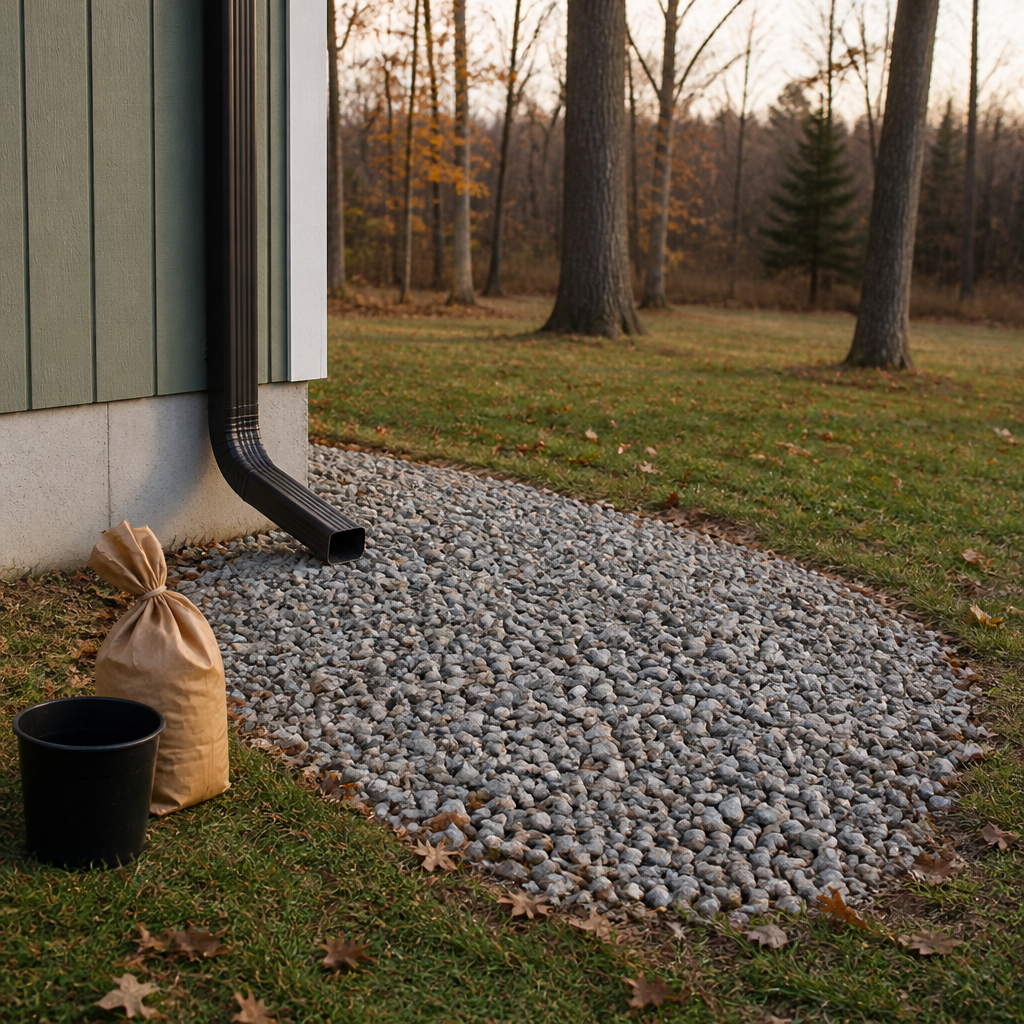
On an acreage, downspouts often end at a splash block, a short plastic extension, or straight onto grass. That looks harmless until a damp patch grows into a soft spot beside the foundation, or a drainage ditch overflows toward the driveway. A clean gutter with a bad downspout is only half a job.
Blockages You Only Find at the Bottom
Most downspout clogs sit at the first elbow under the gutter or in the first two feet of pipe. Leaves and seed pods wash down, stop at the bend, and build up until the trough backs up. You will not see it from the ground, so test the system. Run a hose into the top of the gutter and watch the outlet. If the water comes out slowly or not at all, clear the elbow with a plumber’s snake or a long flexible rod.
Extensions and Splash Blocks That Hold Up
A splash block works only if it sends water away from the foundation and onto ground that slopes away from the house. On many rural lots, the grade is flat, so water pools and drifts back. A rigid or flexible extension that carries the discharge further out is usually the better fix.
On long lots, consider a buried pipe that carries water to a swale or a low, grassed area well away from the house. Before you dig, confirm where your septic system and well are located. A drainage line that runs through the wrong area creates a worse problem than the one you started with.
Rural homeowners sometimes ask if downspouts need cleaning as often as the gutters. They do, though less often. Check them at every gutter visit, and flush them once a year at minimum.
Comparing Cleaning Methods for Rural Gutters
Three approaches come up on acreage properties, and each one fails in a different way. The right choice depends on the height of the eaves, the amount of tree cover, and whether the troughs are in sound condition.
| Approach | Best Suited For | Main Drawback |
|---|---|---|
| DIY ladder and hand scooping | Short single-storey runs with light debris | Fall risk on soft ground, slow on long runs, and loose debris often stays in the low spots |
| Ground-level wand with flush | Single-storey eaves with sound troughs and open downspouts | Does not remove packed needle mats, and can push sludge into a blocked outlet |
| Professional cleaning with debris removal and downspout check | Two-storey homes, long runs, and heavy tree cover | Costs more than a DIY attempt and needs to be booked ahead of the busy leaf-fall weeks |
Where Hand Scooping Goes Wrong
Scooping by hand feels thorough, but most people stop at the reachable section and leave the low spots full. The debris you miss sits right over the downspout outlet, which is exactly where you need the flow. Scoop the full length, then check the low points with a flashlight.
Why Flushing Alone Is Not a Full Clean
Flushing moves loose material, but it does not lift the felt that forms around hangers and joints. Water pushes the top layer through and leaves the base behind. We see this most often on runs where a previous cleaning used only a hose and the homeowner assumed the gutter was clear.
Our rule is simple: remove the solid debris first, then flush, then confirm the flow at every outlet. Anything less leaves a gutter that looks clean and still overflows at the next heavy rain.
Setting a Cleaning Schedule for Tree-Covered Lots
Frequency depends mostly on how much tree cover sits over your eaves, not on the calendar. Our position is firm: a treed acreage needs cleaning at least twice a year, and three to four times a year where the canopy is heavy. A community post on gutter maintenance makes a similar recommendation for homes with overhanging trees, and the reason is the same. Debris builds faster than most people expect.
On a treed acreage, the gutter you cannot see from the ground is usually the one that fails first.
The Spring and Late Autumn Windows
Spring cleaning clears the winter’s leftover debris, sap residue and early seed drop before the summer growth starts. Late autumn is the more important visit. Clean the troughs after the leaves have fallen and before the first hard freeze, because anything left in the gutter will freeze into the trough and expand.
If you only book one visit a year on a treed lot, make it the late autumn one. It removes the largest load of debris and prepares the system for snow and ice.
After Storms and Heavy Wind
A strong wind can drop a branch load or push a mat of leaves into a single section in one afternoon. Check the gutters after any large storm, and look for new debris at the outlets and along the low spots. These checks take a few minutes and can prevent water damage that takes weeks to show up.
Pro tip: Keep a short log with the date, the state of each downspout, and any sagging sections. Over two or three seasons, the log shows you which runs need more frequent attention and which trees are the real source of the load.
Pests, Spider Webs and Nests in the Gutter Line
Gutters on acreages become habitat. Standing water in a clogged trough attracts mosquitoes, spiders spin webs in the corners, and wasps and birds look for protected spots under the eave. The gutter line is also a good place to inspect the perimeter of the house, especially where tall grass and brush meet the foundation.
Standing Water Is the Mosquito Problem
A trough that holds water for a week gives mosquitoes a place to breed. Clearing the debris and restoring the fall toward the downspout removes that standing water. Treatment alone will not solve the problem if the trough still holds a puddle after every rain.
Clean Before You Spray for Spiders
Spider control works better when the webs and egg sacs are removed first. Spraying over packed debris wastes product on material that does not matter and misses the spots where spiders actually nest. Our bug and spider removal service includes tick and mosquito control, and we always clear the gutter line before treating, so the treatment reaches the surfaces where it counts. You can read more about our full service range at Performance Window Cleaning.
Ticks are a separate issue. They are more often found in tall grass and brush around the property than in gutters, so the perimeter of the lot deserves as much attention as the eaves.
Winter Ice and Early Warning Signs
A blocked gutter does its worst damage in winter. Water that cannot drain freezes at the eave, builds up under shingles and forms ice dams that push water back under the roofing. On acreages with long runs, the problem often starts at a single low section that nobody checked.
Signs You Can Spot From the Ground
Look for staining on the fascia or soffit, water marks on siding below the eave, and a neat line of icicles along one section of the roof. Sagging sections, soil washing out from under a downspout, and plants that are suddenly wet at their base also point to a drainage problem. Any of these signs means the gutter is not doing its job.
Why Fixing This in Autumn Beats Winter Repair
A gutter that is cleaned and checked in late autumn gives you a dry trough through the freeze-thaw months. The same trough, left full, can freeze solid and pull a hanger out of the fascia when the ice expands. Repairing a fascia board or a section of trough in January costs more and takes longer than a late autumn visit.
If you already see a line of icicles, do not try to chip them off from a ladder. Book the cleaning and have the outlets checked as soon as the weather allows.
Frequently Asked Questions
How often should gutters be cleaned on an acreage near Fenwick?
Plan on at least twice a year, with a late autumn visit as the most important one. If the property has heavy tree cover over the eaves, three to four visits a year is a better match for the debris load.
Can I clean the gutters on a two-storey acreage home myself?
You can, but the setup is where most of the risk sits. Work from a level, stabilized ladder, never alone, and never in wind or on wet ground. If the eaves are high or the roof pitch is steep, a professional crew with the right access equipment is the safer choice.
Do gutter guards mean I can skip cleaning on a treed lot?
No. Guards keep out larger leaves and some debris, but fine seed, needle felt and sludge can still build up on top of them or behind them. Guards still need inspection and occasional cleaning, and a clogged guard can be harder to clear than an open trough.
Should downspouts be cleaned at the same visit as the gutters?
Yes. Clean the gutters first, then flush each downspout and watch the outlet. A clear trough with a blocked downspout will still overflow, so the two jobs belong together.
What should I check before a gutter crew arrives on a rural property?
Clear a safe path to the ladder area, note any sagging sections or overflow spots you have seen, and tell the crew where the septic system and well are located so the downspout discharge is handled correctly. Ask whether they will check the outlets, not only the gutter itself.
What has worked for your rural gutters, and what would you do differently if you were starting over on a treed lot?