
A gutter downspout blockage is one of the most quietly destructive problems a homeowner can have. Water backs up, overflows, saturates the fascia, and eventually finds its way into your foundation or basement. The worst part is that by the time most Ontario homeowners notice something is wrong, the damage is already underway. This guide covers exactly how to identify a blocked downspout before it becomes an expensive repair, explains why Ontario’s climate makes this problem especially serious, and details why professional service consistently delivers faster, safer, and more complete results than guesswork from a ladder.
Table of Contents
- Quick Takeaways
- What Causes a Downspout Blockage
- Warning Signs You Can Spot From the Ground
- What Happens When You Ignore a Blocked Downspout
- Ontario Winters Make Blockages Worse
- DIY vs. Professional Blocked Downspout Repair in Ontario
- How Professionals Clear and Inspect Downspouts
- Frequently Asked Questions
- References
Quick Takeaways
| Key Insight | Explanation |
|---|---|
| Overflow is the most visible sign | Water sheeting over the gutter edge during rain almost always points to a blocked or overwhelmed downspout, not just a full gutter. |
| Staining on siding is an early warning | Vertical streaks of dirt or rust-coloured staining below the roofline indicate water has been overflowing for some time before you noticed. |
| Sagging gutters signal long-term blockage | Debris and standing water add serious weight. A sagging section usually means a blockage has been sitting there through at least one wet or freeze-thaw cycle. |
| Foundation risk is real and expensive | Water pooling near the base of your home due to a blocked downspout can seep into the foundation, erode soil, and cause basement moisture problems. |
| Ontario freeze-thaw cycles amplify damage | Debris-packed downspouts that freeze in winter turn into ice blockages that stress the entire eavestrough system and can tear it from the fascia. |
| Twice-yearly cleaning is the minimum | Most Ontario homes with deciduous trees nearby need gutter and downspout cleaning every spring and fall at a minimum to prevent seasonal blockages. |
| Professional flushing confirms full clearance | Removing surface debris without flushing the downspout from top to bottom leaves compacted mid-pipe blockages in place. Professionals flush every downspout to confirm flow. |
What Causes a Downspout Blockage
Downspouts fail for a small number of predictable reasons, and all of them can be prevented with regular maintenance. Understanding the cause makes it easier to recognize the problem early.
Leaf and Debris Accumulation
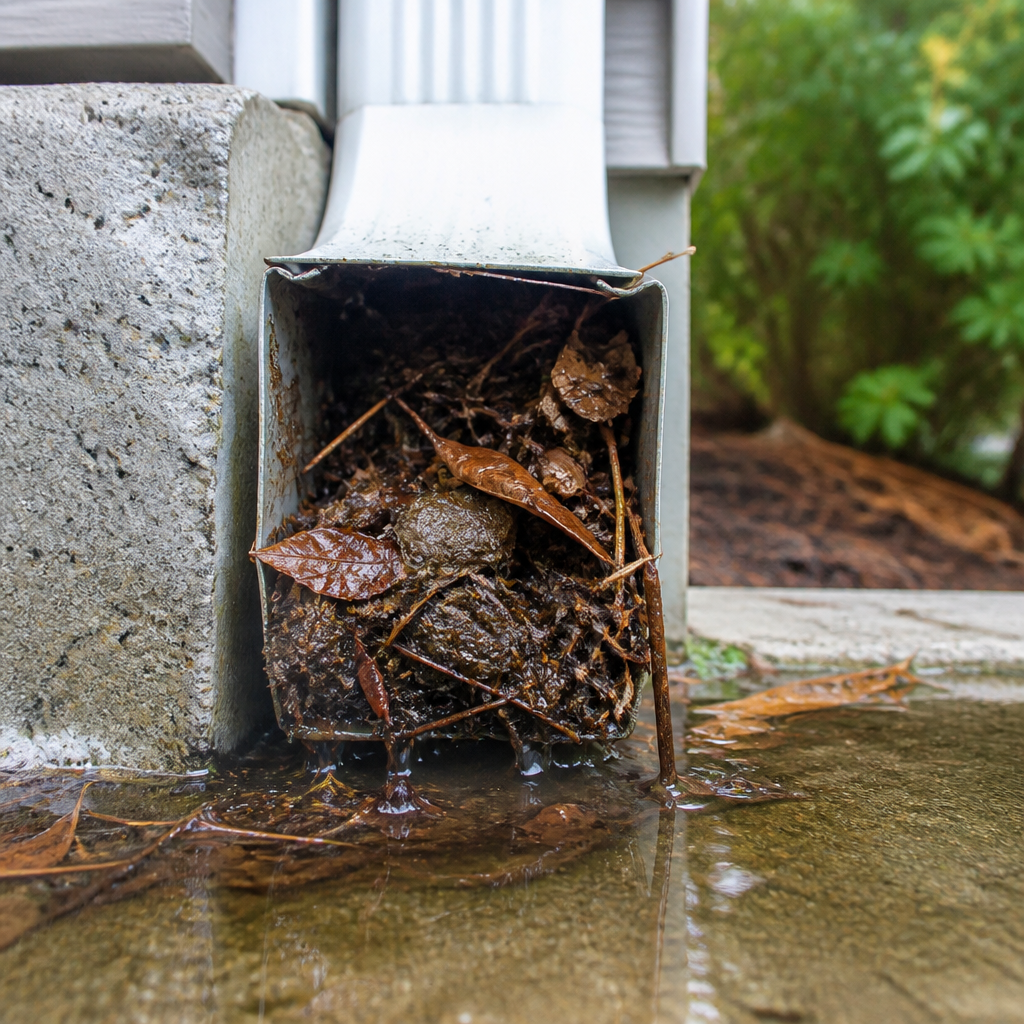
The most common cause is straightforward: leaves, twigs, seed pods, and roof grit wash down into the gutter and pile up at the downspout opening. The elbow fitting at the top of the downspout is a natural collection point. Debris compacts there, restricts flow, and eventually forms a full blockage. Homes surrounded by maple, oak, or pine trees in areas like Oakville, Burlington, and Niagara Falls are especially susceptible in autumn.
A secondary cause that most homeowners miss is the debris that settles mid-pipe. Leaf matter that is wet and partially decomposed does not flush through easily. It compacts into a dense plug that cannot be dislodged simply by hosing the gutter surface.
Granule and Sediment Buildup
Asphalt shingle roofs shed granules continuously, especially on older roofs. These granules wash into the gutter and collect at bends and at the bottom of the downspout. Over time they form a sandy, compacted layer that narrows the pipe’s effective diameter significantly. This type of blockage builds slowly and is easily missed until water stops flowing properly.
Bird Nests and Pest Activity
Birds will nest inside gutters and at the top of downspout openings whenever debris gives them a ready-made base. If you see birds repeatedly landing on or inspecting the same section of your eavestrough, treat it as a warning sign. Nesting material is dense enough to block a downspout entirely.
Pro tip: Check your downspouts after every significant windstorm, not just in fall. A single branch or bundle of leaves from a summer storm can create an immediate blockage just as damaging as anything autumn leaf drop produces.
Warning Signs You Can Spot From the Ground
Most homeowners assume they need to climb a ladder to check for a downspout blockage. That is not true. The majority of blockage warning signs are visible from the ground, and spotting them early is the difference between a routine cleaning call and a costly repair bill.
Water Spilling Over the Gutter Edge During Rain
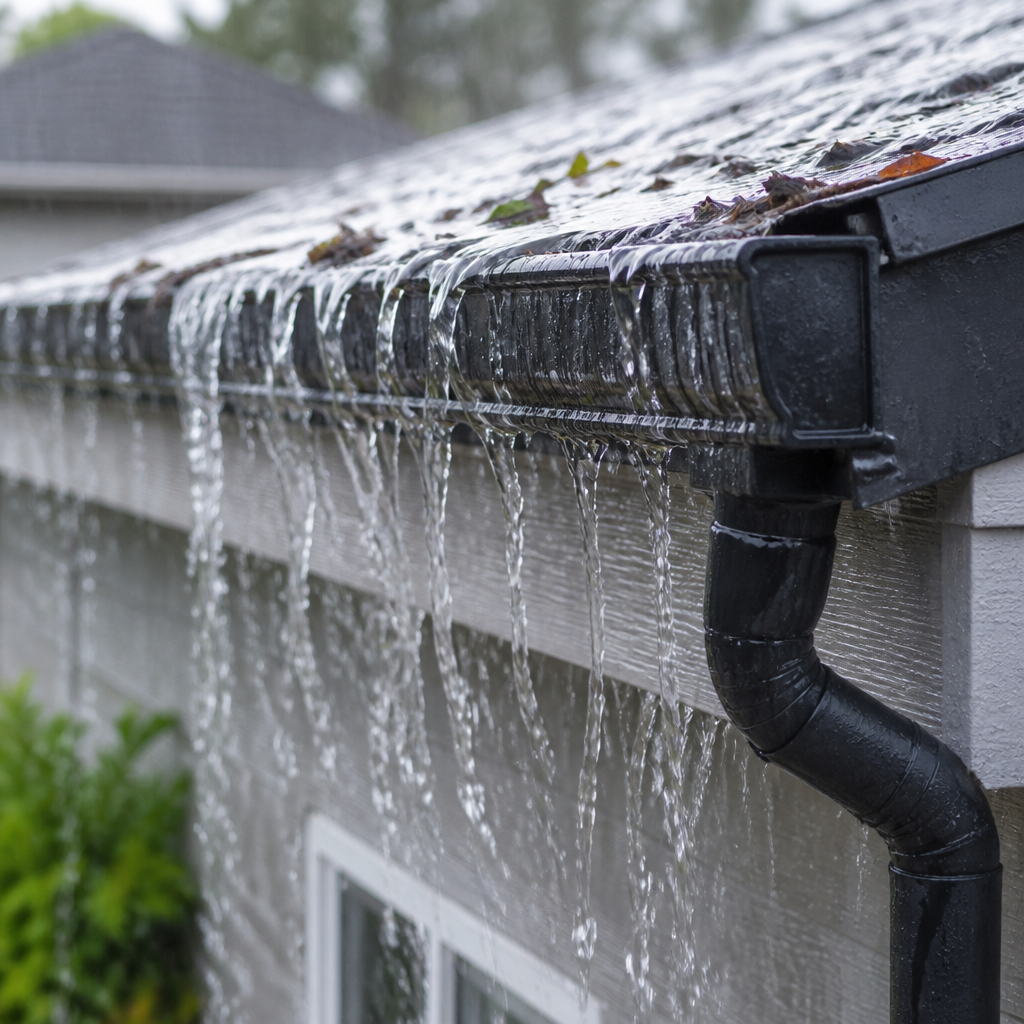
Watch your gutters during a moderate rainfall. Water should flow smoothly toward the downspout and exit cleanly at the bottom. If you see water cascading over the front edge of the gutter, the downspout is not passing water fast enough. Either it is partially blocked, or it is fully blocked and the gutter has become a collection trough.
Little or No Water Exiting the Downspout
During or after rain, stand near the base of each downspout. A clear system produces a visible, steady flow. If you hear nothing and see nothing coming out, or only a slow trickle despite heavy rain, the pipe is blocked somewhere along its length. This test takes thirty seconds and is one of the most reliable indicators available.
Vertical Staining on Siding Below the Roofline
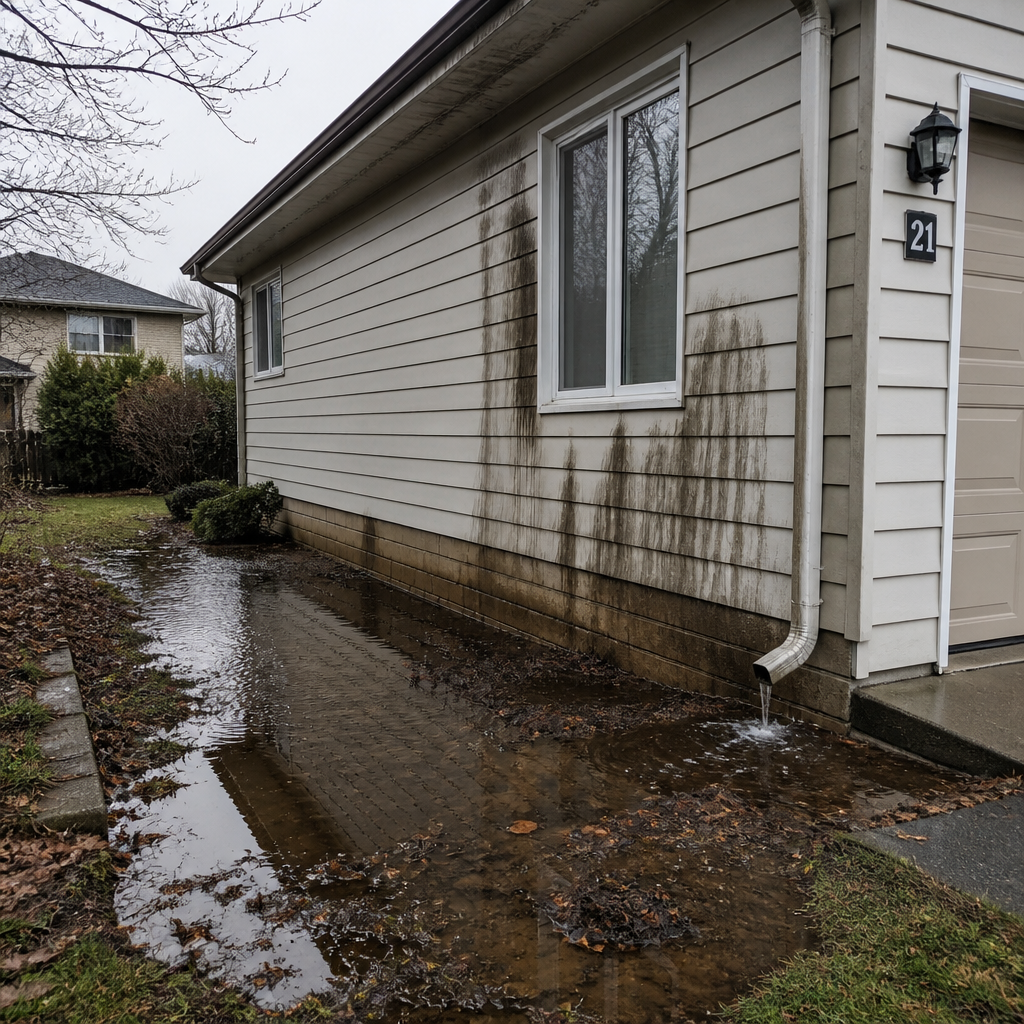
Rust-coloured or dark streaks running down the siding below the gutter line are a reliable sign that water has been overflowing for weeks or months. The staining comes from debris particles and oxidation carried by the water. By the time this staining is visible, the blockage has been present long enough to have caused some degree of fascia saturation.
Sagging or Pulled-Away Sections of Gutter
A gutter that sags in the middle of a run, or that has visibly pulled away from the fascia, is under excess load. Standing water and packed debris are heavy. When fasteners are under that kind of continuous strain, they loosen, and the gutter section drops. A dropped section no longer drains toward the downspout. It pools water in the low point and accelerates the blockage problem.
Plants Growing in the Gutter
If you can see green growth sprouting from your eavestrough, the blockage is so well-established that it has created a growing medium. Seeds carried in by birds or wind have found enough accumulated organic matter and moisture to germinate. This is a late-stage warning sign, not an early one.
A gutter filled with leaves and debris during autumn may still contain that same material when winter temperatures arrive. Wet debris freezes into a heavy blockage. When temperatures rise again, melting snow may then have difficulty moving through the system.
What Happens When You Ignore a Blocked Downspout
The consequences of leaving a gutter downspout blockage unaddressed are not gradual and minor. They escalate in stages, with each stage more expensive to correct than the last.
Fascia Rot
When a gutter overflows due to a blockage, water runs behind the gutter and saturates the fascia board continuously. Wood fascia absorbs water, begins to soften, and eventually rots. Replacing rotted fascia is a carpentry job that costs considerably more than a gutter cleaning, and the root cause still has to be addressed afterward.
Foundation Damage and Basement Moisture
The purpose of the downspout is to carry roof water away from the base of the home. When it fails, water pools at the foundation. That water exerts hydrostatic pressure on foundation walls, infiltrates cracks, erodes the soil grade around the home, and eventually produces basement moisture or flooding. Without functioning downspouts, water can pool around your foundation and seep into your basement, erode your landscaping, and damage your siding and fascia. Many homeowners do not notice downspout problems until water damage has already begun.
Landscape Erosion
Concentrated overflow from a blocked downspout creates a high-velocity water stream that lands in the same spot during every rainstorm. Gardens, lawn edges, and graded soil around the foundation wash away progressively. The slope that was meant to direct water away from the house can reverse entirely over time.
Pro tip: Look at the soil grade around your foundation after a heavy rain. If you see a depression forming near the base of a downspout, or channels in the soil where water is clearly running, address the downspout blockage immediately. The soil erosion will worsen with every storm.
Ontario Winters Make Blockages Worse
For homeowners in Oakville, Burlington, Hamilton, Mississauga, St. Catharines, and Niagara Falls, the seasonal cycle creates a specific risk that homeowners in milder climates do not face to the same degree. Ontario’s freeze-thaw patterns turn an autumn blockage into a winter structural threat.
When a downspout is partially blocked going into winter, any standing water in the system freezes. The ice expands, locks the blockage firmly in place, and prevents any meltwater from draining during the daytime warming periods. That meltwater backs up behind the ice, refreezes at night, and the cycle repeats. The expanding ice puts significant stress on joints and hangers. Repeated freeze-thaw cycles can loosen fasteners, shorten shingle lifespan, and increase the risk of interior water damage over time.
Winter-related water damage claims in Ontario can range considerably in severity. Prevention focuses on keeping gutters and downspouts completely clear before temperatures drop, so there is no standing water left to freeze in the first place. Cleaning gutters before significant winter conditions arrive helps provide a clear route for water. This is why fall eavestrough cleaning is not optional maintenance. It is the specific intervention that prevents ice-related structural damage.
DIY vs. Professional Blocked Downspout Repair in Ontario
The honest answer to whether you can handle a downspout blockage yourself is: sometimes yes, often no. The determining factors are the location of the blockage, the height of your roofline, and whether the debris is surface-level or compacted mid-pipe.
Comparison: DIY Clearing vs. Professional Service
| Factor | DIY Approach | Professional Service |
|---|---|---|
| Safety on ladders | Risk on second-storey or multi-pitch rooflines is significant without the right equipment or training | Trained technicians with proper equipment and experience on residential rooflines |
| Blockage depth | Surface debris near the gutter can be removed by hand; mid-pipe or elbow blockages are very difficult without specialist tools | Full system flush from top to bottom confirms clearance at every point in the pipe |
| Completeness | Easy to miss compacted debris inside elbows and bends, leaving a partial blockage behind | Every downspout is flushed and visually checked at the outlet to confirm full flow |
| Damage identification | Unlikely to identify loose hangers, cracked joints, or misaligned pitch while focused on clearing debris | Experienced eye catches loose hangers, separating seams, sagging runs, and pitch issues in the same visit |
| Time and effort | Multi-hour job including ladder setup, debris disposal, and cleanup, often requiring multiple sessions | Efficient and systematic, usually completed in a single visit with proper disposal |
For a low roofline single-storey section with clearly visible surface debris, a careful homeowner can make a reasonable attempt. But if you are uncomfortable on a ladder, your gutters are at second-storey height, or the blockage is not clearing with a garden hose, call a professional. If a downspout is damaged or there is a total blockage that cannot be removed through DIY methods, a professional can ensure the pipe is not further damaged during cleaning.
How Professionals Clear and Inspect Downspouts
When a professional crew handles a gutter cleaning downspout service in Ontario, the process is more thorough than most homeowners expect. It is not just scooping out the visible debris at the gutter opening.
Top-Down Debris Removal
The crew starts at the gutter surface, removing all accumulated debris by hand or with specialist tools before any water is run through the system. Flushing a heavily blocked gutter before clearing surface debris pushes the load deeper into the downspout and can create a worse compaction problem.
Full Downspout Flush
Once surface debris is cleared, each downspout is flushed from top to bottom with a pressurized water source. The technician watches the outlet at the base of the pipe to confirm a full, unobstructed flow. If the water backs up, the blockage is identified and cleared before moving on. This step is what separates a complete service from a partial one. After cleaning gutters, a full water flush through every downspout confirms there are no hidden blockages remaining.
Visual Inspection During Service
A professional visiting your home for a blocked downspout repair Ontario service is also looking at everything else: the condition of the fascia, any sagging gutter runs, loose or missing hanger brackets, and whether the downspout discharge point is directing water appropriately away from the foundation. This is the kind of observation that catches a minor issue before it becomes a major one.
At Performance Window Cleaning, the eavestrough and gutter cleaning service covers the full system, not just the visible surface. Serving Oakville, Burlington, Mississauga, Hamilton, Niagara Falls, St. Catharines, Fenwick, and the surrounding area, the team handles the complete job from debris removal to downspout flushing so that every section of the drainage system is confirmed clear before leaving the property. If your gutters and downspouts are due for their seasonal clean, reach out to book a gutter and eavestrough cleaning.
Frequently Asked Questions
How do I know if my downspout is blocked and not just the gutter?
The clearest test is standing near the base of the downspout during rainfall. If the gutter is overflowing but little or no water is exiting at the bottom of the pipe, the blockage is in the downspout rather than just the gutter surface. You can also check by running a garden hose into the top of the downspout at low pressure. If water backs up immediately without draining through, the blockage is confirmed.
How often should downspouts be cleaned in Ontario?
Twice a year is the baseline for most Ontario homes: once in late spring after trees have finished dropping seeds and pollen, and once in late fall after the major leaf drop is complete. Homes with heavy tree coverage, particularly maple or oak trees near the roofline, may need an additional mid-season check. Skipping fall cleaning specifically is the most common cause of winter ice blockages.
Can a blocked downspout cause basement flooding?
Yes, and it is a more direct connection than most homeowners realize. When the downspout cannot discharge roof water away from the home, that water concentrates at the foundation wall. Over multiple rain events, it saturates the soil, increases hydrostatic pressure on foundation walls, and can infiltrate through cracks or the joint between the foundation and the basement floor. Grading the soil away from the foundation and keeping downspouts clear are the two most effective preventive measures.
What is the difference between eavestrough cleaning and gutter downspout cleaning?
In Ontario, “eavestrough” and “gutter” refer to the same component: the horizontal channel that runs along the roofline to collect runoff. Downspouts are the vertical pipes that carry that collected water from the eavestrough down to ground level. A complete cleaning service covers both: the eavestrough channel and every downspout. Cleaning the eavestrough without flushing the downspouts is an incomplete job, since blockages in the downspout will cause the same overflow problems regardless of how clean the trough itself is.
Is it safe to use a pressure washer to clear a blocked downspout?
A standard garden hose with reasonable pressure is usually sufficient and much safer than a full pressure washer for downspout flushing. High-pressure water directed into a downspout can force debris into bends where it becomes more difficult to extract, can damage joints or seams, and on older systems can dislodge connections entirely. Professional crews use controlled water pressure calibrated to the condition of the system, not maximum force.
What time of year is worst for downspout blockages in Ontario?
Late autumn is consistently the highest-risk period. Leaf fall from deciduous trees delivers the largest volume of debris in a short window, and if that debris is not cleared before the first hard freeze, it locks in place as an ice-reinforced blockage. Spring is the second most common peak, when accumulated winter debris, seed casings, and roof granules all wash into the system at once. Both seasons should trigger a professional cleaning visit as a routine matter, not just when a problem becomes visible.
Can gutters with downspout blockages attract pests?
Yes. Standing water and decomposing organic debris in gutters create ideal conditions for mosquito breeding, and the accumulated debris provides nesting material for birds and small animals. Compacted leaf matter that stays moist attracts insects generally. Clearing blockages promptly removes both the nesting habitat and the standing water that allows mosquito larvae to develop. If you are already dealing with pest activity around your roofline, a gutter cleaning combined with spider web and insect removal is a practical combined service.
Have you dealt with a blocked downspout causing unexpected damage at your home? Share what you found and how you handled it in the comments below.
References
- How gutter and eavestrough cleaning prevents seasonal blockages and winter damage
- Five visible signs that your guttering is blocked and needs attention
- Downspout repair and replacement guidance for homes in the Niagara Region
- How to winterize gutters and rooflines to prevent ice dams in Ontario
- What eavestroughs actually protect and how blockages compromise that function