
By the time September arrives, your windows have endured four months of relentless abuse: pollen waves, insect impacts, sprinkler overspray, UV-baked mineral deposits, and a slow film of oxidation that builds week by week. Post-summer window cleaning is not simply the same job you do in spring. The residue that accumulates between May and August behaves differently on glass than fresh dirt does, and Ontario’s humid summers make it measurably worse. If you have ever washed your windows in September and still seen haze, streaks, or faint white patches after the pane dried, you have already met the problem this article explains.
Table of Contents
- Quick Takeaways
- Why September Residue Is Different from Regular Dirt
- The Five Layers Summer Deposits on Ontario Glass
- Why DIY Cleaning Falls Short on Baked-On Residue
- Professional Removal Techniques That Actually Work
- Comparing Removal Approaches: What Works for Each Residue Type
- Don’t Forget Tracks, Sills, and Screens
- Timing Your Fall Clean in Ontario
- Frequently Asked Questions
- References
Quick Takeaways
| Key Insight | Explanation |
|---|---|
| Summer residue bonds to glass over time | Heat and UV exposure cause mineral deposits, pollen oils, and insect proteins to chemically bond to the glass surface, making them far harder to wipe away than fresh dirt. |
| Hard water is the main offender in Ontario | Municipalities across the Hamilton, Burlington, and Niagara regions supply hard water. When it dries on glass, it leaves calcium and magnesium deposits that standard soap cannot dissolve. |
| Plain water and dish soap won’t cut it in September | Generic cleaning solutions do not have the correct pH to break mineral bonds or dissolve oxidized insect residue. You need either an acidic rinse or a professional-grade cleaner. |
| Insect residue is oily and adhesive | Bug impacts leave proteins and oils that rain does not rinse off. After months of sun exposure, they require squeegee contact and a proper surfactant, not just rinsing. |
| Tracks and sills carry the heaviest contamination | Dirt washed off the glass during summer rains collects in tracks and sills, where it forms compacted debris that can damage seals if left into winter. |
| Fall cleaning protects windows through freeze-thaw cycles | Debris left in tracks and on frames holds moisture against the seals and frames through Ontario winters, accelerating deterioration and promoting mould growth. |
| September is the last easy window for exterior work | Once temperatures drop below 5°C, cleaning solution performance degrades and some products can streak or freeze. Booking in September gives the best working conditions before winter. |
Why September Residue Is Different from Regular Dirt
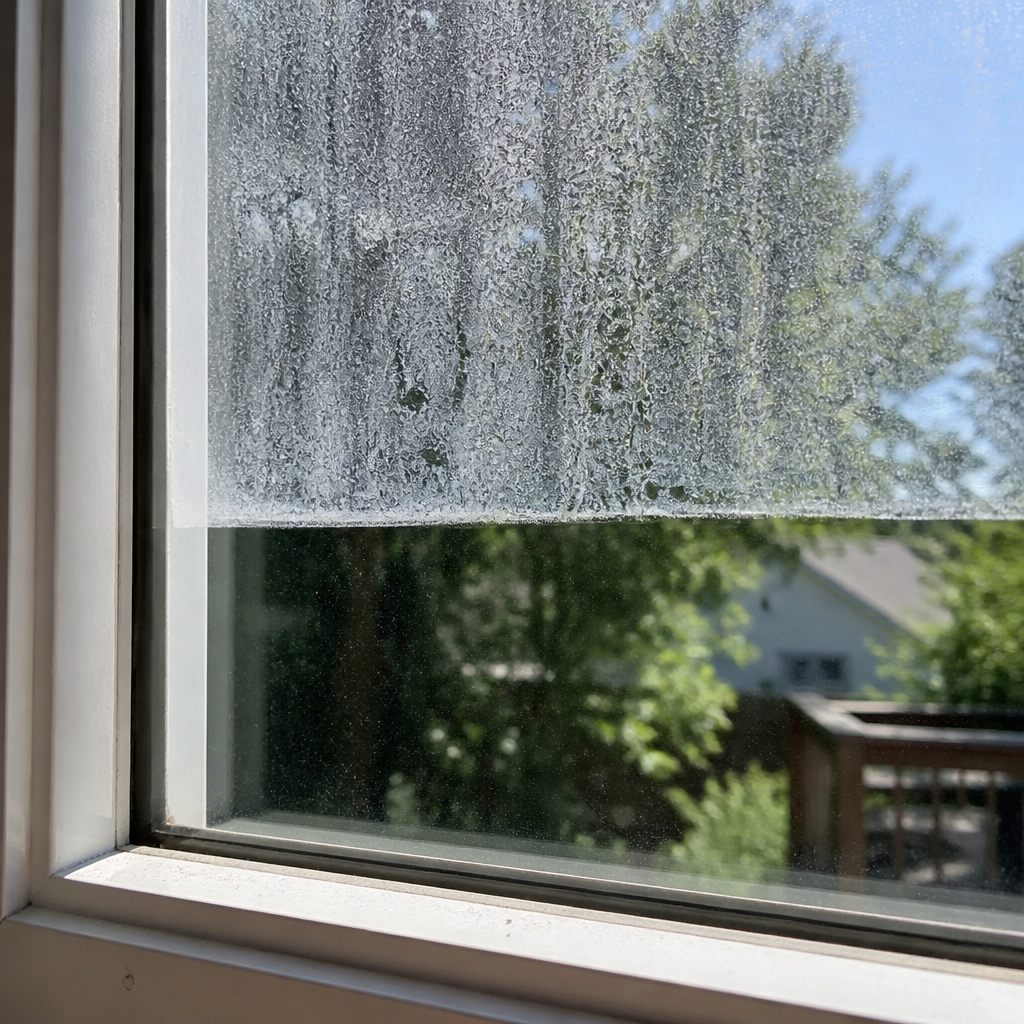
Regular dirt lands on glass and stays loose. September residue is different because it has been cooked. From May through August, Ontario’s sun heats exterior glass surfaces well beyond the ambient air temperature. Every cycle of wetting and drying from rain, dew, and irrigation bakes another layer of dissolved minerals deeper into the micro-texture of the glass surface.
The result is a compound problem. Mineral deposits from hard water create an uneven surface that traps pollen, dust, and organic material on top of it. That organic layer then oxidizes under UV exposure, forming a film that is neither purely mineral nor purely organic. It requires two different cleaning approaches to break down, which is why a single product pass almost never clears it completely.
The glass is not just dirty in September. It is carrying a stratified accumulation of residues that each respond to different chemistry. Treating it like a simple smudge is why so many homeowners finish a DIY wash and still have haze.
This is not unique to one neighbourhood. Homes in Oakville, Burlington, Mississauga, Hamilton, St. Catharines, and the Niagara region all face the same compounding effect. The variation is in degree, not in kind. Properties near irrigation systems, mature tree canopy, or busy roads simply accumulate faster.

The Five Layers Summer Deposits on Ontario Glass
Understanding what you are actually dealing with makes it much easier to understand why the residue is so persistent. Summer does not leave one type of contamination on glass. It leaves at least five, stacked on top of each other.
1. Hard Water Mineral Scale
Ontario’s water supply in the Hamilton, Burlington, and Niagara regions is naturally high in dissolved calcium and magnesium. Every time water dries on glass, whether from rain, sprinklers, or window washing that was not fully rinsed, it leaves a mineral residue behind. These deposits show up as white spots or a general cloudy haze. Over time, the minerals physically bond to the glass surface, creating a layer that standard soap cannot dissolve because soap is pH-neutral and mineral scale requires an acidic solution to break down.
2. Pollen Film
Spring pollen is well known, but pollen deposition in Ontario continues well into August from grasses, late-blooming trees, and ragweed. Pollen is not just a particle sitting on the surface. It contains oils that make it adhesive. After a summer of UV exposure, that sticky film oxidizes into a dull, slightly yellow haze that is most visible when light hits the glass at an angle. Rinsing alone does not remove it.
3. Insect Proteins and Oils
Insects impact glass throughout the warm months, especially on south and west-facing elevations. The residue they leave is a combination of proteins and body oils. Rain does not rinse this off because the oils are hydrophobic. By September, impacts from spring and early summer have had months to dry and oxidize, making them noticeably harder to remove than fresh ones. Squeegee contact with a proper surfactant is required.
4. Tree Sap and Tannin
Properties with oak, maple, or other deciduous trees nearby accumulate sap deposits and tannin stains through the growing season. Tannins in particular leave a brownish film on glass and frames that is stubborn under normal cleaning conditions. Sap spots require a solvent-based approach or significant mechanical agitation to break the bond without scratching the glass.
5. Oxidation and Atmospheric Particulate
General atmospheric particulate, including vehicle exhaust compounds and fine dust, settles on glass continuously. Heat causes a slow oxidation reaction between these particles and the glass surface. This is the least visible of the five layers individually, but it contributes significantly to the overall dullness of glass by late summer. It also acts as a binder, holding the other deposits more firmly in place.
Pro tip: Run your finger along the exterior glass surface before you start cleaning. If it feels rough or gritty rather than smooth, you are dealing with bonded mineral scale, not just surface dust. That gritty texture means a standard cloth wipe will not be enough. You need a professional-grade calcium remover or a fine scrubbing pad specifically rated safe for glass.
Why DIY Cleaning Falls Short on Baked-On Residue
The honest answer to why DIY window cleaning often fails in September is not effort. It is chemistry and tools. Most homeowners reach for dish soap and warm water, which works reasonably well on fresh dirt. Against four months of baked-on mineral scale and oxidized organic film, it is genuinely the wrong product for the job.
The pH Problem
Mineral deposits like calcium and magnesium scale are alkaline by nature. Dissolving them requires an acidic cleaning agent, typically something in the range of a controlled phosphoric or oxalic acid solution at the appropriate dilution for the severity of the stain. Dish soap is pH-neutral to slightly alkaline. It does not break the mineral bond. What it does do is remove the loose surface dust around the deposit, which makes the remaining white spots even more visible than before.
The Pressure Problem
Homeowners using garden hoses or bucket-and-sponge methods rarely achieve consistent mechanical contact across the full glass surface. A professional squeegee with a proper rubber blade maintains uniform pressure and removes the surfactant film cleanly in a single stroke. Without that, cleaning solution dries in place and leaves streaks that contain the very minerals the cleaning was meant to remove.
The Reach and Safety Problem
Even setting chemistry aside, second-storey and upper-floor windows present a real safety risk when accessed from a ladder without the correct equipment. A significant portion of post-summer residue accumulates on upper elevations that receive the most direct sun exposure. Skipping those panes because they are hard to reach means the worst of the seasonal buildup stays in place all winter.

Professional Removal Techniques That Actually Work
Professional post-summer window cleaning is not a single step. For windows that have been exposed to a full Ontario summer, a thorough service works through the contamination in sequence rather than trying to remove everything in one pass.
Step 1: Dry Debris Removal
Before any liquid is applied, loose debris, dead insects, accumulated dust, and spider webs are removed from the glass surface and frame. Applying a wet cleaner over dry debris turns it into a paste that smears across the glass and leaves marks. This step is often skipped entirely in DIY cleaning, and it accounts for a significant share of the streaking that results.
Step 2: Targeted Pre-Treatment for Mineral Scale
For windows with visible white spotting or surface roughness, a pH-appropriate mineral dissolver is applied before the main clean. This needs dwell time, typically a few minutes, to begin breaking the mineral bond. Wiping immediately after application defeats the purpose. The pre-treatment stage is what separates a professional fall clean from a basic wash.
Step 3: Surfactant Wash and Squeegee
Proper squeegee technique is not optional on post-summer glass. The squeegee pulls the contaminated cleaning solution off the glass in a single controlled motion before it can dry and redeposit. On warm glass in direct sun, cleaning solution can begin drying in under 30 seconds, which is why professional teams work in sections and time their squeegee passes deliberately.
Step 4: Frame, Sill, and Track Cleaning
The glass itself is only part of the job. Frames carry oxidation, mould, and debris that will transfer back onto the clean glass the next time it rains. Tracks accumulate compacted grime that needs to be broken loose with a brush and vacuumed or wiped out rather than simply rinsed. Screens trap pollen and insect debris and should be washed separately before reinstallation.
Pro tip: If your windows have screens that have not been removed and washed, they are actively filtering air through a mat of pollen, dust, and organic debris every time you open a window. A proper fall service includes screen removal, washing, and reinstallation, not just leaving them in place and spraying around them.
Comparing Removal Approaches: What Works for Each Residue Type
| Residue Type | DIY Approach | Professional Approach |
|---|---|---|
| Hard water mineral scale | White vinegar solution (50/50 with water) with dwell time works on light scale. Ineffective on multi-season buildup. | pH-calibrated calcium dissolver at appropriate dilution, dwell time, and fine glass-safe scrubbing pad for stubborn deposits. |
| Pollen film and oxidized organic residue | Dish soap with warm water removes some surface pollen but leaves oxidized film. Results in haze on dried glass. | Professional-grade surfactant with proper squeegee technique removes oxidized film cleanly without streaking. |
| Insect proteins and body oils | Baking soda paste can loosen individual spots but is labour-intensive and risks micro-scratching if rubbed too aggressively. | Targeted solvent or enzyme-based pre-spray followed by squeegee. Physical agitation with a tool rated safe for glass. |
| Tree sap spots | Rubbing alcohol on a soft cloth works on fresh sap. Multi-month old sap requires more aggressive chemistry that risks frame damage. | Controlled solvent application with careful technique to dissolve sap without affecting surrounding frame or coating. |
| General oxidation and atmospheric particulate | Surface cleaning with standard products removes visible layer but leaves the underlying oxidized bond in place. | Multi-stage clean addresses the binding layer as part of the overall sequence rather than as an afterthought. |
Don’t Forget Tracks, Sills, and Screens
Glass gets all the attention in any window cleaning conversation, but the tracks, sills, and screens are where the most damaging contamination hides after a full summer. Tracks are effectively funnel systems for everything that washes off the glass during rain events through spring and summer. By September, a typical window track in an Ontario home contains compacted dust, insect debris, mould growth in shaded sections, and hardened mineral deposits from irrigation or rain overspray.
Leaving that contamination in place through winter causes two specific problems. First, the organic material in tracks stays wet through freeze-thaw cycles and promotes mould growth on the surrounding frame. Second, grit in the tracks acts as an abrasive on the window seals and sliding mechanisms every time the window is opened or closed. A proper post-summer clean treats the tracks and sills as critically as the glass itself.
Screens deserve the same attention. A screen that has been in place through a full Ontario summer is carrying a mat of pollen, dust, insect debris, and oxidized organic material. That mat restricts airflow, holds moisture against the frame, and transfers contamination back onto the glass whenever it rains. The correct approach is to remove screens, wash them with a soft brush and appropriate cleaner, rinse them thoroughly, and allow them to dry completely before reinstallation.
Timing Your Fall Clean in Ontario
September is the practical window for post-summer exterior window cleaning in Ontario, and it is a shorter window than most homeowners assume. The combination of cooler temperatures, lower humidity, and reduced direct sunlight makes September conditions noticeably better for exterior cleaning than July or August. Cleaning solution dries more slowly on cooler glass, giving the surfactant more time to work before it needs to be squeegeed off. Streaking is also less likely because the glass surface temperature is closer to the air temperature.
Once October arrives in earnest, temperatures begin to drop toward the threshold where cleaning solution performance degrades. Below approximately 5 degrees Celsius, some cleaning agents stop working effectively and the risk of solution freezing in tracks and on frames increases. Booking a post-summer clean in early to mid-September hits the sweet spot: the summer residue is fully accumulated and ready to address, conditions are cooperative, and there is still time before the first significant cold snap.
For homes in Oakville, Burlington, Mississauga, Hamilton, St. Catharines, Fenwick, Niagara Falls, and the surrounding areas, September cleaning also prepares the home for the increased indoor time of fall and winter. Clean windows let in noticeably more natural light through the shorter days ahead, which makes a practical difference to interior comfort from October through March.
The fall window cleaning visit also pairs naturally with eavestrough and gutter cleaning, which should happen after the main leaf fall but before freeze-up. Scheduling both together reduces the number of service visits and ensures that overflowing gutters do not undo a fresh window clean by splashing dirty water back up onto the glass before winter.
If you are in one of the service areas we cover across Ontario and want to book a post-summer window cleaning before the season closes, contact Performance Window Cleaning to arrange a visit that covers glass, tracks, sills, screens, and eavestroughs in one trip.
Frequently Asked Questions
Why do my windows still look hazy after I cleaned them myself in September?
The haze is almost always residual mineral scale or oxidized organic film that standard cleaning products cannot dissolve. Dish soap and water remove loose surface dust but leave the bonded deposits in place. When the glass dries, those deposits are more visible against the clean glass around them, which is why post-DIY windows often look worse than before. The fix is a pH-appropriate mineral dissolver with proper dwell time before the main wash.
How is fall window cleaning in Ontario different from spring cleaning?
Spring cleaning is primarily dealing with road salt residue, winter atmospheric particulate, and the first pollen of the year. Fall window cleaning addresses a much more complex layered residue: months of mineral scale buildup, oxidized pollen oils, insect proteins, tree sap, and general oxidation from UV exposure. The chemistry and technique required are more demanding in fall than in spring, which is why September cleaning takes longer and requires a more systematic approach.
Is it worth cleaning windows before winter if they will just get dirty again?
Yes, for two reasons that have nothing to do with aesthetics. First, leaving organic debris and mineral deposits on glass through a winter of freeze-thaw cycles allows those deposits to etch deeper into the glass surface over time, making future cleaning harder and potentially causing permanent etching on older glass. Second, debris in tracks and sills holds moisture through winter, promoting mould growth and seal deterioration. A fall clean is preventive maintenance, not just cosmetic work.
Can hard water stains from summer permanently damage my windows?
They can, over multiple seasons of neglect. Fresh mineral deposits sit on the glass surface and are removable with the right chemistry. Deposits that have gone through multiple wet-dry cycles and been exposed to repeated UV heating gradually etch into the micro-texture of the glass, creating pitting that scatters light and cannot be cleaned away. At that point, the only options are professional-grade polishing compounds or glass replacement. Addressing mineral scale annually in the fall prevents the accumulation that leads to this outcome.
Should window screens be cleaned at the same time as the glass?
Always. Screens that have been in place through an Ontario summer are carrying a significant load of pollen, dust, and oxidized debris. If you clean the glass without cleaning the screens, the first rain event will wash screen contamination back onto the fresh glass. Screens should be removed, washed separately with a soft brush and appropriate cleaning solution, rinsed thoroughly, and allowed to dry fully before reinstallation. This step is included in a proper professional fall service.
What other services pair well with post-summer window cleaning?
Eavestrough and gutter cleaning is the most logical pairing because it should happen before winter freeze-up and dirty water from overflowing gutters will immediately contaminate clean windows. Power washing of driveways, walkways, and exterior siding also makes sense at the same visit, clearing the summer’s accumulated grime from all exterior surfaces at once. Spider web and bug removal, including treatment for spiders around windows and entry points, is another service that complements a thorough fall exterior clean.
Have you noticed your windows looking worse after a DIY September clean than before you started? Tell us what you found in the comments or reach out directly. We would like to hear what residue type gave you the most trouble.
References
- How hard water mineral content creates stubborn window stains and what removes them
- Why windows accumulate residue quickly and how mineral bonding works on glass
- Why fall is an ideal time for exterior window washing in Ontario and how temperature affects results
- How calcium deposits from hard water form on glass and how acidic solutions break them down
- A practical guide to identifying hard water stain severity and choosing the right removal approach