
Most Hamilton driveways look their worst in the weeks after the leaves come down. Tannin from wet leaves, oil from parked cars, and a film of summer grit leave concrete and asphalt looking tired, and many homeowners respond by booking a wash in late October without checking the weather. That order is backwards. Pressure washing a Hamilton driveway in fall can work very well, but only if you pick equipment that suits your surface and time the job around temperatures most people never check. Here is how we approach it on residential jobs.
Table of Contents
- Quick Takeaways
- Why Fall Driveway Cleaning Is Different
- Choosing Your Pressure Washer
- Surface Cleaners, Nozzles, and Attachments
- Timing Your Fall Wash
- Pre-Treating Stains Before the Pressure Starts
- Washing Technique and Common Mistakes
- Frequently Asked Questions
- References
Quick Takeaways
| Key Insight | Explanation |
|---|---|
| Check the overnight low before you book | Water left in cracks, joints, and pavers freezes and expands. If a freeze is forecast within a day or two of the wash, reschedule. |
| Start near 2,000 to 3,000 PSI with at least 2.0 GPM | For residential concrete, flow does more cleaning work than pressure. More PSI mostly adds the risk of etching the surface. |
| Use a surface cleaner for full slabs | A rotary surface cleaner keeps the distance constant, so you avoid the overlap lines and streaks a hand wand leaves across a driveway. |
| Keep a 25-degree tip as your default | A 0-degree tip can etch concrete and blow sand out of paver joints. Save narrower tips for spot work only, at a safe distance. |
| Pre-treat oil and tannin before pressure | Degreaser needs dwell time to work. Rinsing too early wastes the product and leaves the stain behind. |
| Clean gutters and eavestroughs first | Debris and dirty water from above will run across a freshly washed driveway and streak it. |
Why Fall Driveway Cleaning Is Different
Fall is the season when a driveway picks up several problems at once. Wet leaves release tannins that tint concrete a brownish yellow as they dry, cars drip oil onto the same spots every morning, and summer grit gets ground into the surface by tires. A wash in October can clear most of that, but only if the surface is warm enough to dry and the equipment is set up for the job.
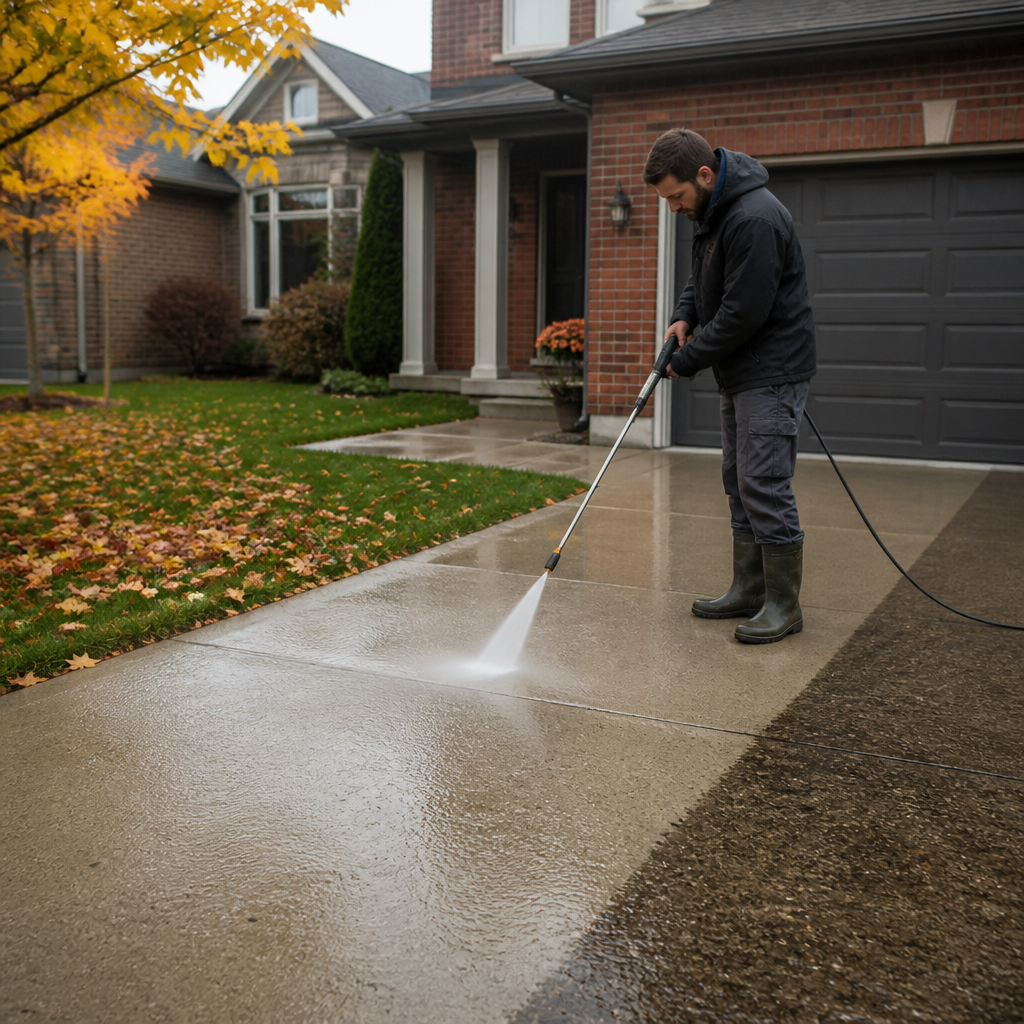
On residential calls, we see the same pattern every year. Homeowners wait until the leaves are down, then call in a rush before the first hard frost. That timing works for some jobs and fails for others, especially when a stain gets hit with the wrong nozzle or a rushed pre-treatment. If you want the driveway, gutters, and eavestroughs handled in one visit, our exterior cleaning services cover all three.
What Leaves and Parked Cars Leave Behind
Tannins from leaves dissolve in water, which sounds harmless until they dry into a faint line along the low spots. Oil behaves differently. It sits in the pores of the concrete and resists plain water, so a driveway can look clean after a rinse and still show a dark outline where the car parks. Most fall driveways we are asked to clean have both problems, usually along the edge where the car sits and underneath the leaf pile nobody swept.
Pro tip: Sweep loose leaves and grit off the driveway before anyone touches a pressure washer. Pushing a wet leaf mat around with a surface cleaner smears tannin across the slab and makes the stain harder to lift.
Why Gutters Come First
Clean the eavestroughs before you wash the driveway. Debris and dirty water from the roof run straight across a freshly washed surface and leave streaks that look like the driveway never got cleaned. We schedule gutter and eavestrough work first on the same visit whenever possible, so the driveway is the last surface hit with water.
Choosing Your Pressure Washer
Equipment matters more than the brand name on the box. A January 2026 driveway guide from a painting contractor describes a machine offering between 2,000 and 3,000 PSI with at least 2.0 GPM as a sound starting point for most residential driveways. We agree with that range, and we would add a caution: above it, you pay for speed you rarely need on concrete and raise the odds of damaging the surface.
PSI and GPM: The Numbers That Matter
PSI measures how hard the water hits the surface. GPM measures how much water moves, and that is what actually cleans a full driveway quickly. A high-PSI, low-GPM machine can strip a stain line but takes forever on a large slab, while a moderate-PSI, higher-flow unit lifts grime across the whole surface without etching it. When a seller leads with the PSI figure, ask about flow next.
Electric, Gas, or Cordless for a Hamilton Driveway
Electric units are quieter, lighter, and easy to store in a garage, but they depend on a solid outlet and a proper extension cord, and their output is more limited. Gas units deliver more flow for larger driveways and keep running through a long job. Cordless units suit small driveways and quick touch-ups, because battery runtime limits how much concrete you can cover in one session.
Wirecutter’s current pressure washer roundup names a 2,600 PSI electric jobsite unit as its top pick, and its testers also worked through several cordless models from different brands. Their results are a useful reminder that the best machine depends on the size of the driveway and how often you will use it.
Pro tip: Before you buy an electric unit, check which circuit it will run on. Sharing a garage circuit with a space heater or a freezer is the fastest way to trip a breaker halfway through a driveway.
Surface Cleaners, Nozzles, and Attachments
A surface cleaner is the single biggest upgrade for driveway work. It is a flat head with rotating jets that sits a fixed distance above the concrete, which keeps pressure even across the slab. A hand wand works well on spot stains, but on a full driveway it leaves overlap lines, zebra streaks, and sore arms.
Why a Surface Cleaner Beats the Wand on Flat Concrete
A residential pressure washing thread on a community forum describes the method we rely on: break the driveway into sections, pre-treat one section, run the surface cleaner over it, and rinse before the treated area dries. The same thread advises rinsing halfway through the process, which keeps a section from drying with a tannin ring on it. We follow that logic on every job because it stops half-finished sections from staining.
The surface cleaner also helps with consistency. Each pass has the same height and pressure, so the finished driveway looks uniform rather than patchy. That matters most on light-colored concrete, where any uneven pass shows.
Nozzle Angles and Where Driveways Get Damaged
Nozzle angle controls how concentrated the water is. A 0-degree tip is a pencil of force that can etch concrete and blow sand out of paver joints, so keep it away from residential flatwork. A 25-degree tip works as the default, and a 40-degree tip suits delicate pavers or painted surfaces.
A common mistake is using a narrow tip at close range to chase a stubborn stain. That focuses enough force to leave a pattern on a light slab. If a stain will not lift from a safe distance, the answer is chemistry and dwell time, not more pressure.
| Setup | Best Use | Main Drawback |
|---|---|---|
| Hand wand with a 25-degree tip | Spot stains, edges, and small patios | Uneven results and fatigue on a full driveway |
| Electric unit with a rotary surface cleaner | Standard residential driveways of moderate size | Limited flow, so large driveways take patience and a good outlet |
| Gas unit with a rotary surface cleaner | Large driveways and multi-surface jobs | Louder, heavier, and needs careful fuel handling and ventilation |
Timing Your Fall Wash
Timing is where most fall jobs go wrong. Concrete needs time to dry, and any water left in cracks, joints, and pavers will freeze if overnight temperatures drop below zero. A driveway that looks spotless at four in the afternoon can crack or scale after a hard freeze a few nights later.
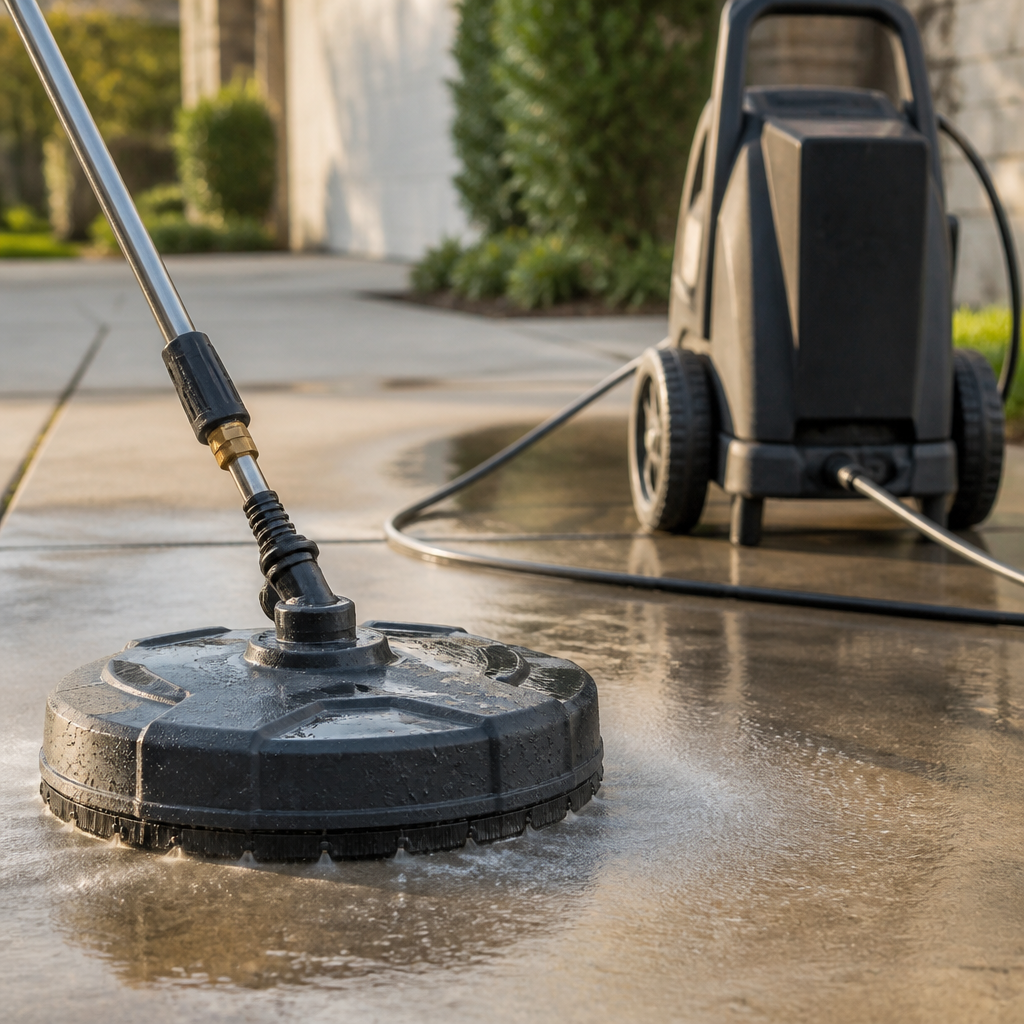
We aim for mild days when the surface dries within a few hours and nights stay above freezing. Late October already gives Hamilton homeowners a short window, and by the time a cold snap shows up in the forecast, it is often too late to wash safely. Plan the job early rather than waiting for a sunny weekend.
Reading the Forecast Before You Book
Check the overnight low for the next two or three nights, not just the daytime high. If a freeze is forecast within a day of the wash, move the job. Washing on a sunny afternoon with a cold night ahead is one of the most common ways a clean driveway turns into a scaling problem by spring.
Starting Early So the Slab Dries Before Dark
Start in the morning so the concrete has hours of daylight to dry. A wash finished near dusk leaves water pooled in low spots overnight, and pooled water is what freezes first. Sun on the slab also helps prevent the uneven drying that leaves faint outlines on the surface.
The season matters too. Once the leaves are fully down and the eavestroughs are clear, you have one good window to wash before winter. Waiting until spring means a full season of tannin and oil has soaked into the surface, and that work costs more to reverse.
Pre-Treating Stains Before the Pressure Starts
Pre-treatment does most of the work on a fall driveway. A pressure washer lifts loosened grime, but it will not dissolve oil that has had a season to soak in. Apply a suitable cleaner to the stained areas, let it dwell as the label directs, and only then run the surface cleaner over that section.
Oil Stains and Degreasers
Oil from parked vehicles responds to an alkaline degreaser applied directly to the spot and scrubbed with a stiff brush before rinsing. Work the product into the stain rather than splashing it across the slab. If a rainbow sheen survives one treatment, a second application usually beats adding more pressure.
Pro tip: Keep the pre-treated section wet until the surface cleaner reaches it. Degreaser that dries on concrete can leave its own film, and that film is often harder to remove than the oil it was meant to lift.
Tannin and Leaf Staining
Leaf tannin responds to a dedicated tannin remover or a mild oxygen-based cleaner, not to a heavy degreaser. Treat the stained patches and work in shade if you can, since direct sun dries product too quickly to penetrate. Rinse thoroughly, because leftover residue can attract dirt and cause a second round of staining.
Protect plants along the edge as well. Wet the planting beds before applying any chemical, and rinse the foliage with clean water afterward. The step takes a few minutes and saves a lot of cleanup.
Washing Technique and Common Mistakes
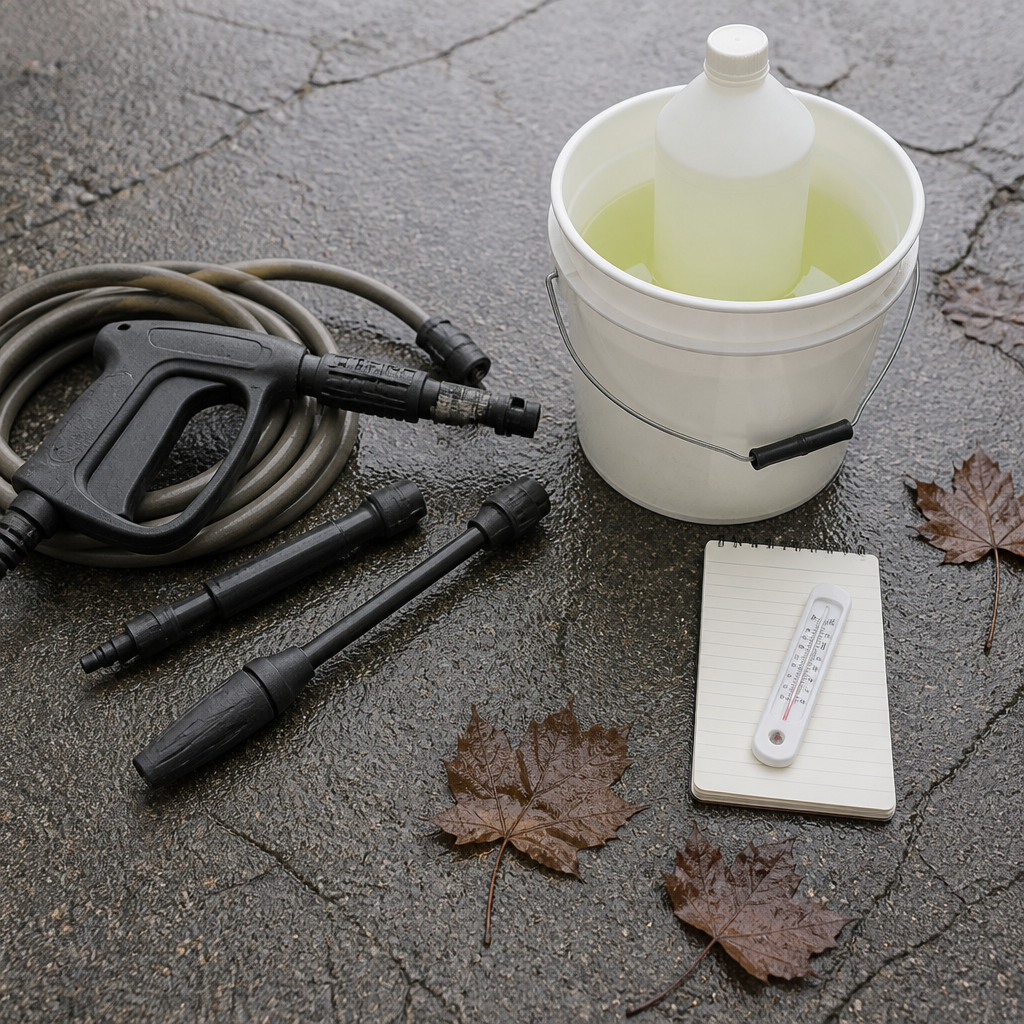
Work in sections about one car width wide. Pre-treat each section, run the surface cleaner over it, and rinse before it dries. Overlap each pass by a few inches so no stripe is left behind, and keep the machine moving, because a paused surface cleaner can leave a dark ring or an etch line.
Working Section by Section
Start at the far end of the driveway and work back toward the garage or street, so you are never stepping on concrete you have just cleaned. Check each section for missed spots before moving on. A second pass on a dry surface is harder to blend in, and it often shows as a lighter patch.
Mistakes That Cost Homeowners Money
The most expensive mistake is using the wrong tip and damaging the surface. The second is skipping the final rinse, which leaves a detergent film that attracts dirt within days. The third is washing the day before a freeze, which hides any damage until the spring thaw reveals it.
On a driveway, the cheapest cleaning is the one you do once, correctly, in the right week of the year.
Pro tip: Stop the wash if water starts pooling or the surface darkens unevenly. That usually means a section was not rinsed or the nozzle is too close, and catching it early saves a return visit to fix a patch.
Frequently Asked Questions
What PSI should I use on a Hamilton driveway?
Start between 2,000 and 3,000 PSI with at least 2.0 GPM on residential concrete, paired with a 25-degree tip on a wand. Increase pressure only if a specific stain will not lift with pre-treatment and dwell time.
Is it too late to pressure wash my driveway in late October?
It depends on the forecast, but the rule is simple. Wash only when days are mild enough for the surface to dry and nights stay above freezing. If a hard freeze is due within a day or two, wait for the next mild stretch.
Do I need a surface cleaner, or can I use a wand?
For a full driveway, a surface cleaner gives more even results and less fatigue. A hand wand is better suited to spot stains, oil marks, and edges.
Can pressure washing damage pavers?
Yes, if you use a 0-degree tip or too much pressure. Pavers can lose joint sand and shift, so use a wider tip, keep the wand moving, and re-sand the joints after the surface dries.
Should gutters be cleaned before the driveway?
Yes. Debris and dirty water from the gutters will run across a freshly washed driveway and leave streaks, so clean the eavestroughs first.
Is renting equipment a good option for one driveway?
Renting can work for a single job if you bring a 25-degree tip and a degreaser suited to oil. If you expect to wash several times a year, buying a unit usually makes more sense.
Tell us what worked, or what went wrong, the last time you washed your driveway in the fall.
We would love your feedback and any insights you would share with others. What perspective would you add?
References
- Step-by-step guide to pressure washing a driveway, from choosing a washer to rinsing
- Residential forum discussion on sectioning driveways and using a surface cleaner
- 2026 driveway guide covering pressure and flow ratings for residential surfaces
- Wirecutter review roundup of tested pressure washers, including electric and cordless models