
Every October, Burlington homeowners walk around the outside of their houses and discover the same thing: green streaks running down the siding, fuzzy black patches near the foundation, and a faint musty smell coming from the north-facing wall. The culprits are moss, algae, and mildew, and a wet Ontario summer gives all three exactly what they need to thrive. If you are researching siding cleaning in Burlington right now, you are probably looking at a wall that has not been professionally cleaned in at least two or three seasons and wondering whether it is a cosmetic issue or something that could actually damage your home. The answer matters, and so does what you do next.
Table of Contents
- Quick Takeaways
- Why Burlington Summers Feed Biological Growth on Siding
- Identifying Moss, Algae, and Mildew: They Are Not the Same Thing
- What Happens If You Leave It on the Siding
- DIY vs. Professional Siding Cleaning in Burlington
- Comparison: Three Cleaning Approaches for Ontario Homeowners
- Hand Washing Siding: Why the Method Matters as Much as the Product
- Prevention After Cleaning: Keeping Siding Cleaner Longer
- Frequently Asked Questions
- References
Quick Takeaways
| Key Insight | Explanation |
|---|---|
| Algae and mildew are not the same problem | Algae is photosynthetic and needs light; mildew is a fungus and grows even in shade. Each needs a slightly different treatment approach. |
| North-facing walls suffer most | In Burlington, north and northeast-facing siding stays wet the longest after rain because it receives the least direct sun, creating ideal conditions for moss and mildew. |
| Pressure washing can make things worse | High-pressure water forced into siding seams, corner posts, and around window frames pushes moisture into the wall assembly, causing exactly the conditions biological growth needs to return. |
| Algae spores wash down from the roof | If your roof has algae or moss, every rain event carries spores directly onto the siding below. Cleaning siding without addressing the roof is a short-term fix only. |
| Hand washing is the safest method for most siding types | Soft brushes and appropriate cleaning solutions applied by hand remove biological growth without damaging vinyl, fiber cement, or wood siding surfaces. |
| Older siding is more vulnerable | Micro-scratches and oxidation on aged vinyl and wood siding create a textured surface where spores grip and colonize faster than on newer material. |
| Annual cleaning prevents structural costs | Biological growth that penetrates past the surface layer, especially on wood siding, accelerates rot. Regular exterior cleaning is far cheaper than siding replacement. |
Why Burlington Summers Feed Biological Growth on Siding
Burlington sits on the western edge of Lake Ontario, and that geography creates a distinctive local climate. Summer humidity regularly pushes into the mid-to-high range, and the city sees consistent rainfall from June through September. When a stretch of wet, overcast days is followed by warm temperatures, the exterior surfaces of a house become a productive environment for moss, algae, and mildew simultaneously.
Mature tree canopy is a contributing factor that most Burlington homeowners underestimate. Many neighbourhoods in the city have well-established deciduous trees that shade large portions of exterior walls. Shaded siding dries significantly more slowly after rain. Combined with the organic material that falls from those trees, including pollen, sap, leaf debris, and dust, you have a surface that is consistently moist and nutrient-rich enough to support biological colonisation through autumn.
Ontario’s climate pattern is particularly relevant here. Humid summers give way to wet falls, and then cold winters keep moisture trapped against north-facing surfaces for months at a time. By the time spring arrives, the growth that started in late summer has had an entire cold season to establish itself deeper into the surface texture of the siding.
A wet Ontario summer does not just feed biological growth in the short term. The moisture that lingers through autumn and freezes in winter forces spores deeper into porous siding materials, making a late-summer or early-autumn cleaning the most effective window for intervention.
Pro tip: Walk the perimeter of your house in early October, specifically looking at the lower two feet of siding and any wall that faces away from direct afternoon sun. These are the areas that accumulate growth first and most aggressively after a wet summer in Burlington.
Identifying Moss, Algae, and Mildew: They Are Not the Same Thing
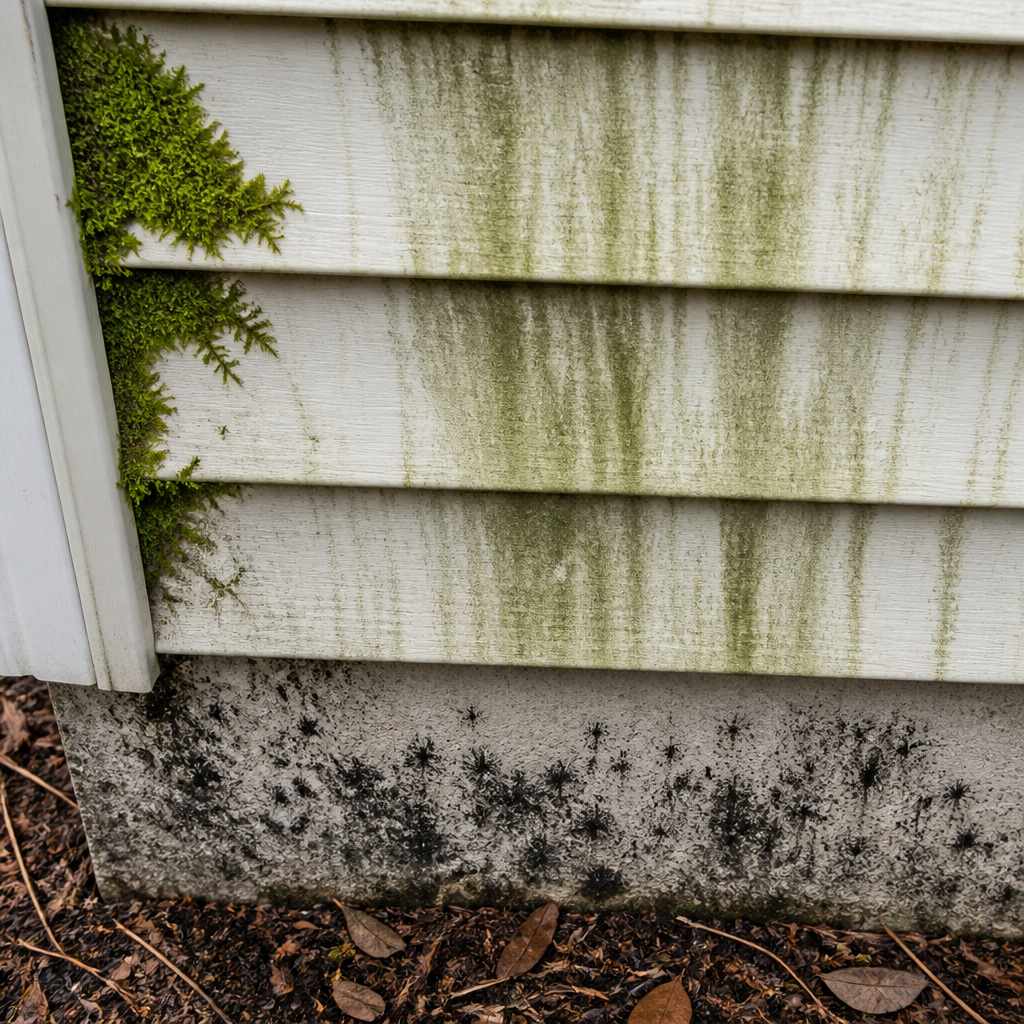
Burlington homeowners often use these three terms interchangeably, but treating them as the same problem leads to incomplete results. Each organism has a different appearance, growth pattern, and response to cleaning agents.
Algae on Siding
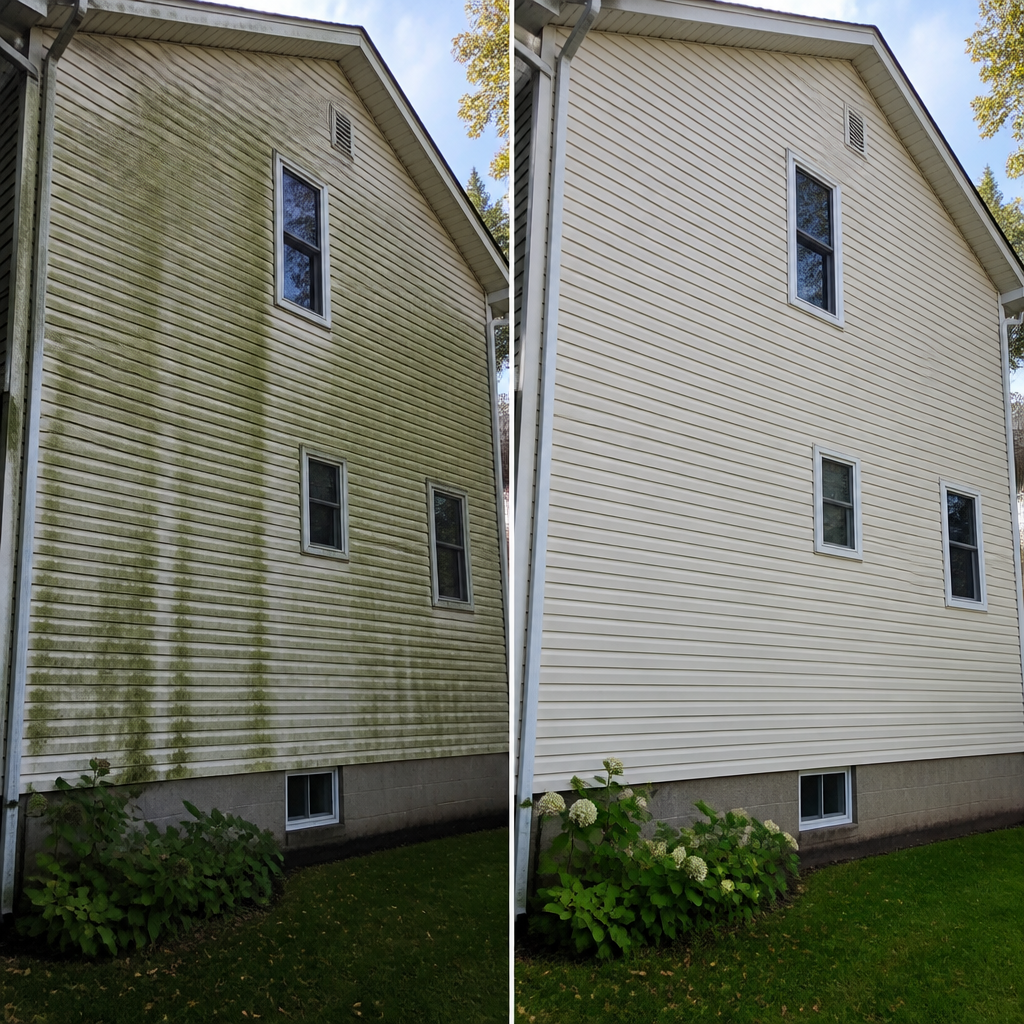
Algae typically shows up as a green or greenish-grey film, often with a slightly slippery texture when wet. It is photosynthetic, meaning it needs light to survive, so you will find it predominantly on south and west-facing walls that receive sun but also experience regular moisture. Roof runoff is one of the main delivery mechanisms: rain carries algae spores from the roof surface directly down the siding face. If you have a green streak running vertically from a soffit or eavestrough seam, algae from the roof is the probable source.
Mildew on House Siding
Mildew is a fungus, not a plant, and it does not need light to grow. It appears as dark spots, black blotchy stains, or greenish-brown patches, most commonly on north-facing walls and under eaves where ventilation is poor and surfaces stay damp. Mildew on house siding is the most common complaint from Burlington homeowners after a wet summer, and it is also the one most commonly mistaken for dirt.
Moss on Siding
Moss has a three-dimensional, fuzzy or carpet-like texture that sets it apart from algae and mildew. It anchors itself into surface texture and is most common on wood siding, rough stucco, and brick, though it can establish on any surface that retains moisture long enough. Moss is harder to remove than algae because its root-like structures hold onto the siding material itself, not just the surface layer.
In practice, most Burlington homes after a wet summer will have all three present at the same time, in different locations and at different stages of growth. A thorough inspection needs to walk each elevation of the house separately before any cleaning work begins.
What Happens If You Leave It on the Siding
The most common mistake Burlington homeowners make is treating visible biological growth as a cosmetic issue and scheduling it for “next spring.” That delay has real consequences, particularly going into autumn and winter.
For vinyl siding, the practical risk is staining. Algae and mildew that stays on vinyl through a winter will discolour the surface in ways that become progressively harder to remove. The organic acids produced by these organisms react with the vinyl surface over time, permanently etching the appearance if left long enough.
For wood siding and fiber cement siding, the risk is more serious. Biological growth that is not cleaned off holds moisture against the material surface. On wood, that sustained moisture exposure leads to softening and eventually rot. On fiber cement, it accelerates paint failure, which then exposes the substrate to moisture penetration. What starts as a cleaning job becomes a repair or replacement project if ignored across multiple seasons.
There is also a gutter connection that many homeowners miss. When moss and algae colonise the siding near rooflines, the same organic material is usually building up in the eavestroughs above. Blocked eavestroughs overflow, directing large volumes of water against the upper portion of the wall and compounding exactly the moisture problem that feeds biological growth in the first place.
Pro tip: If your eavestrough is overflowing during rain events, the moisture cascade onto your siding is not accidental. Eavestrough cleaning and siding cleaning should always be done in the same service visit for Burlington homes, because solving one without the other produces a partial result.
DIY vs. Professional Siding Cleaning in Burlington
There is a legitimate DIY path for siding cleaning, and it is worth being honest about when it works and when it does not. For mild algae growth on accessible single-storey walls, a homeowner with the right brush, an appropriate cleaning solution, and a garden hose can achieve a decent result. Mild dish soap mixed with water is effective on light growth. For heavier buildup, oxygen bleach solutions are more effective and considerably gentler on landscaping than chlorine bleach.
The DIY approach breaks down in several common Burlington scenarios:
- Two-storey or split-level homes where upper wall sections cannot be safely reached without ladders
- Homes with established moss, where surface scrubbing is not sufficient to remove anchored root structures
- Heavily shaded north-facing walls with mildew that has penetrated into surface texture over multiple seasons
- Any situation where the homeowner reaches for a pressure washer to compensate for limited elbow grease
The pressure washer issue is worth emphasising. Forcing high-pressure water into vinyl siding seams, around corner posts, or at window and door frames pushes water directly into the wall assembly behind the siding. That trapped moisture creates the exact warm, dark, damp environment where mildew thrives, meaning a pressure-washed house often shows renewed growth faster than one that was not cleaned at all.
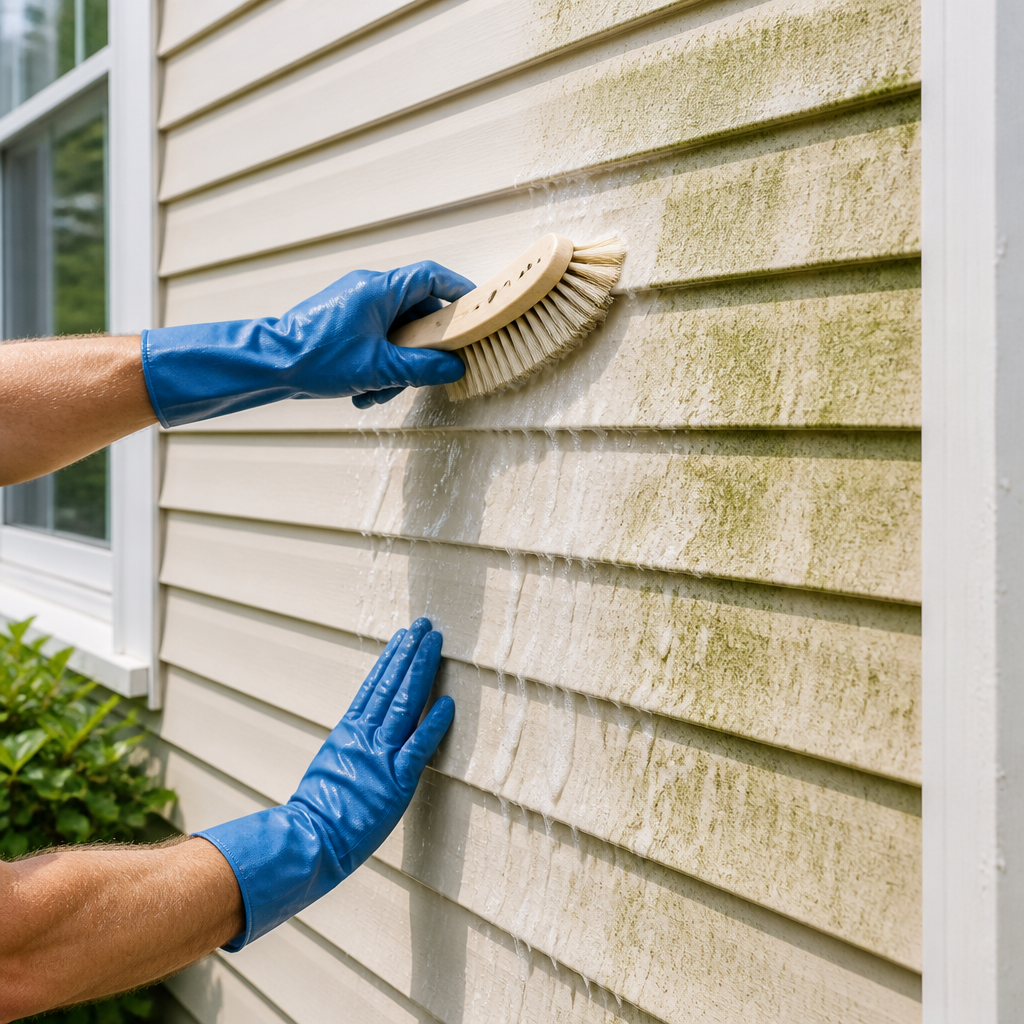
Home exterior cleaning in Burlington done professionally uses soft brushes, appropriate cleaning chemistries matched to the siding type, and controlled application pressure that removes growth from the surface without forcing water into the structure.
Comparison: Three Cleaning Approaches for Ontario Homeowners
| Approach | Best For | Key Limitations |
|---|---|---|
| DIY hand scrubbing with mild cleaner | Light algae or mildew on accessible single-storey walls; fresh growth caught early in the season | Labour-intensive; insufficient for established moss or multi-storey homes; easy to miss shaded sections |
| Pressure washing (high pressure) | Hard, impermeable surfaces like concrete driveways and brick retaining walls | Not recommended for vinyl, wood, or fiber cement siding; forces water into wall assembly; can strip paint and damage seals around windows |
| Professional hand washing with appropriate cleaning solutions | All siding types; multi-storey homes; established moss and mildew; homes with tree canopy shading; annual maintenance cleaning | Requires scheduling; higher upfront cost than DIY, though far less than remediation or siding replacement if biological damage is left to progress |
Hand Washing Siding: Why the Method Matters as Much as the Product
Hand washing siding in Ontario is not a lesser substitute for pressure washing. It is the correct method for residential siding surfaces, and the distinction matters most for Burlington homes with mixed siding materials, detailed trim work, or older surfaces.
The process starts with a thorough pre-rinse using a standard garden hose. This removes loose surface material and saturates the siding before any cleaning solution is applied. The pre-rinse also creates a water buffer over nearby plants and grass, which reduces contact with cleaning solutions.
Cleaning solution is then applied and allowed to dwell. Five to ten minutes of dwell time lets the chemistry work on the organisms themselves rather than requiring aggressive mechanical scrubbing to compensate. During this period, you can often see the colour of algae or mildew changing as the organisms begin to break down.
Soft-bristle brushes matched to the siding profile do the actual cleaning work. The goal is surface agitation, not pressure. On vinyl siding, the brush follows the profile of the panel. On wood, direction matters: always scrub with the grain to avoid raising the wood fibre surface.
The final rinse uses a garden hose at normal pressure working from top to bottom, so that rinse water and loosened material runs down the wall without being re-deposited on already-cleaned sections below.
Why Siding Type Changes the Approach
Vinyl siding is the most forgiving surface and handles most standard cleaning solutions without issue. Wood siding requires more care around cleaning chemistry because harsh alkaline solutions can raise the grain and accelerate paint failure. Fiber cement, which is common in Burlington neighbourhoods built after 2000, needs to be dried promptly after cleaning because sustained moisture exposure is exactly what its manufacturer warranties caution against. A professional who works on all three material types in the same day handles each differently, which is something a one-size approach cannot replicate.
Prevention After Cleaning: Keeping Siding Cleaner Longer
Cleaning siding in autumn is the right move for Burlington homes. Preventing the same buildup from returning the following summer requires addressing the conditions that allowed it to establish in the first place.
Drainage is the most controllable factor. Water pooling near the foundation creates a persistently moist environment at the base of the siding. Downspout extensions that direct water at least two metres from the foundation significantly reduce moisture contact at the most vulnerable siding zone. Grading that slopes away from the house does the same thing passively.
Trimming shrubs and trees that press against the siding wall improves airflow. Reduced airflow is one of the main reasons north-facing siding in Burlington stays wet long enough after rain to support biological growth. A gap of at least 30 centimetres between vegetation and the siding surface makes a measurable difference in drying time.
Roof treatment is the prevention step that most homeowners skip because it is invisible from the ground. If your roof has moss or algae, every rain event is carrying spores and organic material directly onto the siding below. Cleaning the siding while leaving an active roof source untreated means the siding will recolonise within one or two seasons. Zinc strips installed near ridge caps are a passive long-term deterrent to roof algae regrowth.
For homes with significant tree canopy, an annual exterior cleaning schedule is realistic and cost-effective. The biology of Burlington’s summer climate means that some level of growth will occur each year on shaded or north-facing walls. Annual professional cleaning keeps it at the surface level, where it is inexpensive to address, rather than allowing multi-season accumulation that requires more intensive work to remove.
Frequently Asked Questions
How do I know if what is on my siding is algae, mildew, or just dirt?
The easiest test is texture and location. Algae typically feels slightly slippery when wet and appears as a greenish film, most often on sun-exposed walls. Mildew presents as dark spots or irregular black and greenish-brown patches, usually on shaded or north-facing walls. Dirt tends to accumulate in horizontal ledges and follows water streaks downward uniformly. If you wipe a small area with a damp cloth and the discolouration remains, it is likely biological growth rather than loose dirt.
Is mildew on house siding a health risk for my family?
Exterior mildew on siding itself is generally not a direct indoor air quality concern, because it is growing on the outside of the building envelope. However, if mildew has penetrated to areas near window frames, door seals, or any gaps in the building envelope, there is a pathway for spores to enter the living space. The more significant risk is that untreated exterior mildew indicates sustained moisture against the wall assembly, which over time can lead to interior moisture problems. Cleaning exterior biological growth is always worth doing regardless of the indoor risk assessment.
Can I use bleach to clean algae off my siding?
Diluted chlorine bleach is effective on mildew and algae, but it carries risks that make it a last-resort option rather than a first choice. Chlorine bleach can discolour or damage landscaping, and on certain siding materials it can accelerate paint degradation or react with surface coatings. Oxygen bleach is a safer and more environmentally considerate alternative that handles moderate to heavy biological growth effectively. For vinyl siding specifically, oxygen bleach mixed with dish soap and water is a well-established cleaning combination that removes most biological growth without the collateral risks of chlorine bleach.
How often should Burlington homeowners have their siding professionally cleaned?
For most Burlington homes with mature tree coverage or north-facing wall sections, once a year is the right interval. The best timing is late summer or early autumn, before the first freeze locks in whatever biological growth established over the summer. Homes in more open settings with good sun exposure on all elevations can often extend that to every two years, but any season that brings above-average rainfall should prompt an inspection regardless of the last cleaning date.
Does eavestrough cleaning need to happen at the same time as siding cleaning?
Yes, in most cases it should. Overflowing or blocked eavestroughs direct large volumes of water down the upper portion of your siding with every rain event, which is one of the primary causes of algae and mildew streaking from the roofline down. Cleaning the siding without clearing the eavestroughs leaves the moisture delivery mechanism in place, meaning the same sections of siding will show regrowth faster than they should. For Burlington homes going into autumn, combining eavestrough cleaning with siding cleaning in one visit is the most complete approach.
Will power washing remove moss from my siding?
High-pressure washing can blast moss off the surface, but it does so at a cost. Moss attaches to siding with root-like structures, and forcing it off with pressure tends to abrade the surface layer of vinyl or wood siding in the process. More importantly, the high-pressure water that dislodges the moss also penetrates seams and openings in the siding, depositing moisture behind the wall surface. Hand washing with an appropriate cleaning solution is more effective because it kills the moss at the organism level, making it easier to remove without mechanical force and without the risk of water intrusion.
What siding types are most vulnerable to algae and mildew in Ontario’s climate?
Wood siding is the most vulnerable because it is an organic material that biological growth can actually feed on, not just colonise. Aged vinyl siding with micro-surface scratches and oxidation is the next most vulnerable because the surface texture gives spores more to grip. Fiber cement siding is more resistant but not immune, particularly at areas where paint has weathered. New vinyl siding in good condition is the most resistant of the common residential types because its smooth, non-porous surface gives algae and mildew spores very little to adhere to.
Have you noticed moss, algae, or mildew on your Burlington home’s siding this fall? Share what you found and where on the house it appeared in the comments below.
References
- How Ontario’s climate contributes to algae and mould growth on residential siding
- Why pressure washing damages siding and how to safely clean algae with soap and oxygen bleach
- How to identify and remove mildew from home siding surfaces
- How algae and mildew grow on vinyl and fiber cement siding and how to prevent their return
- Burlington, Ontario climate averages including summer humidity and precipitation patterns