
Most Hamilton homeowners treat siding washing as a spring job, then wonder why the brown streaks and dark patches from October are still there in April. Autumn staining behaves differently from the pollen and road grime you deal with in summer. Wet leaves, shaded walls, and cooling temperatures work together to bond stains to the surface, and a quick pass with the hose rarely lifts them. Below, we explain why fall stains resist cleaning, what actually works on siding, and when a hand wash beats a pressure washer. Siding washing in Hamilton this fall is a timing problem as much as a cleaning problem.
Table of Contents
- Quick Takeaways
- Why Autumn Staining Is Different From Summer Dirt
- Leaves, Gutters, and Overflow Stains
- Why Cold Weather Makes Stains Harder to Lift
- Hand Washing vs Power Washing Your Siding
- Step-by-Step Hand Wash for Hamilton Siding
- Choosing the Right Method
- Common Mistakes That Set Autumn Stains
- Timing Your Siding Wash Before Winter
- Frequently Asked Questions
- References
Quick Takeaways
| Key Insight | Explanation |
|---|---|
| Leaf stains are tannin stains | Wet leaves leave brown outlines and rain-run streaks within days. Fresh stains lift with a brush and mild detergent, while stains that have sat through several damp weekends need a second pass. |
| Clogged eavestroughs cause vertical stripes | Overflowing water runs down the same section of wall every storm. Clear the gutters first, or the stain returns after the next rain. |
| The shadiest walls grow mildew first | Walls that stay damp for days after rain develop algae and mildew before any other part of the house. Check under eaves and along shaded corners after a rainy week. |
| Cold, wet siding resists cleaners | Detergents and oxygen bleach work slower on cold surfaces. Schedule washing for mid-afternoon on mild days, and skip nights when a freeze is forecast. |
| Pressure can lift vinyl edges | High pressure can force water behind lap joints and lift the bottom edge of vinyl panels. Use a soft brush or a low-pressure soft wash on siding. |
| Never mix cleaning products | Combining a bleach product with another cleaner can create fumes and reduce effectiveness. Use one product at a time and rinse thoroughly between applications. |
| Remove spider webs before washing | Webs and egg sacs collect under soffits and in siding corners as the weather cools. Brush them down first so the cleaner reaches the surface. |
Some of the most stubborn siding problems we see in Hamilton start as ordinary autumn leaves. Those leaves look harmless on the lawn, but they become a staining source once they are soaked and pressed against a wall. Understanding the mechanism is the first step to choosing the right cleaning method.

Why Autumn Staining Is Different From Summer Dirt
Summer grime on siding is mostly dust, pollen, and road film. It sits on the surface and comes off with a soft brush and a mild detergent in one pass. Autumn stains are a different category because they are organic, and they begin to bond with the siding as soon as they get wet.
Tannin stains from wet leaves
Leaves release tannins when they get wet, the same compounds that give tea its color. When a damp leaf sits against vinyl, fiber cement, or painted wood for a week, it leaves a brownish outline and a faint yellow-brown wash. Rain running off that leaf carries the color down the wall in streaks.
Tannins dissolve in water, but they also grip the fine texture of the siding. A rinse moves some of the color, and the rest stays until a detergent has time to break that bond. In practice, a stain from last week often lifts with a bucket and a brush, while one that has survived two weekends of drizzle usually needs a second pass.
Shade, moisture, and early mildew
The shadiest walls on most Hamilton homes stay damp for days after rain, especially where a deck, hedge, or tall tree blocks the sun. That band of siding is where algae and mildew start in September and October, when nights are cool and the wall dries slowly. Once the growth is established, it looks like dirt but behaves like a living stain.
Pro tip: After a rainy week, walk the perimeter of the house and look for dark, fuzzy patches or streaks under the eaves. Catching them in October is far easier than scrubbing them off in May.
Autumn sun is weaker and lower than summer sun, so it dries the wall less effectively. That is why a stain that disappeared in August can look worse by the end of October. The moisture is still there, and it is feeding the growth.
Leaves, Gutters, and Overflow Stains
Clogged gutters are the single biggest source of siding stains we see in autumn. When an eavestrough overflows, water sheets down the wall in the same spot every time it rains. It carries dissolved leaf material and grit with it, leaving a dark vertical stripe below each joint or downspout.
Overflow patterns below the eavestrough
Look for stains that start at a joint or corner rather than spreading evenly across the wall. These usually point to a sagging section, a blocked downspout, or a leaking seam. Cleaning the siding without clearing the gutters means the stain comes back after the next storm.
Stains that begin right under a gutter seam and run straight down tell you the gutter is the source. Stains that spread sideways across a wide section usually come from water sitting on a ledge or from leaves packed in the trim. Each pattern points to a different fix.
Downspouts and splash-back
Downspout outlets that dump water right against the wall splash mud and organic matter onto the lower courses of siding. A short extension that moves water a few feet away from the house prevents that splash. It is a cheap fix that keeps the bottom of the wall from staining every rain.
Clean the gutters first, then the siding, so you are not rinsing debris onto freshly washed walls. Doing it in that order also tells you whether the stain you are seeing is from the gutter or from the wall itself. This is why we often bundle gutter and eavestrough cleaning with siding work when homeowners ask for both.
Why Cold Weather Makes Stains Harder to Lift
Cleaning chemistry slows down as temperatures fall. Detergents and oxygen bleach work best when the surface and the solution are warm enough to loosen the stain, and a wall in morning shade can be close to freezing even on a mild afternoon. A product that worked well in August may seem to do nothing in late October.
Choosing a working window
Plan washing for the middle of the day, when the wall has had some sun. Avoid applying any solution when frost is expected, because it can freeze on the surface and will not rinse properly. If the overnight low is near freezing, put the job off until the weather settles.
Work on the sunny side of the house first if you have a choice. The sunny walls will dry faster, and you can move back to the shadier sections once they have warmed. Keeping the work in that order reduces the chance of streaks.
Drying time and trapped water
Siding that stays wet overnight in cool weather grows mildew faster than siding that dries by evening. Rinse thoroughly, then leave the wall in the afternoon sun to dry. If rain is expected that night, consider a smaller section rather than the whole wall.
Autumn stains rarely survive because the cleaner was too weak. They survive because the wall was too cold or too wet for the cleaner to do its job.
The fix is almost always about conditions and sequence, not stronger chemicals. A mild detergent on a warm, dry-enough wall often outperforms a harsh product on a cold, damp one.
Hand Washing vs Power Washing Your Siding
Power washers are fast, and for concrete or a deck they are often the right tool. On siding, they can cause damage when used carelessly. High pressure can force water behind lap joints, lift the edge of vinyl, and etch softer painted finishes. Hand washing takes longer, but it gives you control over every section of the wall.
Where a pressure washer fits
Pressure washing is useful for driveways, walkways, and sealed decks, where the surface can handle the force and the water has an easy path away from the house. If you do use a pressure washer near siding, use a wide fan tip, a low setting, and keep the nozzle at a safe distance from the wall. Never aim the spray upward under the lap, because that is how water gets behind the panels.
Why hand washing wins on stained siding
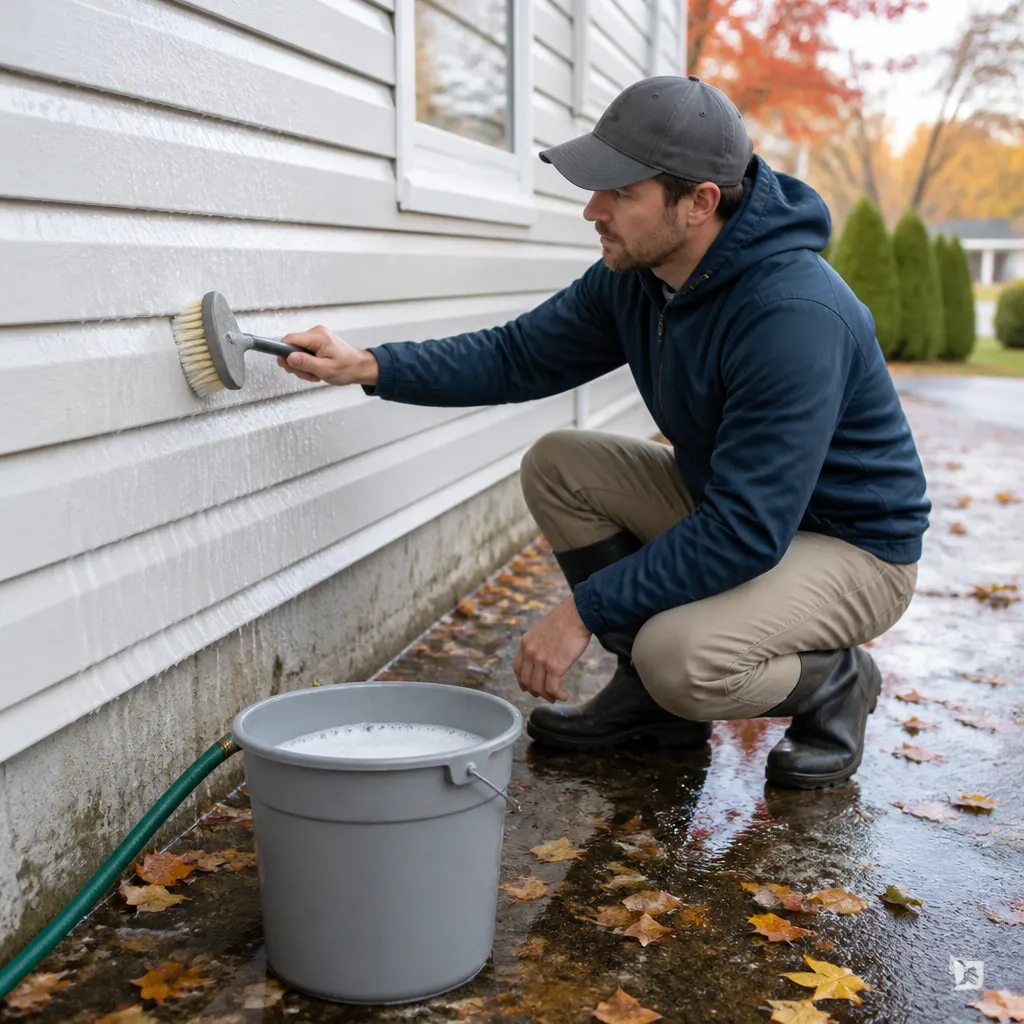
A soft brush and a bucket of cleaning solution let you target the tannin stain and the mildew line without spraying the rest of the house. You also control dwell time, which matters because the cleaner needs a few minutes to work. Hand washing lets you check for loose trim, cracked panels, and failing caulk while you work.
For most Hamilton homes, hand washing takes a few hours for an average house with a ladder, a hose, and a helper. That time is worth it because the stain comes off the surface rather than being pushed deeper into it. You also end up with a wall that looks clean rather than one that just looks wet.
Step-by-Step Hand Wash for Hamilton Siding
A reliable hand wash follows a simple sequence. The steps matter more than the product you choose, because a good cleaner applied in the wrong order still leaves streaks. Work in sections, keep the solution from drying on the wall, and finish with a thorough rinse.
Mixing and testing the solution
For routine tannin stains, a mild dish soap in warm water is a good starting point. For established mildew or algae, an oxygen bleach cleaner made for siding is a better choice, used at the dilution on the label. Oxygen bleach is generally gentler on nearby plants than harsher bleach products when it is used properly.
Test any solution on a small hidden area first, such as the back of a garage wall or an inside corner. Stronger chemicals are not always the best choice, and some siding finishes react badly to them. Never mix cleaning products together, and rinse the wall fully between different products.
Working from the bottom up
Wet a section with clean water, then apply the solution from the bottom up. Working upward keeps the cleaner from running down into areas you have not yet washed, which is a common cause of streaks. Let the solution dwell for the time the label recommends, then scrub gently with a soft brush following the panel lines.
Do not let the solution dry on the siding. On a warm afternoon, work in sections that you can finish within a few minutes. If the wall starts to dry, wet it again before you continue.
Rinsing and checking for missed spots
Rinse from the top down so the dirty water runs off the wall rather than into areas already cleaned. Pay attention to the corners, under the eaves, and around window trim, because that is where leaves and webs collect. Brush down spider webs and egg sacs before rinsing so they do not get smeared across the wall.
Once the wall is dry, walk around and look at it in the sun. Any remaining brown outline usually needs a targeted second pass with the brush, not a stronger cleaner. Spot-treat those areas and rinse again.
Choosing the Right Method
Three approaches cover most autumn siding jobs in Hamilton. Each one has a clear best use and a clear risk. The table below compares them so you can match the method to the stain and the surface.
| Method | Best For | Main Risk |
|---|---|---|
| Hand wash with soft brush and mild detergent | Fresh tannin stains and light mildew on vinyl, painted wood, and fiber cement | Slower than other methods, and high spots may need a ladder and careful footing |
| Low-pressure soft wash with oxygen bleach cleaner | Established algae and mildew in shaded areas where the stain has bonded | Needs proper dwell time and a thorough rinse, and runoff can reach nearby plants if not controlled |
| High-pressure power washing | Concrete, driveways, and sealed decks | Can force water behind siding, lift vinyl edges, and etch softer finishes |
For siding, the first two options are almost always safer. The hand wash is the best choice when the stain is fresh and the wall is accessible. A low-pressure soft wash is the better option for heavier mildew on larger walls, provided the crew or homeowner controls runoff and rinses thoroughly.
High-pressure power washing belongs on hard surfaces around the house, not on the siding itself. Keep those jobs separate so the wrong tool does not end up on the wrong wall.
Common Mistakes That Set Autumn Stains
Most stains that get worse after a cleaning attempt were made worse by the cleaning itself. The mistakes below are common, and they are easy to avoid once you know what to look for. They also explain why some homeowners feel that autumn stains are impossible to remove.
Scrubbing dry stains with a stiff brush
A stiff brush on dry siding can scratch the finish and push the stain into the texture. Wet the wall first, then use a soft brush with light pressure. If the stain is still there after a proper dwell time, it needs a different cleaner, not more force.
Mixing cleaners to get more power
Combining a bleach product with another cleaner can produce fumes and cancel out the active ingredients. Use one product at a time, rinse thoroughly, and let the wall dry before trying a second product. More chemicals on the wall do not mean a cleaner result.
Pro tip: Keep a spray bottle of clean water and a soft brush in the same bucket as your cleaner. Rinsing as you go keeps the solution from drying on the wall and reduces streaks on the lower courses.
Skipping the gutters and leaf debris
Washing siding while the gutters are still full of wet leaves almost guarantees a repeat stain. The first storm after the wash will carry fresh debris down the same line of siding. Clear the eavestroughs and downspouts before you start, and check the gutter seams for leaks while you are up there.
Timing Your Siding Wash Before Winter
Late September and October are the best months for outdoor cleaning in our region. Cooler temperatures make the work more comfortable, and the wall has enough warm, dry days to let cleaners do their job. If you are reading this at the end of October, the window is narrowing, so plan the work for the next mild stretch.
Plan around the forecast
Choose a day with a dry forecast for the next 24 hours and no hard freeze overnight. A mild, dry afternoon gives the solution time to work and gives the wall time to dry. Rain shortly after washing can leave streaks, and a frost can cause the cleaner to fail completely.
Book before the first hard frost
Once temperatures are regularly below freezing overnight, siding washing becomes a far less reliable job. Stains that could have lifted in October often become permanent by spring, because mildew keeps growing through the winter months. Scheduling the wash before the hard frost is the most practical way to protect your siding.
If the stains are already there, do not wait for spring to tackle them. A fall wash removes the organic material and leaves the wall in better shape for the cold months. For homeowners who want the job handled, you can find more information about our exterior cleaning services on our website at https://performancewindowcleaning.ca/.
Frequently Asked Questions
Can I wash my siding in cold weather in Hamilton?
Yes, but only on a mild afternoon when the wall has had some sun and no freeze is forecast overnight. Cold, wet siding slows the cleaner, and water can freeze in the joints. If the forecast is unsettled, wait for a better window.
Will a pressure washer remove leaf stains from vinyl siding?
It may remove the surface color, but it can also force water behind the panels and lift the edges of the vinyl. A soft brush with a mild detergent or a low-pressure soft wash is a safer choice for siding. Save the high-pressure wand for driveways and walkways.
How can I tell mildew from ordinary dirt on siding?
Mildew usually appears as dark, fuzzy, or spotty growth, often in shaded areas under eaves or along the lower courses. Dirt tends to wipe away with a damp cloth, while mildew needs a cleaner with proper dwell time. Tannin stains from leaves look like brown outlines or streaks that follow rain runoff.
Should I clean the gutters before or after washing the siding?
Clean the gutters first. Otherwise, leaves and grit from the eavestroughs will wash down onto the siding you just cleaned. Check the downspouts for blockages while you are up there.
Do you remove spider webs as part of exterior cleaning?
Yes, spider web removal is part of our exterior work, and it makes a noticeable difference on soffits, corners, and window trim. Webs and egg sacs tend to multiply as the weather cools. Removing them before the siding wash helps the cleaner reach the surface.
Tell us what you have tried on your siding this fall and which approach worked best for your home.
We would love your feedback and any insights you would share with others. What perspective would you add?