
Most homeowners assume a professional home detailing service is just a fancy term for a basic wash-down. It is not. A proper home detailing visit covers every exterior surface systematically, from roofline to foundation, and the difference in outcome versus a DIY approach is significant. Research from the National Association of Realtors consistently shows that exterior cleanliness is one of the top factors influencing perceived property value. If you have never booked a professional service before, knowing exactly what happens during a visit helps you prepare properly and get the most out of every dollar spent.
Table of Contents
- Quick Takeaways
- What Home Detailing Actually Covers
- The Pre-Service Walkthrough
- Hand Washing Siding: Why It Matters
- The Exterior Home Cleaning Sequence
- Comparing Service Approaches
- What Happens After the Service
- Frequently Asked Questions
- References
Quick Takeaways
| Key Insight | Explanation |
|---|---|
| Home detailing is surface-specific | Each exterior surface, siding, windows, gutters, eaves, and entrances, receives a different cleaning method tailored to that material. |
| Hand washing siding protects your investment | High-pressure washing can force water behind siding panels and cause mold. Hand washing controls pressure and protects the material. |
| A pre-service walkthrough is standard practice | Reputable companies assess your property before starting to identify fragile areas, staining types, and access challenges. |
| Pest and spider removal is often included | Full-service home detailing packages typically include removal of spider webs, wasp nests, and visible pest buildup from exterior surfaces. |
| Scheduling flexibility reflects professionalism | A well-run service will offer customized scheduling rather than one-size-fits-all appointment windows. |
| Exterior cleaning extends maintenance intervals | Removing organic matter, mold, and debris regularly prevents premature deterioration of paint, caulking, and wood trim. |
| Results are immediately visible | Unlike many home services, home detailing produces a clear before-and-after outcome that is visible the same day. |
What Home Detailing Actually Covers
The term home detailing is borrowed from automotive detailing, where every component of a vehicle is cleaned individually rather than treated as one mass. The same logic applies to your home’s exterior. A professional service does not treat your house as one big surface. It treats the siding, windows, eaves, fascia boards, entrance areas, and gutters as separate components that each need specific attention.
At Performance Window Cleaning, a home detailing service established since 2008 covers all of these components in a single coordinated visit. That means a crew arrives with the tools and solutions appropriate for each surface type, not just a pressure washer and a general-purpose soap.
In practice, homeowners are often surprised by how much of their exterior they had been ignoring. Cobwebs packed into soffit vents, algae streaks on north-facing siding, calcium deposits on windows near sprinkler zones, and debris-clogged gutters all get addressed in a proper detailing session. None of these issues get resolved by a standard hose-down.
Pro tip: Before the crew arrives, walk the perimeter of your home and note any areas with visible staining, pest activity, or paint that looks chalky or peeling. Share this list with the team during the pre-service walkthrough so they can allocate extra time where needed.
The Pre-Service Walkthrough
A professional home detailing company does not start spraying the moment they pull into your driveway. The first 10 to 15 minutes of any quality visit involves a walkthrough with the homeowner or property manager. This is not a formality. It is how the crew learns what they are working with.
What Gets Assessed During the Walkthrough
During the walkthrough, the technician will check siding material type, since vinyl, wood, stucco, and composite all respond differently to cleaning agents and pressure levels. They will also look for existing cracks or damaged sections where water infiltration could cause harm if pressure is applied. Access points matter too, such as locked gates, landscaping close to the house, and overhead obstacles.
A common mistake made by lower-tier services is skipping this assessment entirely and jumping straight into the work. This leads to accidental damage, missed areas, and complaints afterward. Companies like Performance Window Cleaning build the walkthrough into every visit because it protects both the client and the crew.
Agreeing on the Scope Before Work Begins
The walkthrough also confirms the agreed scope of work. If your package includes window cleaning, gutter flushing, hand washing siding, and spider removal, the technician will confirm each element before starting. This eliminates confusion about what is included and prevents surprise charges at the end.
If you notice something during the walkthrough that was not in your original package, this is the right moment to add it. Adding work mid-job is disruptive. Adding it before the crew starts is straightforward.
Hand Washing Siding: Why It Matters
Hand washing siding is one of the most misunderstood services in exterior home cleaning. Many homeowners assume pressure washing is always the better option because it looks more powerful. This assumption gets expensive when it causes damage.
The Problem with High-Pressure Washing on Siding
High-pressure washing on vinyl or wood siding can drive water behind the panels, saturating the underlying sheathing and insulation. This creates conditions for mold growth inside your wall cavity, which is invisible, expensive to remediate, and not covered under most home insurance policies when it results from improper cleaning methods. The Insurance Information Institute notes that water damage and mold are among the most costly home insurance claims, and preventable causes matter.
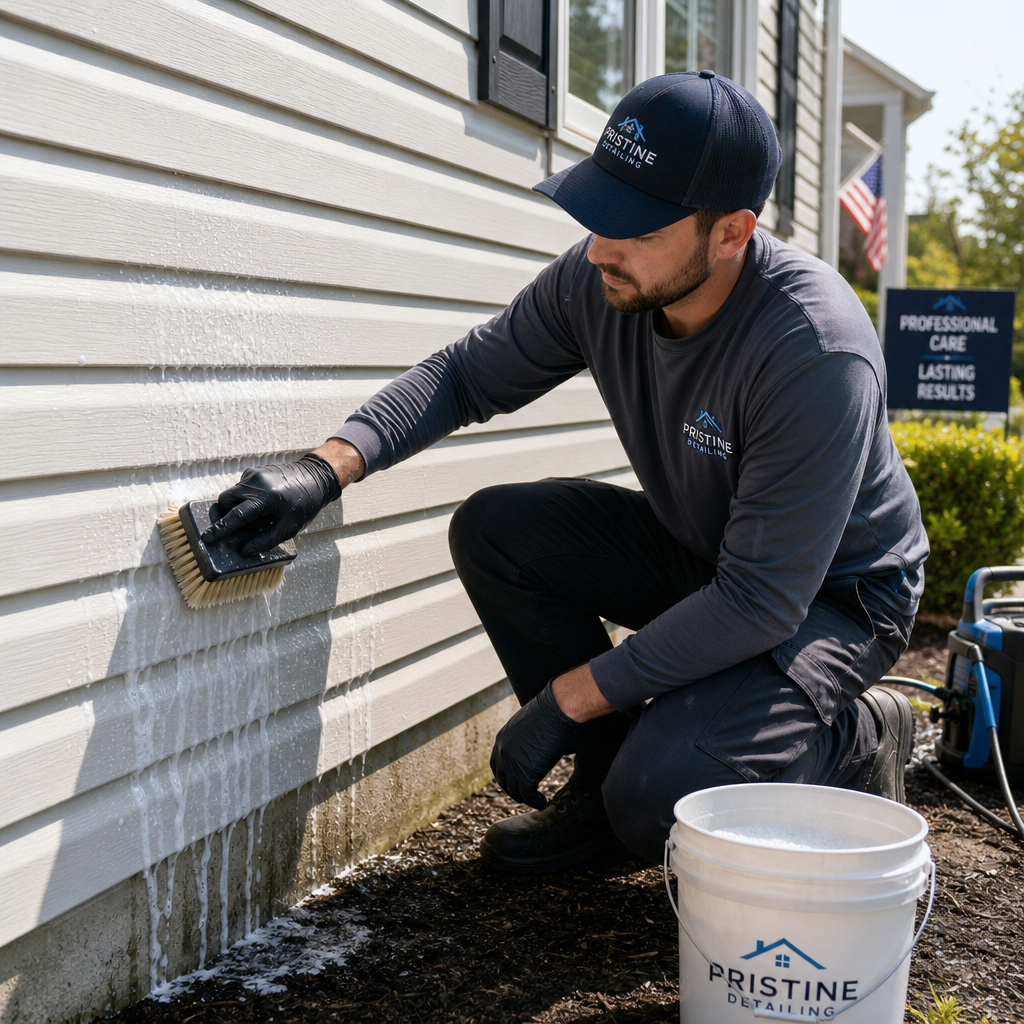
Hand washing controls the water pressure precisely. Technicians use soft-bristle brushes, appropriate cleaning solutions, and controlled rinse pressure to lift dirt, algae, and oxidation from the siding surface without forcing moisture into gaps and seams.
What Hand Washing Siding Looks Like in Practice
In practice, a crew member works section by section, starting from the top of each wall and working downward. They apply a cleaning solution appropriate for the siding material, agitate with a brush, and rinse from above so dirty water runs down rather than being pushed upward into gaps. For two-story homes, this involves working from ladders or extension poles, which requires skill and experience to do safely.
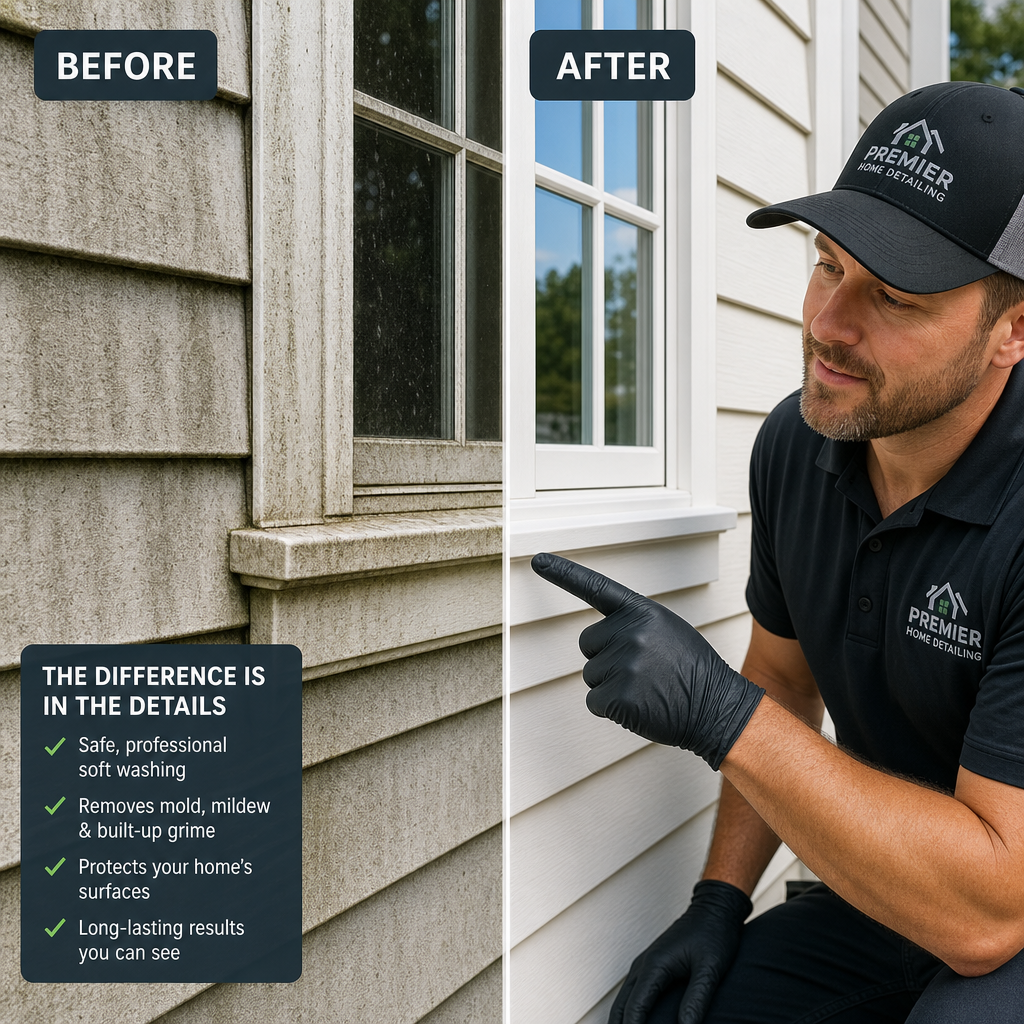
The result is a siding surface that is genuinely clean rather than just wet and partially rinsed. Streaking, which is common with pressure-only approaches, is eliminated because the agitation step physically removes dirt rather than just blasting it in a different direction.
Pro tip: Ask your service provider specifically whether they hand wash or pressure wash your siding, and request the method appropriate for your siding material before signing any agreement. If they cannot answer this question clearly, that tells you something about their level of expertise.
The Exterior Home Cleaning Sequence
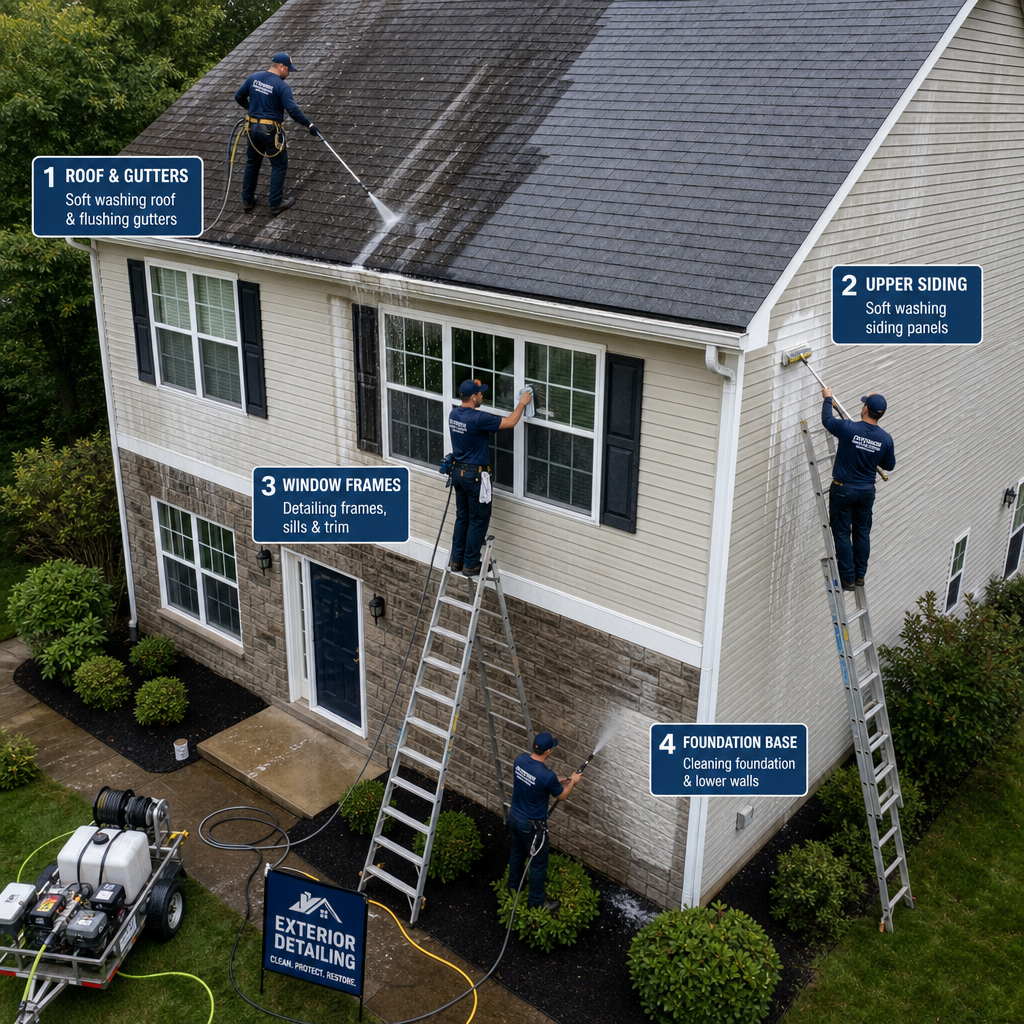
A well-organized exterior home cleaning service follows a logical sequence from top to bottom. This is not arbitrary. Working from the top down means that debris dislodged from gutters does not land on freshly cleaned windows, and rinse water from the siding does not dirty an already-cleaned entrance. The sequence matters as much as the individual tasks.
Gutters and Eaves First
Gutter and eavestrough cleaning happens first. Crews remove accumulated leaf debris, compacted sediment, and blockages from downspouts. They flush the system with water to confirm drainage is working. Fascia boards and the underside of eaves are wiped down to remove cobwebs, wasp nests, and staining left by overflow from clogged gutters.
Skipping gutter cleaning before washing the siding below is a common sequencing error. Any gutter overflow during the next rainstorm will streak the freshly cleaned siding within days of your service visit.
Windows Next
Window cleaning follows gutter work. For residential home detailing, this typically means scrubbing each pane with a professional-grade solution, using a squeegee for a streak-free finish, and detailing the frames and sills with a separate cloth. Interior window cleaning, when included in the package, is done after the exterior to avoid re-contamination from outdoor work.
Siding, Entrances, and Final Details Last
Siding hand washing comes after windows to prevent overspray and brush splatter from landing on clean glass. Entrance areas, including front steps, door frames, light fixtures, and adjacent wall sections, receive targeted cleaning last. Spider web removal across the entire exterior is typically done as a final pass, since webs tend to catch debris during the rest of the cleaning process.
“The sequence of cleaning tasks on a home exterior is as important as the quality of the cleaning itself. Get the order wrong and you redo work. Get it right and every step builds on the last.” – Performance Window Cleaning, field operations guidance, established 2008
Comparing Service Approaches
Not all exterior cleaning companies approach home detailing the same way. Understanding the differences between service models helps you make an informed decision rather than simply choosing the lowest quote.
| Approach | What It Includes | Best Suited For |
|---|---|---|
| Full Home Detailing Package | Hand washing siding, window cleaning (interior and exterior), gutter cleaning, eave cleaning, spider removal, entrance detailing | Homeowners wanting comprehensive exterior maintenance in a single visit |
| Pressure Washing Only | High-pressure water application to driveways, walkways, and some siding types. No agitation, no detailing of individual surfaces | Concrete, brick, and stone surfaces where high pressure is appropriate and safe |
| Window Cleaning Standalone | Exterior and sometimes interior window cleaning with squeegee finish. Frame and sill wiping included by reputable providers | Properties with recent siding cleaning that primarily need glass attention |
The full home detailing package is the most cost-effective approach for most residential properties when calculated on a per-surface basis. Booking individual services separately across multiple visits costs more in total and leaves gaps in coverage between appointments.
What Happens After the Service
Once the crew completes the job, a reputable company will walk you through what was done. This post-service review is your opportunity to inspect the work and raise any concerns before the team leaves. Do not skip this step, even if everything looks good from a distance. Check window sills for missed debris, confirm gutters are draining by running a garden hose at the downspout, and check the siding along north-facing walls where algae accumulation is most common.
A professional service provider will also offer guidance on maintenance intervals. For most homes in temperate climates, a full home detailing service once or twice per year maintains exterior surfaces effectively and prevents the kind of deep-set staining that requires aggressive treatment to remove. Properties surrounded by trees or near high-traffic roads may benefit from quarterly gutter cleaning even when full detailing is done semi-annually.
Performance Window Cleaning provides customized scheduling and package options built around your property’s specific needs rather than a standard calendar. This matters because a home with mature cedar trees and dense canopy coverage will accumulate gutter debris at a completely different rate than a property on an open street with minimal tree cover.
After the service, you should also receive clarity on what is not included in your package, so you can plan accordingly. A good provider will tell you directly if they noticed areas outside the scope of your booking that need attention, such as a cracked downspout or siding panel that has come loose, without pressuring you into an upsell on the spot.
Frequently Asked Questions
How long does a professional home detailing service take?
For a standard single-family home, a full home detailing service including window cleaning, gutter cleaning, hand washing siding, eave cleaning, and spider removal typically takes between three and six hours. Larger properties, homes with complex rooflines, or those with significant buildup from multiple seasons of deferred cleaning will take longer. A reputable company will give you an estimated time range after the pre-service walkthrough rather than quoting a flat time before seeing the property.
Do I need to be home during the service?
You do not need to be present for the entire service, but being available at the start for the walkthrough is strongly recommended. This ensures you can communicate any concerns, confirm the scope of work, and provide access to locked gates or areas that require your direct attention. If interior window cleaning is part of your package, someone will need to be inside to allow access to each room.
What is the difference between home detailing and standard house washing?
Standard house washing typically refers to a pressure washing pass over the siding and sometimes the driveway. Home detailing is a comprehensive surface-by-surface service that includes hand washing siding, window cleaning with squeegee finishing, gutter flushing, eave and fascia cleaning, entrance detailing, and pest and spider web removal. The two services are not equivalent in scope or outcome.
Is hand washing siding better than pressure washing?
For most residential siding materials including vinyl, wood, and composite, hand washing is the safer and more effective method. It removes dirt through mechanical agitation rather than relying solely on water force, which means less risk of water infiltration behind panels and better results on staining that pressure alone cannot dislodge. Pressure washing is appropriate for hard surfaces like concrete driveways and brick walkways where high force does not cause damage.
How often should I book a professional home detailing service?
Most residential properties benefit from a full home detailing service once or twice per year. Spring and fall are the most popular timing choices. Spring cleaning removes winter grime and prepares the exterior for warm weather. Fall cleaning removes summer pollen, algae growth, and early leaf debris before winter sets in. Properties with heavy tree cover or located in humid climates may need more frequent attention, particularly for gutters.
Will the service damage my landscaping or garden beds?
A professional crew will take precautions to protect landscaping during exterior cleaning. This includes pre-wetting plants before applying any cleaning solutions, directing rinse water away from sensitive garden beds, and using plant-safe cleaning agents where appropriate. If you have particularly delicate plants or recently installed landscaping near the foundation, point these out during the pre-service walkthrough so the crew can adjust their approach accordingly.
Have you had a home detailing service done recently? Share what surprised you most about the process and what you wish you had known beforehand.
References
- Insurance Information Institute: research on water damage and mold claims for residential properties
- United States Environmental Protection Agency: guidance on mold prevention and moisture control in residential buildings
- National Association of Realtors: reports on curb appeal, property maintenance, and home value factors
- Statista: market data on home maintenance services and consumer spending on exterior cleaning
- Forbes: coverage of home improvement return on investment and professional maintenance value