
Using the same deck power washing technique on every deck is one of the most common and costly mistakes homeowners make. A pressure washer that restores a cedar deck to life can permanently scar a composite board, void its manufacturer warranty, and force an expensive replacement that no amount of re-washing will fix. The pressure, nozzle, angle, distance, and cleaning direction all have to change depending on whether you are working with wood or composite material. If you are in Oakville, Burlington, Hamilton, Mississauga, St. Catharines, or anywhere else in Ontario, here is what that actually looks like in practice.
Table of Contents
- Quick Takeaways
- Why Deck Material Changes Everything
- Wood Deck Power Washing Technique
- Composite Deck Power Washing Technique
- The Warranty Issue with Composite Decks
- Technique Comparison: Wood vs. Composite
- Ontario Deck Cleaning Context
- Frequently Asked Questions
- References
Quick Takeaways
| Key Insight | Explanation |
|---|---|
| PSI is not one-size-fits-all | Wood decks generally tolerate 1,200 to 1,800 PSI. Most composite manufacturers cap safe pressure at 1,500 PSI for routine cleaning, though limits vary by product generation. |
| The 40-degree nozzle is your safest starting point | A 40-degree fan tip spreads water over a wide area and reduces direct impact. A zero-degree or narrow-angle tip on either wood or composite can gouge and permanently scar the surface. |
| Always spray with the grain, never across it | Moving the wand against the grain on wood raises and splinters fibers. On composite, it forces water into board seams and can lift the material over time. |
| Keep the wand moving at all times | Holding the spray in one spot – on wood or composite – gouges the surface. Consistent, steady back-and-forth strokes prevent uneven cleaning and surface damage. |
| Composite decks can lose their warranty | Pressure washing a composite deck incorrectly – or at all, in some older product lines – can void the manufacturer warranty. Checking the care guide before starting is not optional. |
| Distance from the surface matters as much as PSI | For composite, keep the nozzle at least 12 inches from the surface. For wood, 12 to 20 inches is the practical range. Closer is not more effective – it is more destructive. |
| Pre-soaking wood saves time and reduces pressure needed | Applying a deck cleaner and letting it sit for 10 to 15 minutes before washing loosens embedded dirt and mildew, meaning you need less pressure to finish the job cleanly. |
Why Deck Material Changes Everything
Wood and composite decks look similar from a distance. Under a pressure washer, they behave in completely different ways, and that difference requires a fundamentally different approach from the first trigger pull to the final rinse.
Wood is a soft, porous, fibrous material. Pressure that is too high raises the grain, splinters the surface, strips existing stain or sealant, and leaves visible marks that cannot be undone without sanding. Softwood species like pine are especially vulnerable. Even cedar and pressure-treated lumber, which are more commonly used in Ontario residential decks, have a threshold above which power washing does more harm than cleaning.
Composite decking is a blend of wood fibers and plastic. It resists rot, warping, and splintering in ways that natural wood cannot. However, this does not make it pressure-washer-proof. High pressure can scar the textured surface, damage the embossed grain pattern, and force water deep into the board structure. Many manufacturers have specific PSI limits, nozzle requirements, and distance minimums written into their care guidelines, and violating those guidelines can void the product warranty.
Treating a composite deck the same way you treat a wood deck is a shortcut that costs homeowners money. The materials respond differently under pressure, and the technique has to reflect that.
The practical takeaway is this: you cannot guess at a setting and start washing. You need to know what you are cleaning before you connect the hose.

Wood Deck Power Washing Technique
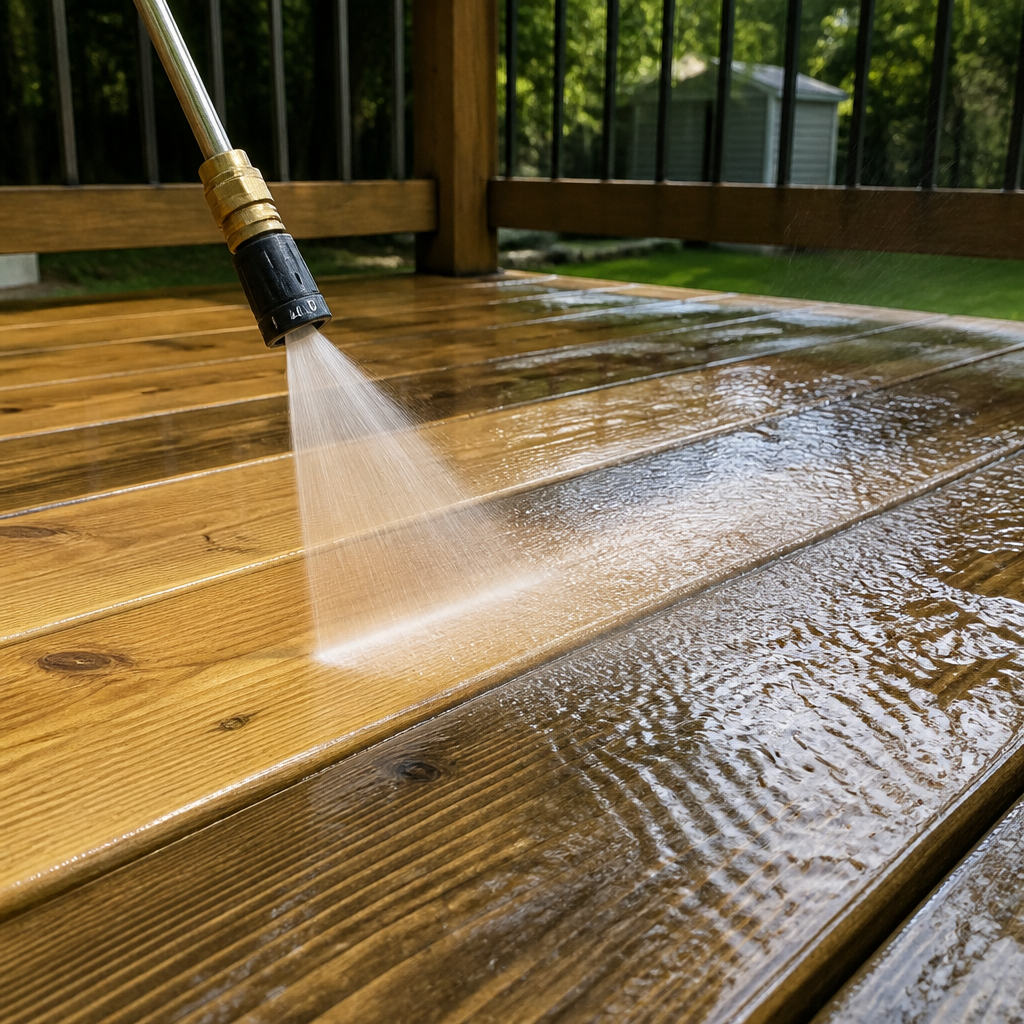
Wood decks respond best to a methodical, lower-pressure approach. Starting too high is the most common mistake. Many homeowners reach for the highest PSI setting because it feels efficient. It is not.
PSI and Nozzle Selection for Wood
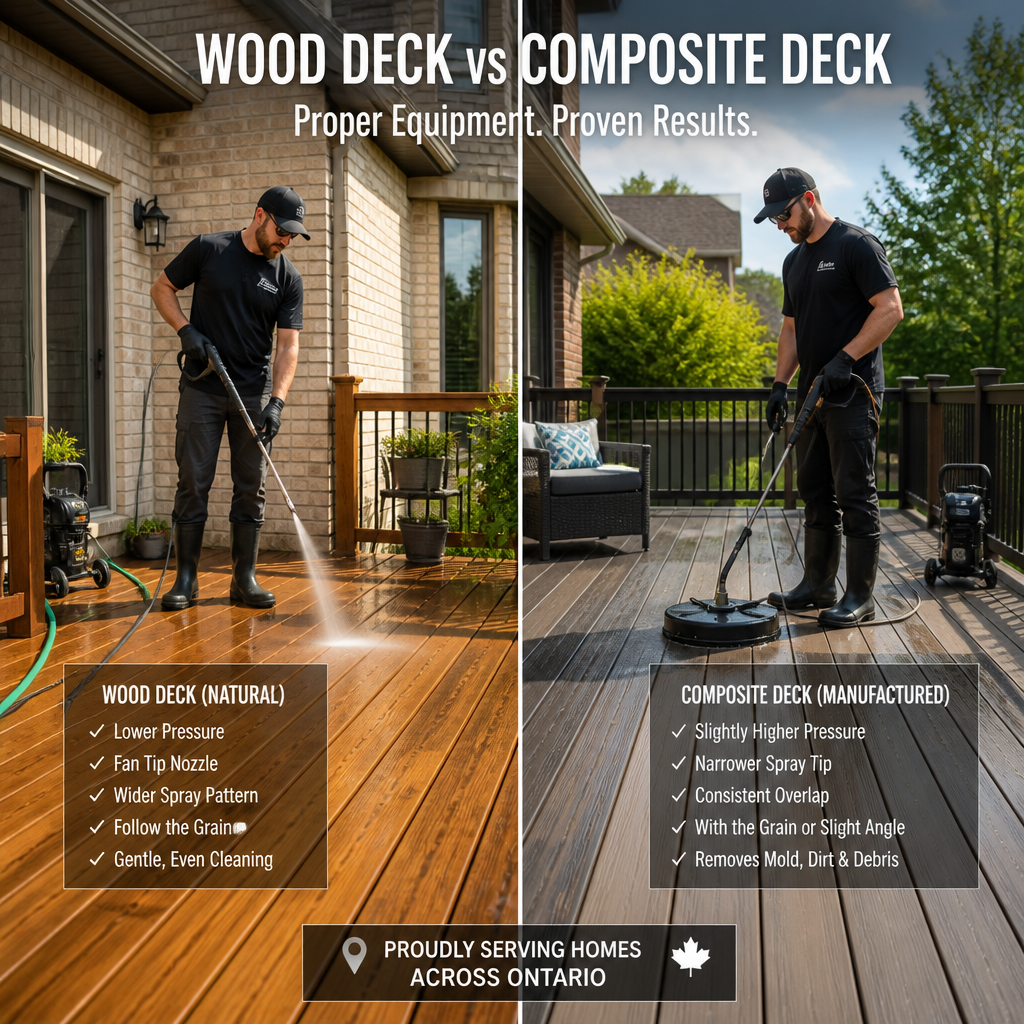
Start around 1,200 to 1,500 PSI and increase gradually only if needed. Exceeding 2,500 PSI on a wood deck significantly raises the risk of stripping paint, stain, and the wood’s surface fibers. A wide fan nozzle, typically 25 to 40 degrees, is the right choice. A zero-degree tip has no place on a wood deck – it will crater the surface.
Pre-Treating Before You Wash
If the deck has mildew, algae, or embedded grime, apply a deck-cleaning solution before touching the pressure washer. Let it dwell for 10 to 15 minutes but do not let it dry out. Working in the shade or on an overcast day helps here. This pre-treatment step means the pressure washer is doing finishing work rather than heavy lifting, which lets you keep the PSI lower.
Motion, Distance, and Direction
Hold the nozzle 12 to 20 inches from the surface. Move in long, even strokes that follow the direction of the wood grain. Never stop moving. Holding the spray in one spot even briefly can gouge wood fibers, leaving permanent depressions that are visible once the deck dries.
After washing, rinse thoroughly to remove all cleaner residue. Allow the wood to dry fully, at least 24 to 48 hours, before placing furniture back or applying any sealant or stain. Sealing too early traps moisture and creates the exact rot conditions you were cleaning against.
Pro tip: Test your pressure setting on a small, hidden area of the deck first – under a step or near a corner post – before committing to the full surface. If the wood shows raised fibers or obvious texture change after that test patch, reduce the PSI before continuing.
Composite Deck Power Washing Technique
Composite decks require more restraint, not less. The surface feels harder than wood, which leads some people to assume it can handle more pressure. That assumption causes real damage.
PSI Limits and Nozzle Choice for Composite
For most composite products, staying under 1,500 PSI is the safe standard for routine cleaning. Some newer composite lines from brands like Trex and TimberTech have published their own specific limits, and those numbers vary by product generation – a setting that is fine for a newer board may damage an older one. A 40-degree fan tip is the safest nozzle selection because it distributes pressure across a wide area and reduces concentrated impact. Avoid zero-degree or narrow-angle tips entirely; they create a focused stream that can permanently scar or gouge the composite surface.
Angle, Distance, and Grain Direction
Start with the nozzle at a 45-degree angle to the surface. This helps lift dirt without directing full force straight into the board. Keep the nozzle at least 12 inches from the surface at all times. Spraying closer increases effective PSI at the point of contact and raises the risk of surface scarring.
Always spray in the direction of the board grain, never across it. Moving the wand against the grain forces water into the seams between boards and can lift the composite material over time, creating edge separation that worsens with each subsequent wash.
Cleaning Motion on Composite
Move at a steady, even pace. Do not stay in one spot – this causes scratches and uneven cleaning that becomes visible once the surface dries. Work from the inside of the deck outward, and from railings and posts down to the deck boards, so dirty water rinses away from already-cleaned areas rather than back onto them.
Pro tip: For regular upkeep between deep cleans, a garden hose, warm soapy water, and a soft-bristle brush carry far less risk than a pressure washer and will handle most routine composite deck dirt without touching your warranty coverage. Reserve the pressure washer for the annual deep clean.
The Warranty Issue with Composite Decks
This is the part most homeowners do not find out about until after the damage is done. Composite decking products come with manufacturer warranties, and those warranties often include specific conditions around cleaning methods. Using a pressure washer incorrectly, or using one at all on certain older product generations, can void the warranty entirely for any condition caused by that cleaning.
Trex, for example, does not recommend pressure washing on their early-generation decking products at all. For newer lines, there are maximum PSI limits specified in their care documentation. TimberTech has published its own maximum PSI threshold. Other brands have their own specific guidelines. The point is that these limits are not suggestions – they are the documented standard against which warranty claims are evaluated.
Before pressure washing any composite deck, locate the manufacturer’s care and cleaning guide. If you no longer have it, most manufacturers publish current versions on their websites. The few minutes this takes is worth it against the cost of a denied warranty claim or having to replace boards.
A professional exterior cleaning service that works regularly with both wood and composite decks will already know these thresholds and how to verify them before starting. That institutional knowledge is part of what you are paying for when you hire someone who does this work properly.
Technique Comparison: Wood vs. Composite
| Technique Variable | Wood Deck | Composite Deck |
|---|---|---|
| Recommended PSI range | 1,200 to 1,800 PSI; stay under 2,500 PSI maximum | Under 1,500 PSI for most products; always confirm with manufacturer |
| Safest nozzle | 25 to 40-degree fan tip | 40-degree fan tip; never use a zero-degree tip |
| Nozzle distance from surface | 12 to 20 inches (30 to 50 cm) | Minimum 12 inches; do not go closer |
| Spray direction | With the wood grain, always | With the board grain, always; never across seams |
| Pre-treatment | Recommended – deck cleaner, 10 to 15 minutes dwell time | Warm soapy water and soft brush first; check cleaner compatibility |
| Post-wash steps | Full rinse; 24 to 48 hours drying; consider sealant or oil | Full rinse; inspect for seam separation or surface marks |
| Warranty risk | No manufacturer warranty typically in play | High – incorrect technique can void the product warranty |
Ontario Deck Cleaning Context
In Ontario, deck surfaces take a harder hit than many other climates. Freeze-thaw cycles through the winter work moisture into wood grain and composite seams. Spring brings algae, mildew, and pollen accumulation. Decks in Oakville and Burlington that face the lake see additional moisture exposure. Decks in Hamilton and the Niagara region deal with seasonal humidity that accelerates mold growth. By the time power washing season arrives, most decks have several months of biological growth and embedded grime to deal with.
This means Ontario homeowners are often washing decks that need more than a quick rinse. Pre-treatment matters more here. The temptation to crank up the pressure to compensate for stubborn staining is real, but it is the wrong solution. More dwell time with an appropriate cleaner, combined with correct pressure technique, will out-clean a high-PSI blast without leaving the wood fibrous or the composite board scarred.
At Performance Window Cleaning, we handle power washing for residential properties across Oakville, Burlington, Hamilton, Mississauga, St. Catharines, Niagara Falls, Fenwick, and surrounding Ontario communities. We adjust technique based on material, not habit. That means different settings, different nozzles, and different motion patterns depending on what is actually underfoot on each property.
If you are also dealing with leaves and debris collecting in your gutters and eavestroughs after deck season, our gutter and eavestrough cleaning service addresses that directly. And if your home’s exterior siding has taken on the same layer of seasonal grime as the deck, home detailing handles hand-washing of siding, entrances, and doors without the risk that comes from applying full washer pressure to painted or vinyl surfaces.
Deck cleaning is not where you want to improvise. The material tells you what it needs, and the job is to listen to it.
Frequently Asked Questions
Can I use the same PSI setting on a wood deck and a composite deck?
No. Wood and composite materials have different tolerances. Most wood decks are cleaned at 1,200 to 1,800 PSI, while most composite deck manufacturers recommend staying under 1,500 PSI. Some older composite product lines should not be pressure washed at all. Using a single PSI setting for both materials risks damaging the one with lower tolerance.
What nozzle should I use when power washing a composite deck?
A 40-degree fan tip is the safest choice for composite decking. It spreads the water stream across a wide surface area and reduces concentrated impact. Never use a zero-degree or narrow-angle nozzle on composite – it creates a focused stream that can permanently gouge or scar the board surface.
Does power washing a composite deck void the warranty?
It can, yes. Many composite manufacturers specify cleaning methods in their warranty documentation. Pressure washing beyond their stated PSI limit, or pressure washing products they have designated as incompatible with power washing, can void warranty coverage for any resulting damage. Always check the manufacturer’s care guide before starting, and document the settings you used.
Why do I have to spray in the direction of the grain on wood decks?
Wood grain runs longitudinally along the board. When you spray across the grain, the water stream cuts perpendicular to the fibers, raising them, splintering the surface, and leaving permanent texture damage. Spraying with the grain keeps the water moving along the natural fiber direction, which cleans effectively without lifting or tearing the material.
How long should I wait after power washing a wood deck before sealing it?
Allow at least 24 to 48 hours of drying time before applying any sealant or stain. Sealing too early traps residual moisture inside the wood, which promotes rot and causes the sealant to fail prematurely. If the weather has been wet or the wood was heavily saturated during washing, extend that drying window further.
Is it safe to power wash a deck in Ontario in the spring?
Spring is actually the best time for deck power washing in Ontario, as it removes the mold, algae, and debris that accumulated over winter. The key is to wait until overnight temperatures are consistently above freezing, so the wood or composite is not entering a freeze-thaw cycle immediately after washing. The technique requirements – PSI, nozzle, distance, grain direction – are the same regardless of season.
What should I do if I have stubborn mold or staining on my wood deck that does not come off with lower pressure?
Increase the dwell time of your deck-cleaning solution rather than increasing the PSI. Most mold and staining on wood responds to a longer pre-treatment soak combined with a scrub brush before the pressure washer is applied. If additional pressure is genuinely needed, increase gradually in small increments and test on an inconspicuous area first. Jumping to maximum pressure as a first response is how wood surfaces get permanently damaged.
Have you run into surface damage or unexpected results when power washing your deck? Share what happened – other Ontario homeowners dealing with the same material questions will benefit from your experience.
References
- How to pressure wash a deck: PSI guidance, nozzle selection, and grain direction for wood surfaces
- Composite deck power washing technique: PSI limits, fan tip guidance, and grain direction rules
- Manufacturer-specific PSI limits and warranty considerations for composite decking products
- Spray angle, cleaning motion, and nozzle distance recommendations for composite decking
- Wood deck cleaning technique: nozzle distance, grain direction, and post-wash care steps